What the Boy Recorded
The Gap in the DoorTheo Hale had learned how to be small.
It was a skill, like swimming or tying a shoe, and like all skills it came with practice. You made your breaths shallow, so the air barely moved. You kept your knees tucked tight. You counted: in for four, out for four, the way the school counsellor had shown him on the day his mother’s funeral cards arrived in the post. You pressed your tongue against the roof of your mouth so that your teeth wouldn’t chatter. And you told yourself the oldest, simplest story there is: if I am small enough, and quiet enough, then the dark can’t find me.
He was eight years old, and he had been in the cabinet for forty-one minutes.
He knew it was forty-one because he had been counting the chimes of the grandfather clock in the hall. It was an ugly old thing, made of black walnut, with a brass pendulum like a swinging sun and a ticking that had once seemed to him as friendly as a heartbeat. Now each chime reached him through the wood like a bell at the bottom of a well, long and flat and slow. Eight o’clock. Eight-fifteen. Eight-thirty. The storm had come in around eight, and rain was hammering against the tall windows at the end of the hall in great heavy handfuls, and every few seconds a flicker of lightning drew a thin white seam around the edge of the door.
That was how he knew there was a gap.
He had found it in the first ten minutes, with his fingers, in the dark. The cabinet was an old thing, a tall mahogany wardrobe where the housekeeper kept the spare linens and the Christmas decorations, and one of the two doors had split years ago along the grain. A crack ran from the top almost to the floor, about as wide as a finger. When he put his eye to it, he could see a long thin slice of the world: a strip of dark carpet, a brass lamp on a console table, the glitter of rain on the glass.
He put his eye there now. He had been doing it for what felt like hours, and his eyelashes were stuck together with salt.
It was so dark in the cabinet. It smelled of cedar and mothballs and old tinsel. There was a box of baubles digging into his hip. He was still wearing the blue pyjamas that his mother had bought him, the ones with the white piping, which were now filthy with something that might have been spilled juice and might have been dust and might have been tears. His feet were bare. There was a scab on his elbow, where he had banged it on the door frame when she pushed him in.
He had not screamed. That was the part he was proudest of.
He had said, Please, Vivienne. He had said it very politely, because Daddy always said that politeness was a kind of armour. And Vivienne had smiled at him, in the hallway, in her long blue evening dress with the sapphires at her ears, and she had gone down on one knee to his height and put a cool, perfectly manicured hand against his cheek. She had smelled of jasmine. She always smelled of jasmine.
Theo, she had said gently. You really are a very clever little boy. And you’re old enough to understand that clever little boys have to be careful about what they see.
Then she had taken the phone out of his hand.
She had looked at it for a moment, turning it over, as if it were an interesting insect. Whose is this? she had said. Oh, yes. Your mother’s old one. How sweet that you kept it. And before he could snatch it back, she had thrown it against the wall.
He had heard the crack. It had gone through him like a needle.
But she had not seen the other phone.
He touched it now, in the dark, through the cloth of his pyjama shirt. It was a small hard rectangle against his ribs, tucked into the waistband where his mother used to tuck a handkerchief. His own, secret, birthday phone, the one that Daddy had given him in September, with a case that was decorated with tiny white stars. He had hidden it there the very second she turned her head. She had thrown the old one, the useless one, the one with the dead battery that he carried around for luck. Its screen had spidered into a thousand cracks.
The new one was warm against his skin.
It was the one that had recorded everything.
He had not meant to spy. He wanted that understood, if anyone ever asked.
He had come down for a glass of water. That was all. It was seven o’clock, after his bath, and the penthouse was filled with that deep, expensive, listening quiet that it always had when Daddy was out. Theo had padded down the long carpeted corridor in his socks, past the paintings and the marble busts and the great silent windows with the city spread out below like spilled jewellery, and he had been halfway to the kitchen when he heard a voice.
It was Vivienne’s.
The door to Daddy’s study was ajar. Gold lamplight leaked out in a thin long slice. And Vivienne, with her back to the door, was talking on the phone in a voice he had never heard her use.
That was the strange thing. Not the words. The voice. In front of Daddy it was always soft and low and musical, a voice like a hand stroking a cat. But this voice was brisk. Flat. Quick. A voice for checking a shopping list. It was the voice, thought Theo, with a funny cold feeling in his stomach, of somebody who has stopped pretending, and it frightened him more than anything else could have.
Six more weeks, it said. No, Doctor, I don’t care about the tremor. I care about the paperwork. If he can’t remember where he parked the car, he can’t remember who signed what. I need three more incidents on file before the board meets.
Theo had stopped. His socks made no sound on the carpet.
Yes. Same dosage. I’ll make sure it’s in the cognac. He never notices the taste after the second glass. A low, smooth, wicked little laugh. And the boy? The boy is eight. Boys forget. By the time he’s old enough to ask questions, he’ll be at a very nice boarding school in the Alps, and his father will be at a very nice facility in Zurich, and I will be running Hale Dynamics.
Something inside Theo had gone very quiet.
He didn’t understand all of it. He was eight. Dosage. Incidents. The board. But he understood cognac. He understood Daddy. He understood, from some deep place beneath understanding, that the soft woman who read him bedtime stories and brushed his hair on Sunday evenings had just said a sentence about his father in the voice of a stranger who did not love him.
And without thinking, with a hand that seemed to belong to someone else, he had slipped his birthday phone out of his pyjama pocket, and he had pressed the little red circle, and he had held it up to the crack in the door.
He had recorded for nineteen seconds.
It might have been enough. He thought afterwards that it would have been enough, if the thunder hadn’t cracked. A sudden, huge, earth-shaking boom that made the windows ring. He flinched, and his elbow hit the door, and the door swung inward with a long, low, creaking groan.
Vivienne turned round.
She did not scream. She did not shout. She did something much worse. She smiled.
That was forty-one minutes ago.
Now he lay on his side in the cedar-scented dark with the secret phone pressed to his ribs, and he watched through the gap as the rain slid down the windows, and he did the thing that he had been trying not to do for a long, long time.
He listened for Daddy.
Daddy was at a dinner. He was supposed to be at a dinner until eleven, with some people from the bank. He had kissed Theo’s forehead at the door at half past five, in his black suit, with the car waiting downstairs, and said, Be good for Vivienne, champ. I’ll look in when I’m back. He had smelled of soap and coffee. He had been tired. His eyes, these days, were always tired, with grey smudges under them and a faint tremble in his hands that he tried to hide in his pockets.
Theo had thought it was because of Mummy. He had thought it was grief. He had not known there might be another reason.
It’s in the cognac.
He pressed his forehead against the wood.
He knew, of course, what he ought to do. He ought to shout. He ought to bang on the door with both fists and scream until the whole building heard. But the building was empty, apart from them. The housekeeper had the weekend off. The doorman was twelve floors down. And somewhere out there, beyond the little slice of dark carpet, a woman in a blue dress was waiting for him to do exactly that.
He could feel it. He could feel her listening. She was out there, quite near, perfectly still, with her head cocked, the way a cat sits by a mouse hole. If he screamed, he thought, she would come. She would be kind about it. She would say, there, there, darling, you’ve had a nightmare, and she would carry him to bed and put something sweet and bitter into a spoon.
So he did not scream.
He lay in the dark and he counted. In for four, out for four. He counted the chimes. He counted the flashes of lightning. He counted the drops sliding down the glass, one by one, a thousand silver snails.
And at nine minutes past nine, on the face of the grandfather clock that he could see slantwise through the crack, a sound came up the corridor that made every muscle in his body leap.
A key.
A key turning in the front door, down at the other end of the penthouse, in a lock that he would have known in his sleep. The long, soft, expensive click of heavy oak swinging inward. The rustle of a coat. The slow, tired thud of a man’s shoes on the marble in the hall.
Theo stopped breathing.
Daddy, he thought. Daddy, Daddy, Daddy.
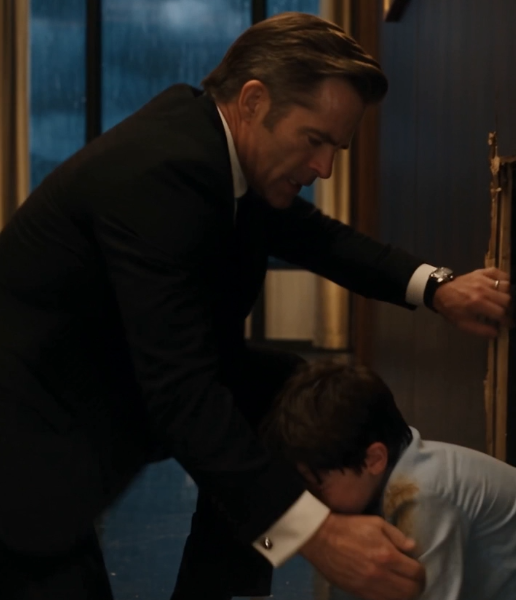
He could not shout. If he shouted, she would hear, and she was closer. He could not bang. But through the gap, down the long dark corridor, he could see a tall black shape stop at the end of the hall under the sconce lamp. A man in a black suit, loosening his tie, with a rain-spattered coat over one arm.
He was too far away. Much too far. And he was walking away.
Theo pressed his mouth right up against the crack in the door, until the splintered wood cut into his lip and he tasted copper. He had one chance. He could feel it in his chest like a held breath. He wet his dry lips, and in a voice so thin and cracked that it was barely a voice at all, he whispered, as softly as a prayer:
“Daddy?”
Nothing.
The tall shape stopped. The coat slid from its arm.
“Daddy,” whispered Theo again, shaking all over. “Daddy, is that you?”









