What the Boy Recorded
Home EarlyMarcus Hale had left the dinner at eight-forty because he had forgotten his own sentence.
It was the third time that month. He had been in the middle of a toast, standing at the head of a long white table in a private room at the Savoy Grill, with twelve senior bankers looking up at him with polite attention and a glass of red wine in his hand. He had been telling them about the new turbine contract. He had known the figures; he had known them for weeks. And then, in the middle of a word, there had been nothing at all. A bright white blank. A feeling as if a trapdoor had opened underneath his thoughts and they had all poured through it like water.
He had stood there for four seconds with his mouth open.
It had been enough. A man to his left, Dennis Roper from Barclays, had politely coughed. A woman further down the table had glanced at her neighbour. And Marcus, forty-five years old, founder and chairman of a company that employed eleven thousand people in nine countries, had put down his glass with a hand that would not stop trembling, and said, Forgive me. I seem to have lost my place.
Nobody had laughed. That was what had been so terrible. They had all been so kind.
He had made an excuse about a headache. He had shaken hands round the table, looking each man in the eye, and he had felt, as he left, the particular shape of a silence that closes behind you like a wave. Poor Hale, it said. He’s not been the same since Anna died. He’s not been the same since the spring.
His driver, Petrov, had been waiting in the street with the engine running. They had driven through the storm in silence. Rain slashed the windscreen. The wipers swung. And Marcus, in the back seat, had pressed his fingertips against his eyelids and asked himself the question that had begun, six months ago, to follow him from room to room.
What is happening to me?
It had begun after the wedding. Or after the funeral. He could never decide which. A word he couldn’t find. A meeting he forgot. A phone call he knew he had made, with details he could recite, that the other party swore never happened. Keys in the fridge. A car left running in a car park. A tremor in his right hand, small at first, like a leaf, and now so persistent that he had begun to keep both hands in his pockets.
His doctor had said stress. His new neurologist, a soft-spoken Scandinavian called Dr. Lund, whom Vivienne had found for him, had said early signs, and had used the phrase cognitive decline in a gentle voice that made it sound like a stage in a journey rather than a sentence. He had prescribed tablets. He had suggested that it might be wise, in the circumstances, to begin putting certain matters in order.
Marcus had not wanted to hear it. He was forty-five. His father had lived to ninety. But the evidence was in his own hands, and in the way the room at the Savoy had gone so very quiet.
And Vivienne had been wonderful. That was the thing he always came back to. In the long months of his unravelling, she had never wavered. She had reminded him of appointments, taken his calls, sat up with him on bad nights, laid cool fingers on his temples and murmured shh, darling, I’m here, you’re not alone. She had even taken, gradually, with such tact that he had hardly noticed, a few small jobs off his plate: a signature here, a proxy vote there. Just till you’re better. A woman of forty-two in a sapphire necklace, standing between her husband and the abyss.
He was a lucky man. Everyone said so.
The car glided up to the base of Hale Tower at 9:04. Petrov held the door; the doorman touched his cap. Marcus rode the private lift to the fifty-ninth floor in a daze, watching the numbers climb, with a feeling in his chest like a bruise he could not locate.
He had decided to take a glass of cognac, and go to bed.
The penthouse was dark when he let himself in. The lights were low, in the way that Vivienne liked them at night, a long sweep of amber lamps down the great central corridor with its marble floor and its tall windows. Beyond the glass, the storm raged over the city, black and silver, and the whole building seemed to hum faintly, like a struck glass. He hung his coat on its hook. He loosened his tie.
He thought: the house feels strange.
It was not a thing he could have named. There was no sound. There was no smell. It was only that the quiet had a quality to it: a held, expectant, listening stillness, as if the air itself were waiting. As if he had walked into a room in which somebody had just stopped speaking.
“Vivienne?” he called.
No answer.
He walked slowly down the corridor. His shoes made a hollow sound on the marble. He passed the dining room, dark; the library, dark; the little music room where Anna’s piano still stood with its lid down. He stopped at the foot of the long gallery that led to the bedrooms, with the old grandfather clock ticking in the corner and the rain drumming on the tall windows at the far end.
And then, very faintly, from somewhere behind him, he heard it.
A whisper.
It was so soft that at first he took it for the rain. A thread of a sound, thin and cracked and dry, a little breath of speech. He stood quite still with his coat sliding off his arm, and he thought: I am hearing things. It is the tablets. It is the tremor. Dr. Lund said there might be auditory—
“Daddy?”
He knew that voice.
He would have known it at the bottom of the sea. It was the voice that had first said Da-da at eleven months in a hospital cot, the voice that had sung off-key in the bath, the voice that had asked, three days after the funeral, in the pitch-dark, with its small chin trembling, Is Mummy cold?
It came from the wall.
“Daddy,” it whispered. “Daddy, is that you?”
Marcus Hale turned round.
The gallery was empty. A strip of dark carpet. A console table, with a brass lamp. A tall mahogany wardrobe that stood against the panelling, as it had stood for as long as he had owned the apartment, filled with spare linen and boxes of Christmas baubles. He stared at it. And as he stared, something moved in the darkness of a crack along the wardrobe’s left-hand door: a pale, wet, shining glint, an eye, with a trembling edge of lip below it.
He did not remember crossing the floor.
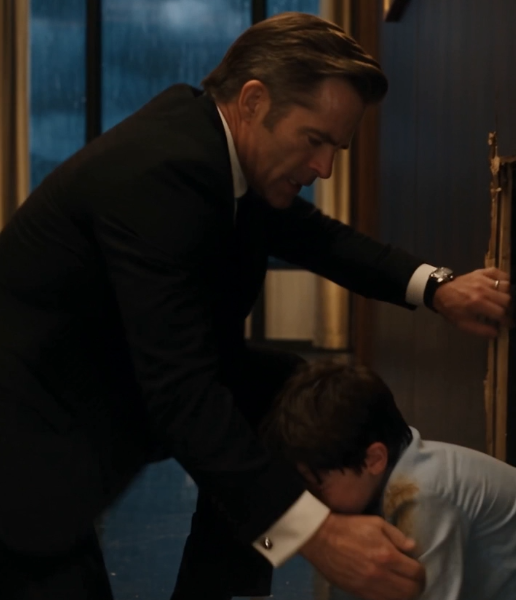
He remembered only that he was suddenly there, on his knees on the carpet, with his hand flat against the polished wood and a sound coming out of his own throat that he had not made since the night in the hospital. Through the gap, he could see a small white face. Eyelashes stuck together. A cut lip. A thread of blood.
“Theo,” he said. “Theo. Theo, I’m here.”
“Please,” whispered the little voice. It shook. It was so small and so polite and so utterly, unbearably brave. “Please. Don’t let her hear.”
A terrible, cold, clear calm came over Marcus Hale. It was the calm of a man who has been in a long dream and has just, at last, woken.
Her.
He did not ask who. He did not ask why. He took the brass handle in his right hand, and he saw the wedding band glint on his finger in the lamplight, and he saw, a half-second after, that the handle was locked, and that the key was nowhere, and that the door was a good inch of seasoned mahogany that had been fitted by a craftsman in 1932.
He set his shoulder against it.
There was a crack like a pistol shot. The old wood screamed. The split along the grain ran suddenly the whole length of the door, and he threw himself at it a second time with the whole weight of his body, and the lock tore out of the frame in a spray of splinters, and the two halves of the wardrobe door burst open.
He saw a boy.
A small boy, in blue pyjamas filthy with dust, curled in a nest of crumpled tissue paper and Christmas baubles, with his knees drawn up and his bare feet black and his arms wrapped around his ribs. His hair was plastered to his forehead. His face was grey with fear. He stared up at his father with the wide, stunned, disbelieving eyes of someone who has been waiting for a rescue for so long that he has forgotten how it is done.
Then he tumbled out of the cupboard and into Marcus’s arms.









