What the Boy Recorded
What Theo KnewThere is no sound quite like the sound a child makes when he stops being brave.
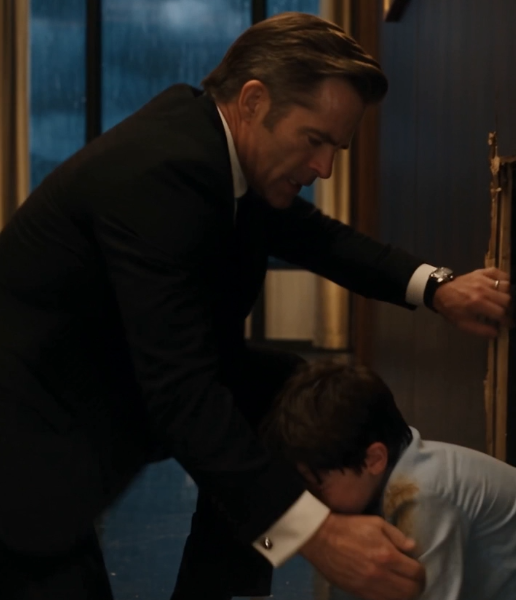
It does not come all at once. It begins as a hiccup, a catch in the chest, and then it spreads: a shudder, a gasp, a long ragged wobbling inhale, and finally a great loose wail that seems to come up from the soles of the feet. Theo Hale had held it back for forty-one minutes. He had held it back through the thunder, through the dark, through the bruised silence of the cabinet and the smell of mothballs and the little pointed corners of the Christmas baubles. And now, in the warm circle of his father’s arms, on the cold marble of the gallery floor, with a heartbeat thudding against his ear like a fist on a door, it broke.
He cried until he thought he would be sick.
He wept into the lapel of the black suit, into the smell of rain and aftershave and car leather, with his fingers knotted so tight in the cloth that he could feel the stitching. He could not stop. He did not want to. He could feel his father’s hand moving up and down his back, slow and heavy and steady, and he could hear his father saying something over and over in a voice that shook so badly the words came out in pieces.
“I’ve got you. I’ve got you. I’ve got you, Theo. You’re safe. I’m here.”
The rain beat on the great windows. The clock ticked. Somewhere in the distance a fire engine wailed and faded. And in the long, dim, lamplit gallery of the fifty-ninth floor, the two of them rocked on their knees in the middle of the floor, a tall man in a black suit and a thin boy in blue pyjamas, for what might have been one minute or ten.
“She said you’d never believe me,” whispered Theo at last.
He felt his father’s body go rigid.
It was a very small movement. A tightening, no more, as if a wire had been drawn taut along his spine. But Theo felt it, because he had his whole ear pressed against that chest, and what he heard in it was a sound he had never heard before: the heartbeat of a man who was learning to be dangerous.
“Believe you?” said Marcus Hale.
His voice was very quiet. He took Theo gently by the shoulders and held him a little away, so that he could look at his face. He had very light eyes, Theo’s father. A cool, clear grey, like a winter sky. They were red-rimmed now, and wet, and astonishingly gentle.
“Theo,” he said. “Look at me. Listen. I am going to believe every single word you tell me. Every one. I don’t care what it is. I don’t care how strange it sounds. I’m listening to you now. I’m listening to everything.”
Theo’s lip began to tremble again.
He had planned a speech. For forty-one minutes, in the dark, he had rehearsed it, so many times that the words had worn smooth, like a pebble in his pocket. Daddy, Vivienne is putting something in your drink. Daddy, she’s lying about the doctor. Daddy, she locked me in the cupboard. But now that the moment had come, all the sentences broke into pieces, and what came out instead was a small, stupid, babyish sob.
“Your glass,” he managed.
“My glass?”
“The one from Mummy. The crystal one. She puts the stuff in it. I saw. And then you forget things, and she tells everyone it’s because you’re sad, but it’s not—it’s not—” He was gasping now. “She talks to the doctor on the phone. In the study. She said six weeks. She said she needs three more incidents, and then the board, and then it’ll all be hers. And I—I heard, and I didn’t mean to, and I made it go—”
He stopped, because he could not make the words come in the right order.
His father had gone very still.
It was the stillness of a person who has just heard the answer to a question he had been asking for six months, and who is trying with every nerve in his body not to flinch. Theo saw something go through his face, a series of changes, quick and complicated, like the shadow of clouds crossing a field. First blankness. Then a kind of terrible, tender confusion. Then, very slowly, as pieces began to slide into place behind his eyes, something flat and hard and cold.
“Theo,” said Marcus, with enormous care. “What did you do?”
“I recorded it.”
The words dropped into the gallery like a stone.
“On my phone. The new one. You gave it to me.” He had been holding it, he realised, all this time. He had dragged it out of his waistband the moment the cabinet door burst open, a small hard thing with a case covered in painted stars, and he had gripped it so tight that his palm had gone white. “I hid it. She threw the old one, the one with Mummy’s pictures, but she didn’t know about this one, so I—”
He held it out in his fist.
The screen was shattered.
It was only then that he saw it. In the glow of the little brass lamp on the console, the glass was a white web of cracks, radiating in a perfect starburst from a single deep pit near the top, like the mark of a bullet in a window. He stared at it in dismay. It must have happened when he fell out of the cabinet. He had come down on the marble floor with all his weight on his side, and the phone had struck the edge of the brass lamp-stand, and now it lay in his hand like a dead beetle with its shell split open.
“Oh,” said Theo. “Oh, no.”
The sob came back, all at once, huge and dry.
“No, no, no, no— It’s ruined, Daddy, I broke it, I broke it, and now you won’t be able to—”
“Theo.”
“I recorded it, I did, I swear I did—”
“Theo. Sweetheart. Look at me.”
A large warm hand closed round his small cold one, over the phone, and held it. Marcus was smiling. It was a strange, wobbling, crooked smile, with tears running down both cheeks, and it was the most beautiful thing Theo had ever seen.
“It’s all right,” said his father. “Glass is only glass. What matters is what’s inside. Do you remember what I taught you about ships? How a hull can be dented to ribbons and still be sound, as long as the keel is true?”
Theo hiccuped. “Y—yes.”
“Is it still on?”
“I don’t know.”
“Let’s find out.”
Theo looked down at his hands, at the white web of the cracks, the glowing dot in the corner, the tiny stubborn light that was still, miraculously, faintly shining beneath the shattered glass. He took a long, wet, shuddering breath, and he wiped his face on his sleeve, and he lifted his chin, and he said, in his smallest and bravest voice:
“I recorded it, Daddy. I recorded all of it. It’s broken, but it still works.”
Marcus did not look at the screen yet.
He looked at his son.
He took his time about it, with the sort of slow, deliberate care that a man gives to things that he cannot afford to get wrong. He looked at the grazed elbow, and the scab, and the black bare feet, and the thin wrists that had been bruised a faint violet where a hand had gripped them. He looked at the small split in the lower lip, where the splintered door had cut it. He looked at the filthy pyjamas, the plastered hair, the eyes that were far too bright and far too old.
He saw that his son was holding himself as one holds himself in a house where there are strangers.
Something happened to Marcus Hale then, something that he would never be able to describe to anyone, not to a doctor, not to a lawyer, not to the grey-faced man who would one day take his statement at a police station at four in the morning. It was not rage. He had felt rage, and this was not that. Rage was hot and loud and shaking. This was a vast, quiet, level coldness that rose in him like a tide from some great depth, so steady, so absolute, that it seemed to still even the trembling in his hands.
He thought, with perfect lucidity: I am going to remember this moment for the rest of my life.
And then he thought, more quietly: and so is she.
“Theo,” he said. “Where is Vivienne now?”
“I don’t know.” The boy’s voice sank to a thread. “She said she was going to change. She said there were people coming. At ten.”
“People?”
“Dr. Lund. And some men from the board. She said—” He swallowed. “She said Daddy was going to have a very bad night, and everyone would see, and it would be very sad, and then they would help.” A pause. “She said it was all planned.”
Marcus closed his eyes.
He could see it. As clear as a photograph, he could see how it would have gone. Ten o’clock. The doorbell. The doctor and the directors, grave and gentle in their dark overcoats, arriving through the storm to find the chairman in his dressing gown, in the middle of an “episode.” A tremor. A confusion. A glass dropped. A name forgotten. And at his elbow, white-faced and loyal, in her sapphires, his beautiful wife: oh, thank God you’re here. I didn’t know who else to call. It’s been getting worse and worse.
They would have signed the papers by midnight.
He opened his eyes. He pulled his son against his chest again, and held him so hard that he could feel the thin ribs flex under his arms.
“Thank you,” he said into the boy’s hair. His voice cracked in the middle. “Thank you, Theo. Thank you.”
“For what?”
“For being so brave. For keeping it safe. For not making a sound.”
The boy was silent a moment. Then, in a tiny, trembling, heart-wrenching voice, he asked what he had wanted to ask since the moment the door was torn open:
“Am I allowed to make a sound now?”
Marcus laughed. It came out as half a sob. “Yes,” he said. “You can make all the noise you like. You can make it for as long as you like. But maybe, just for a few minutes, buddy, one more small favour. One more quiet game. Can you do that?”
Theo nodded against his shoulder.
“Good man,” said his father.
He took the phone from the small hand. He turned it over, looked at the pitted and spider-webbed screen, and pressed the button on the side.
Nothing happened.
Then, in the lower corner, a pale blue glow came up through the cracks.









