What the Boy Recorded
The Woman in BlueVivienne Hale had been standing at the end of the gallery for exactly ninety seconds, and she had enjoyed every one of them.
She had not set out to watch. She had meant to come out of the dressing room, sweep through the long hall to the foyer, and check the arrangement of white lilies on the console table before the guests arrived. She had put on the navy silk with care, the one that Marcus had chosen in Mayfair, plain and long and severe, with a bateau neck that showed her collarbones and sleeves cut just above the elbow. Elegant, the shop assistant had breathed. Almost widow-like. Vivienne had smiled at her reflection and said nothing. She had known exactly what it was for.
It was the dress of a woman who would be photographed on a courthouse step, tearful, brave, and impeccable.
She had fastened the sapphires at her ears. She had pinned up her hair. She had looked in the mirror at a woman of forty-two with clear skin and a wide still mouth and pale, clever, quiet eyes, and she had thought, as she often did: what a very long way you have come.
A nurse’s daughter from a mining town. A trained carer who, twelve years ago, had learned that a certain kind of rich dying woman will tell her palliative nurse anything, in the small grey hours between morphine doses. Anna Hale had talked about her husband, her son, her fear, her fortune. Anna Hale had held her hand. Anna Hale had said, in the last week, with a faint, grateful smile, you will look after them for me, won’t you, Vivienne?
And Vivienne had said, of course.
It was the single truest promise she had ever made. She had meant every syllable. She would look after them beautifully. Hale Dynamics. The tower. The art. The house in Gloucestershire. In a way it was almost a pity that the little boy would have to go, but the world was full of very good schools, and he was young, and he would adapt.
She was rounding the corner at the end of the main corridor, humming under her breath, when she heard the first crash.
A wrenching, splintering, wood-on-wood crash from the gallery, like a tree coming down in a gale. Then a man’s voice, hoarse, ragged, shouting a name.
She had stopped dead.
Something cold had touched the base of her spine. It was not alarm. She would never have called it that. It was the quick, bright, focused attention of a card player who has just heard an unexpected chair scrape.
He is not supposed to be here.
That was the first thought. He is at the Savoy till eleven. Petrov was told. I checked. The second was: he has found the cupboard. The third, an instant after, arrived on a cold clear wave: what does he think he has found?
She had slipped off her shoes.
It was an old habit, from the nursing wards. You move quietly when there is something to be learned. In her stockinged feet, she had slid along the wall of the corridor to the corner of the gallery, where a tall potted palm stood in a brass tub, and she had looked through its fronds.
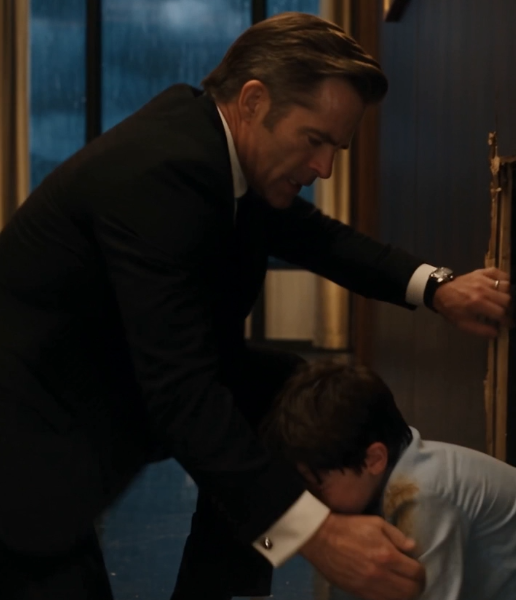
And there, in the pool of the amber lamplight, on the cold marble floor, kneeling amid the splinters of a broken wardrobe door, she had seen the two of them. The tall man in black, with his back to her, his head bent. The small boy in blue pyjamas, pressed so close against his chest that she could see only a smear of dark hair and a pair of small bare feet.
An embrace. A father and a son. Nothing more.
Vivienne had let her breath out, very slowly, through her nose.
It’s all right, she thought. It’s a scene. It’s a tantrum. The child has made himself hysterical in the dark, and now he’s weeping into Daddy’s jacket. A little unfortunate, but manageable. She had even felt, for a moment, a thin, pleasant thrill of anticipation. This was the sort of problem that she liked. A tangled scrap of string that could be pulled in the right direction.
She knew what Theo would say. She had already composed the reply. Marcus, my darling, I am so sorry. He has been so difficult these past weeks. I only put him in there for a moment, to calm down. He’s been having such terrible nightmares— A gentle pause. A hand to the heart. I think he may be picking up on your own distress.
A sick father. A fretful boy. A faithful wife.
She had begun, quite softly, to count the ways it could go.
It was only when the man bent his head, and a glow flickered up from between them, that she saw the phone.
A small, bluish, cracked rectangle of light, cupped between two hands. A child’s hand. A man’s.
Her heart did a small, tight, interested skip.
But then she saw the shattered glass, and she relaxed. She actually smiled. She had heard that crack herself, at the study door, a sharp bright report against the wall. The old phone, she thought. Anna’s phone, the one he carries about for luck. The one that doesn’t work. He’s showing it to Daddy. He’s saying look what she did, look what Vivienne did. The pathetic little tragedy of a little boy whose dead mother’s last photographs had been destroyed.
And Marcus would be furious, of course, and she would be so sorry, and they would buy another.
It was a very small thing, and she was very, very good at small things.
She watched them a little longer. She watched the man’s face, in profile now, lit blue from below by that pale cracked screen. She thought: he looks pale. She thought: he is trembling. Marcus was very still, with his chin tucked in, staring down at the little glowing thing with the fixed, motionless, glassy attention of a man hearing bad news.
Good, thought Vivienne. Let him upset himself. Let him be seen upset.
She smoothed her hands down her dress.
She slipped her shoes back on, one by one. She composed her face: a soft, anxious, gently questioning face, the face of a woman who has just come upon a family tragedy in her own hall. She tilted her head. She let the corners of her mouth tremble, just slightly.
And she walked out of the shadow of the palm tree, into the lamplight, and stopped.
She stood there for a moment, tall and straight, with the black glass of the windows behind her and the storm rolling over the city in great slow bursts of silver. She was a slim blue figure in the middle of a marble corridor. She knew she looked magnificent.
“Marcus?”
Her voice was warm. It was the perfect voice: a little breathless, a little bewildered, with just the faintest edge of hurt.
The man did not move.
“Marcus, darling. You’re home early.”
It was only then that he turned his head.
He did it very slowly. First the shoulder. Then the neck. Then the profile, dark against the lamp, with the cheekbone and the jaw and the grey eye catching a spark of light. It seemed to take a very long time. It seemed to Vivienne, standing there in her silks with her hands loosely clasped, that she could hear every one of the tiny sounds in the gallery: the rain, the clock, the faint electric hum of the lamp.
He looked at her over his shoulder.
He did not say anything.
And Vivienne, who had never in her life lost her nerve, who had stood by a hundred deathbeds and held a hundred hands without so much as a flicker, felt something she did not recognise move softly across the back of her neck, like a draught from an open door.
She smiled a little wider.
“Is Theo being dramatic again?” she said.
The small boy at his father’s side did not look up. His head was bent over the phone. He was very still, with his small hand flat over the glowing glass, and she saw him whisper something, so low that she almost missed it, so quiet that it might have been a prayer.
“Don’t let her see the phone.”
She didn’t catch the words. She only saw the movement of his lips. But she saw something else, too, and it puzzled her, because it did not belong.
The child was smiling.
Not a happy smile. A small, tight, tremulous, fierce little smile, like that of a very young soldier who has seen the enemy break formation. It lit his wet face from the inside, and it was so strange that she almost took a step back.
“Marcus,” said Vivienne, with a faint note of reproach. “Darling. Say something.”
And Marcus Hale, still kneeling on the floor of the gallery with his son at his side and a shattered phone in his hand, regarded his wife for one more long, strange, thoughtful moment, and then answered her in a voice that was quiet and perfectly steady.
“No, Vivienne,” he said. “He’s being very brave.”









