What the Boy Recorded
Nineteen SecondsThe passcode, Theo whispered, was zero-four-one-one.
Marcus did not need to ask whose birthday it was.
He typed the numbers with a thumb that did not shake. That was the strange thing, he would think afterwards. For six months his hands had trembled like leaves, at every dinner table, at every board meeting, through every endless humiliating night. And now, when it mattered more than anything he had ever done, they were as steady as stone.
The screen opened under his thumb in a lattice of broken light.
There was a little grey rectangle at the foot of the gallery, with a white arrow pointing to the right. A thumbnail. Ten words beneath it in a child’s careful lettering, where Theo had labelled the file the way his mother had taught him: V. + Doctor. Do NOT erase.
He pressed it.
The world narrowed to the width of a hand.
The video came up crooked and dark and shaking, filmed at the height of a child’s chest through a narrow slit between a door and its frame. He could see the edge of the study. Gold lamplight. The leather spines of the books on the far wall. The big mahogany desk with its green-shaded lamp. And in the middle of the picture, with her back to the camera, a tall woman in a long navy dress.
He knew the dress. He had picked it for her himself, in October, at a little shop in Mayfair, because she had stood in front of the mirror with her head tilted and said, Do you think it makes me look like a widow? and he had laughed and kissed her hair.
She was standing at the desk.
He could see her hands. Her long, elegant, familiar hands, with the pale polish and the thin gold wedding band. In one of them she held a mobile phone, flat on her palm, with the speaker switched on. In the other, a tiny brown glass bottle, no larger than a thumb.
And on the desk before her, in the pool of lamplight, sat a crystal tumbler.
His chest contracted.
It was heavy, squat, and cut with a diamond pattern. A wedding present, from Anna’s mother, thirty years ago. Anna had given it to him the night they moved into the first flat, with a bow tied round it: for your whisky, you dreadful man. He had drunk from it every evening for fifteen years. He drank from it still. He had carried it with him through the grief, and the hospital, and the long grey winter, and every night at nine o’clock Vivienne had brought it to him with a small kind smile and said, there, darling. To help you sleep.
On the screen, the woman tipped the bottle.
Four drops. Five. Six. They fell into the amber liquid with a soft, bright, silvery plink. He could hear them. In the little speaker, over the hiss of the storm, he could hear every drop.
“Six more weeks,” said a voice from the phone in her hand.
But it was not Vivienne’s voice. It was a man’s, mild and tidy and slow, with a faint clipped accent, and he knew it, as he knew his own pulse. He had heard it in a clean white consulting room on Harley Street, saying there is no need to be afraid, Mr. Hale.
“The tremor is entirely consistent with the dosage,” said Dr. Anders Lund. “But Vivienne, I must be frank with you. I cannot certify incapacity on the strength of three episodes. The board’s lawyers will want—”
“I don’t care about the board’s lawyers,” said Vivienne.
It was the voice that undid him. Not the words. The voice. It was not warm, or low, or musical, or kind. It was brisk and flat and bored: the voice of a woman reading out a shopping list to a stranger. He had lived beside her for three years and he had never heard it. He listened to it now with a feeling of vertigo, as if he were watching the floor of a building he had lived in all his life dissolve into a hole.
“I care about the paperwork. If he can’t remember where he parked the car, he can’t remember who signed what. I need three more incidents on file before the board meets, and I’ll have them. I’ve been careful. The keys. The car park. The telephone call to Roper. All they need is a pattern.”
“And the dosage?”
“Same dosage. I’ll make sure it’s in the cognac. He never notices the taste after the second glass.” A low, smooth, wicked little laugh. “You’d be amazed how little it takes to convince a man that he’s losing his mind. The mind does the rest. They always do it to themselves.”
Marcus did not breathe.
The keys. The car park. The telephone call to Roper that he knew, with a surety like iron, he had made, with details that he could still recite, and that Dennis Roper of Barclays had sworn on his children’s lives had never happened. Six months of it. Six months of lying awake at three in the morning, in sweat-soaked sheets, with his heart pounding like a trapped bird, thinking this is how it begins. This is how Father’s brother went. A word, a name, a face, and then a long white corridor. Six months of curling up in the dark with Vivienne’s cool hand on his forehead and her voice murmuring shh, darling. I’ve got you. You’re not alone.
He felt something move in his throat.
It was a sound. He recognised it. It was the same sound that Theo had made at the door.
On the screen, the voice went on.
“And the boy?” said Dr. Lund, sounding faintly uneasy.
“The boy is eight,” said Vivienne. “Boys forget. By the time he’s old enough to ask questions, he’ll be at a very nice school in the Alps, and his father will be in a very nice facility in Zurich, and I will be running Hale Dynamics.”
Then came the thunder.
On the video, it was only a bang, a flare of light across the study window, a violent lurch of the picture as a small hand flinched, and the whole frame swung sideways in a blur of lamplight and wood and carpet. The recording went dark for a half second. And then, in the last instant before it cut out, in a flash of lightning that lit the room like noon, the woman at the desk turned.
He saw her face.
He saw her face looking straight into the lens, her dark blonde hair coiled up and gleaming, her sapphires blazing at her ears, and the long pale mouth beginning, slowly, delicately, to curve.
The video ended.
Nineteen seconds. He had counted.
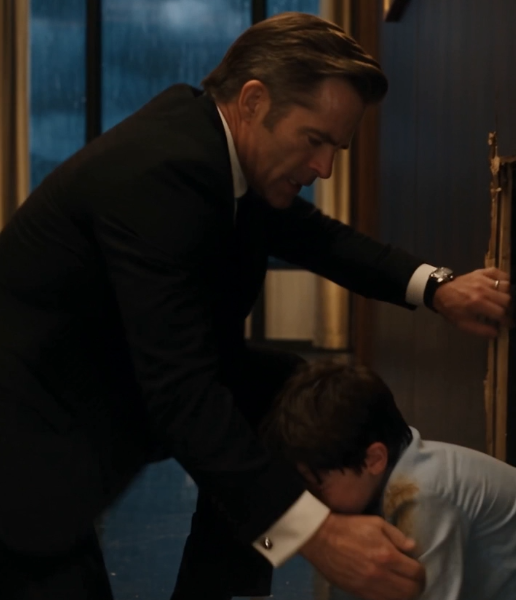
Marcus sat quite still, on the floor of his own gallery, in the amber lamplight, with the cracked phone in his hand and his son’s head against his arm. His thumb was still on the screen. The glow of the shattered glass lit his face from below, in a pale blue web, and in it his eyes were very wide, and his lips were slightly parted, and he looked, for the first time in all his life, like a man who had seen a ghost.
“That’s my glass,” he whispered.
He heard his own voice as if from a long way off. “That’s my glass. That’s the doctor’s voice.”
“Daddy?” said Theo, in a tiny, frightened voice. “Daddy, are you okay?”
He did not answer.
He was seeing, as in a series of lantern slides, every evening of the last half-year. Every cool fingertip on his wrist. Every soft word. There, darling. To help you sleep. Every time he had stumbled over a word and caught her eyes across a crowded room and seen, in them, such perfect and tender concern. He remembered how she had wept in the car after the Savoy dinner, when he had lost his place in the toast. He remembered how she had said, oh, my love, I’m so sorry, and held his face between her hands.
He had thanked her.
The cold, still sea that had been rising in him all this while reached its highest point, and there, quite suddenly, it stopped, and settled, and became a floor.
He understood several things at once.
He understood that he was not ill. That the white blank at the Savoy, the keys in the refrigerator, the unmade telephone call, had been done to him, with a dropper and a bottle, six drops at a time. That he was a healthy man in the prime of his life, and that every doctor in London would say so, if the right blood were taken on the right day.
He understood that the video in his hands was worth more than the company. That in this narrow cracked piece of glass, in a child’s shaking, nineteen-second clip, lay a woman’s freedom, and a doctor’s licence, and the end of a conspiracy that had been three years in the building.
And he understood, with a lurch of the heart that was almost fear, that there was not one word of it that Vivienne yet knew he had heard.
She was somewhere in the apartment. She was dressing, or waiting, or pouring a drink. She believed that her husband was out at dinner with the bank until eleven. She believed that her stepson had been shut away in the dark, silent and ashamed. She believed that in an hour the doctor would ring the bell. She believed that she had won.
And all that he had to do, in the next sixty seconds, was not let her know otherwise.
“Theo,” he said, very low.
“Yes, Daddy?”
“I need you to do something for me. It’s going to be the hardest thing I’ve ever asked. I need you to put the phone in your pocket and look at the floor and be quiet. Whatever happens. Whatever she says. Don’t let her see it. Don’t let her see your face. Can you do that?”
The boy’s eyes were enormous. But he nodded.
“I can do the quiet game,” he whispered. “I’m really good at it.”
Marcus kissed his hair.
He was just closing the screen when he saw it. Reflected in the black, shattered glass, beneath his own face, faint and small and perfectly formed, like an image at the bottom of a pool: a tall slim shape in dark blue silk, standing at the far end of the gallery, quite still.
She was watching them.
She had been watching them for some time.









