What the Boy Recorded
Marcus?It was the steadiness that frightened her.
She would try, in the weeks to come, to put a finger on the exact instant when it all went wrong. There would be a great many people willing to help her. Lawyers, with soft voices. Prosecutors, with hard ones. A court-appointed psychiatrist with a notebook. And she would tell them all, in the end, that it was not the child’s smile. It was not the phone. It was not any of the things that you might have expected.
It was Marcus’s hands.
For six months she had watched those hands. She had watched them with the intimate, loving, professional attention of a woman who is building something. She had known every nuance of their decline. The faint fluttering in the right thumb at breakfast. The wine glass that rattled against his teeth. The cufflinks that he could no longer fasten, so that she had to do it for him, with a gentle laugh, bending over his wrists in the bedroom mirror. She had measured the tremor, day by day, the way a doctor takes a pulse, and she had known, from that small quivering weight in her own palm, how very close she was to the end.
Now those hands lay quite still on his knees.
They lay in the lamplight, long-fingered and square, with the wedding band glinting on the left. They were not shaking. They were not trembling. They had not so much as twitched. The right hand, which held the phone, was as steady as a surgeon’s.
That isn’t possible, thought Vivienne.
It was a small, clear, mild thought. It did not feel like fear. It felt like a number that did not add up.
The dose is in the cognac. It’s still in him. It was in his last glass, at six o’clock. It should be at its peak. There is no way, no possible way, that he can—
Unless he did not drink it.
She looked at his face.
He had turned to her fully now, still kneeling, with one arm wrapped around his son. The lamplight caught the planes of his cheekbones, the faint shadow of stubble, the grey at his temples. His eyes, those cool grey winter eyes, were fixed on her without a flicker. There was no confusion in them. There was no fog. There was no pleading, no hurt, no tender bewilderment. They were clear as glass. And in their depths she saw, for the first time in the three years she had known him, something she had never seen there at all.
Recognition.
He was looking at her as one looks at a stranger who has been sitting at one’s own table for years, and has just turned round and shown a different face.
“Marcus,” she said again.
Her voice was still warm. But a thread had come into it, a faint high singing wire, and she heard it herself and could not take it out.
He did not answer.
She looked at the boy.
He had lifted his head at last. He was gazing straight at her, wide-eyed, wet-cheeked, with a small, white, set little face. He was holding the phone cupped against his chest in both hands, with the screen turned inward, away from her. And in the amber light, he looked suddenly older than eight. He looked a hundred years old. He looked like something that had come out of a deep place and learned its names.
The phone.
She stared at it. A small cracked slab of black glass, scored with white. She saw the case. Painted stars. White stars on a dark blue ground.
And a great, quiet, terrible cold went through Vivienne Hale from the crown of her head to the soles of her feet.
She had seen that case before.
Not on the phone that she had thrown against the wall. That one had been a plain black thing, a scratched grey brick with a cracked rubber cover. She remembered it perfectly. She remembered how it had felt, light and dead in her palm, with its battery long drained, like the shell of a beetle. She had thrown it as one flicks away a crumb.
This one had stars on it.
It was the birthday phone. The one that Marcus had given him in September. The one that she had checked, the next morning, with a swift practised thumb, and found to contain nothing but a few games and some photographs of a dog.
But she had not checked it tonight.
She stood there, with her hands clasped in front of her, quite motionless, in her long dark dress, and she watched a number of small ugly things slide very slowly into their places in her mind. The door of the study, ajar. The flash of lightning. The sudden lurch in the dark, a small sound, a creak. The boy’s face, in the cupboard doorway, with its odd bright eyes. She had thought it was terror. She had been delighted by it.
It had been attention.
“Theo,” said Vivienne.
She was surprised at how calm her voice sounded.
“Theo, sweetheart. What have you got there?”
The child said nothing. He only held the phone a little tighter.
“May I see it?”
“No,” said Marcus.
He had risen to his feet.
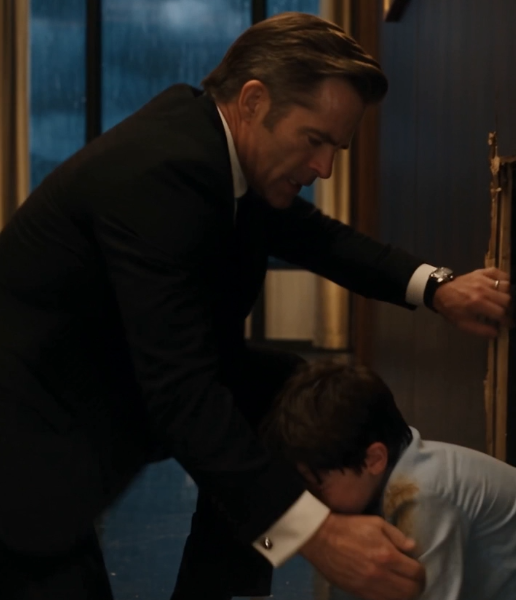
She had not seen him do it. He had simply, without any haste or effort, uncoiled from the floor, in one smooth movement, like a man standing up from a chair. He was a tall man, and he stood with his son held against his side, one broad hand resting on the boy’s shoulder, and the light from the tall windows silvered the edges of his shoulders. He looked, quite suddenly, enormous. He looked the way a man looks when he has been told the worst thing in the world, and has decided, with great calm, what to do about it.
“No,” he said again, gently. “I don’t think you may.”
The rain had begun to ease. A last long sheet of lightning ran across the city and lit the gallery from one end to the other, and for one white blinding instant Vivienne saw everything with horrible exactness. The shattered wardrobe. The scattering of Christmas baubles on the marble, rolling gently where they had spilled. The tall man in black. The boy. The phone. The grandfather clock, ticking, with its brass pendulum glittering like a small sun.
She saw her own reflection in the glass of the window, a slim dark-blue figure with a white face, standing quite still in the middle of the floor.
And she saw, in that face, what she had not allowed herself to see for three long years of patient and meticulous arrangement: that she was frightened.
Something in her chest gave a small, dry, silent crack.
“Marcus?” she said.
It was barely a breath. It was the smallest sound she had ever made. It came out of her mouth quite on its own, without permission, the way a name comes out of a sleeper. The pale polished mask on her face, the one she had worn so long and so well, wavered like a reflection in disturbed water. Her lips parted. Her eyes, those pale clever quiet eyes, went very wide. And for the first time since the day she had walked into the bedroom of a dying woman with a tray of pills and a kind smile, Vivienne Hale did not know what to say.
Marcus looked at her for a long moment.
“It’s all right,” he said.
His voice was kind. It was very gentle. It was the most terrible thing she had ever heard.
“It’s finished, Vivienne. The video has finished playing.”
From somewhere far below them, deep in the heart of the building, there came a long, soft, familiar sound: the chime of the private lift arriving at the fifty-ninth floor. The faint hush of the doors sliding open. The murmur of male voices. The measured, polite, unhurried tread of several pairs of expensive shoes on the marble of the foyer.
It was twenty-five minutes before ten.
They were early.
Vivienne’s hand flew to her throat. Her eyes darted past him, down the long corridor, to the great carved doors at the far end. Then, slowly, slowly, they came back to the man in the black suit. And she saw, with a slow cold dawning dread, that he was smiling. A small, grave, terrible smile, without any warmth in it at all.
“Right on time,” said Marcus Hale softly. “Shall we let them in?”
At his side, the little boy lifted the cracked phone in both hands, as if offering up a lamp.
A voice called out from the hall, mild and tidy and slow, with a faint clipped accent:
“Mrs. Hale? Vivienne? Is everything all right? We rang, but there was no—”
And in the long amber gallery, as the storm began to die over the city, Vivienne Hale, in her widow’s blue silk, with the sapphires burning at her ears, drew a single sharp breath, and for the first time in her life could not decide which of her faces to wear.
PART TWO
CHAPTER SEVEN — The Board
They came down the long gallery in a line, like a delegation to a funeral.
Sir Hugh Aldous walked first, tall and stooped and white-haired, in a cashmere overcoat he had not yet taken off, the chairman of the board of Hale Dynamics for twenty-two years. Behind him came Margaret Ng, small and sharp, with a leather folio under one arm, and Julian Pierce, the youngest of the directors, who looked as if he would rather have been almost anywhere else. At the rear, with his hands clasped before him and his neat grey beard glistening with rain, walked Dr. Anders Lund.
They stopped at the sight of the shattered wardrobe.
For a moment nobody spoke. They took it in: the splintered mahogany, the Christmas baubles scattered across the marble, a barefoot boy in muddy pyjamas, a tall man in a black suit, and a woman in a navy gown standing between them with one hand at her throat.
Vivienne moved first.
She did it beautifully. Marcus would think of that afterwards with a kind of reluctant awe. In the space of one breath the white face softened, the shoulders sagged, the eyes filled, and the woman who had stood rigid in the lamplight a moment ago was gone, replaced by a frightened, loving, exhausted wife at the end of her strength.
“Oh, Hugh,” she said. “Oh, thank God you’re here.” Her voice trembled perfectly. “I didn’t know who else to call. It’s Marcus. He came home early, and he’s not himself, he’s frightened Theo, he’s broken the cupboard— I tried to calm him, I swear I tried. Dr. Lund, please. I think it’s one of his episodes.”
The directors turned to look at the man in the black suit.
Marcus let them look.
He stood in the amber light with one hand on his son’s shoulder, quite still, quite quiet, his tie loosened and his hair a little rumpled from the struggle with the door. He knew exactly how it looked. Chairman, forty-five, alone with a smashed cabinet and a sobbing child. He had seen this scene in his mind an hour ago, with himself in the central role, hunched and grey and trembling, while the doctor made kind noises.
He took a breath, and he smiled, and he spoke in a voice that was calm and warm and unhurried.
“Good evening, Hugh. Margaret. Julian. Anders. You’re early. Do come in.”
Sir Hugh blinked.
“I’d like you all to sit down,” said Marcus pleasantly. “There’s a sofa in the library, and chairs. I’d offer you a drink, but my wife has been generous with the cognac, and I think we’ll leave it. Theo, would you hold my hand?”
The boy slid his small cold fingers into his father’s.
“There’s something we’d like to show you,” said Marcus. “Something my son made. It’s nineteen seconds long. After that, you can decide who is unwell.”
The library had been Anna’s favourite room.
He had not changed it in three years. The long shelves of poetry, the green velvet sofa with its worn arms, the Persian rug where Theo had learned to crawl. Marcus stood at the fireplace with the cracked phone in his hand and watched the four of them settle into the leather chairs, wary and puzzled and slightly appalled, like people who had been asked to a surprise party and found a courtroom.
“Marcus,” said Sir Hugh gently, “if you’re not well, there’s no shame in it. We all want what’s best for you—”
“I’m very well, Hugh. I’d like Dr. Lund to confirm it.” He turned. “Anders. Would you do me a kindness? You’ve a bag with you. I expect there’s a syringe in it. Please take a sample of my blood, here, now, in front of these witnesses, and send it to a laboratory of Margaret’s choosing. Not yours.”
There was a very small silence.
Dr. Lund’s mild face did not change. But the hand that rested on the clasp of his leather bag went, for an instant, quite white.
“That would be, ah, premature,” he said. “Marcus, you’re agitated. A test at this hour would be unreliable. In the morning, perhaps, at the clinic—”
“I’d prefer now.”
“Dr. Lund,” said Margaret Ng, very quietly, from her chair, “is there a reason you’d rather not?”
Vivienne laughed. It was a soft, tremulous, wounded little sound. “Margaret, please. This is exactly what I told you. He’s paranoid. He thinks everyone is—”
“Press play, Theo,” said Marcus.
The boy stepped forward.
He was very small in the great room, in his filthy blue pyjamas, with his bare feet on the Persian rug and his dark hair standing up in tufts. He looked at the four directors with grave, wet, steady eyes. Then he took the phone from his father’s hand, as carefully as if it were a bird, and set it on the low table in the middle of the room, with the shattered screen facing up.
He pressed the little arrow.
The room filled with rain.
It came out of the tiny speaker thin and tinny and huge, a crackle of storm, a creak of a door, the pale glimmer of the study in lamplight. A woman’s back, in a navy dress. A crystal tumbler in a pool of light. A brown glass bottle. And then the plink, plink, plink of six bright drops into amber, and a mild clipped voice from a phone in a woman’s palm:
“The tremor is entirely consistent with the dosage. But Vivienne, I must be frank with you—”
Nobody in the library moved.
Sir Hugh sat quite still in the leather chair with his big spotted hands gripping the arms. Julian Pierce had gone green. Margaret Ng’s lips had parted, very slightly, and her eyes were fixed on Dr. Lund with a look of the most extraordinary attention.
“I need three more incidents on file before the board meets, and I’ll have them.”
The voice on the phone was flat and bored. It was the voice of a woman reading a shopping list.
“Same dosage. I’ll make sure it’s in the cognac.”
Vivienne had risen. She had risen a little too quickly, so that her chair rocked on its legs. Her face had gone the colour of candle wax.
“That’s—” she said. “That’s not— It’s a trick. It’s some kind of— He’s coached the child. It’s one of those programs, those voice— Hugh, you know me. You’ve known me three years. You know I would never—”
“And the boy?” asked Dr. Lund’s voice on the phone, sounding faintly uneasy.
“The boy is eight. Boys forget.”
A small sound came from the leather chair on the left. It was Julian Pierce, the youngest director, who had put his hand over his mouth.
The tape ended on the thunder, and the swing of the lens, and the last white flash of a woman’s face turning, smiling, to look straight into the camera. In the silence that followed, nobody breathed.
“Anders,” said Sir Hugh.
His voice was low and heavy. He had not looked away from the cracked screen.
“That is your voice.”
Dr. Lund did not answer. He had risen, and was holding his leather bag against his chest like a shield, and his neat beard was trembling. He looked from the table to the door to the faces of the directors, quickly, one after the other, like a man calculating the distance to an exit.
“I told her it was too far,” he said suddenly.
It came out of him high and thin and cracked, the voice of a frightened schoolboy. “I said so! I said it from the very start. I said, Vivienne, you can’t certify a man on three episodes. I said it was dangerous. I said—” He saw Margaret Ng’s face, and he stopped, and the colour drained out of his own.
Vivienne turned her head and looked at him.
She did not say anything. She only looked, for about two seconds, with an expression of such complete, still, contemptuous disappointment that the doctor took a step back.
Then she looked at her husband.
The mask was gone. Quite gone. What was left was a pale, narrow, clever, tired face with a hard mouth, and for the first time in three years Marcus Hale looked at the woman he had married and saw her clearly, all of her, without the soft lamplight or the sapphires or the cool fingertips on his wrist. He thought he might have felt grief. He did not. He felt only a vast, quiet, level tiredness, like a man at the end of a long road.
“It’s rather a pity,” said Vivienne, almost to herself. “It would have worked.”
“I know,” said Marcus.
“If it hadn’t been for the thunder.”
“Yes.”
“A child.” She shook her head slowly, with a ghost of her old, cool, rueful amusement. “I had a whole board of lawyers, a licensed neurologist and the signature of a sitting chairman. And I was beaten by an eight-year-old with a birthday phone.”
A small voice spoke from beside the fireplace.
“I’m nearly nine,” said Theo.









