Cast Out at 17, She Stockpiled Food in a Hidden Cave—Then the 8-Day Blizzard Hit
Cast Out at 17, She Stockpiled Food in a Hidden Ca…
The cold came down before the sun did. It settled over the silver mining valley in the Idaho high country like something with weight and purpose, a physical force that pressed against the timber-framed houses and the weary spines of the two hundred souls who lived there. Sable Creek smoked under a sky the color of a fresh bruise, and every chimney breathed as though nothing were coming.
But the geese had knifed south in ragged formations three weeks too early. The wind had swung around twice in a single week, tasting of iron and something vast and merciless gathering in the north.
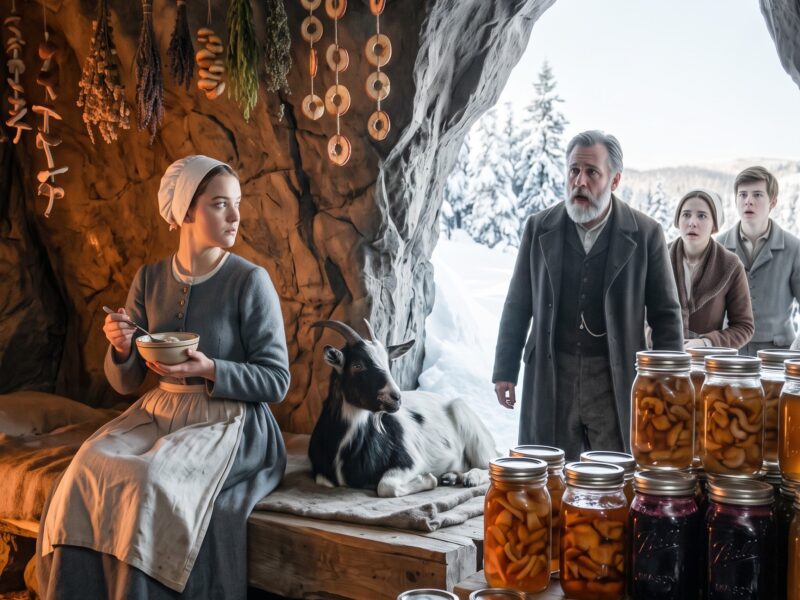
On a slope above the town, a narrow seam in the rock exhaled a breath of air that was not quite as cruel as the world around it. Before this crack in the earth stood a girl of seventeen. Her name was Marin Pasco. She had a heavy burlap sack of potatoes slung across her back, and frost was already crystallizing in the loose strands of her dark hair.
Below her, the valley of Sable Creek was entirely oblivious. They had laughed at the strange girl hauling supplies up to a hole in the hill. They did not see the clouds stacking in the north, thick and impenetrable. They did not feel the subtle, lethal shift in the barometric pressure. And they certainly did not know that when the worst storm the valley had ever seen finally broke over the mountains, the only warm door left standing would belong to the one person they had thrown into the snow.
The first thing Marin had carried up the hill was not blankets, nor firewood, nor the good wool coat she had outgrown two winters back. It was potatoes. She carried them because hunger frightened her more than cold. She had learned that lesson the way feral animals learn which berries kill—through the raw suffering of it, and the narrow, brutal luck of surviving it.
Three weeks. That was how long she had been an outcast. Three weeks of sleeping in frozen sheds and beneath abandoned wagons had taught her a fundamental truth of the frontier: cold only makes a person miserable, but hunger makes a person stupid. And stupid in an Idaho winter gets you buried before the ground has even finished freezing.
The memory of her eviction was still a sharp, splintered thing in her chest.
It had happened in the kitchen of the house she had lived in for two years—the house that belonged to Silas Rener, the man her mother had married fourteen months after Marin’s father went into the cold ground. Silas was a man who trusted arithmetic the way other men trusted holy scripture.
He had not shouted. That was the detail Marin kept returning to, the thing that lodged under her ribs. He had not raised his voice even a fraction. He had simply laid a single sheet of paper flat against the scarred wooden table and waited for her to read it, the way a bank clerk waits for a ruined man to understand the deficit at the bottom of a ledger.
Marin had read it. A column of numbers ran down the left side in Silas’s careful, upright handwriting—an inventory of everything the house held against the coming cold. Flour, salt, lamp oil, cordwood, dried venison, and the last of the autumn’s canned squash. On the right side ran the mouths that food had to keep breathing until the spring thaw. Beneath both columns was a line of subtraction, clean, balanced, and entirely merciless.
The numbers did not meet in the middle.
Beside one name on the household’s list, Silas had drawn a single horizontal stroke. A thin line of ink through two words: Marin Pasco.
“There isn’t enough,” Silas had said, his voice as flat as the paper itself. “Not enough wood. Not enough food. Not enough of anything to carry four through to the thaw. You can see the figures for yourself. I’m not asking you to go. I’m showing you why someone has to.”
Marin had looked at her mother. Ruth sat at the far end of the table with her hands folded in her lap, her eyes fixed on a knot in the floorboards as though it might magically open and offer her somewhere to fall. Ruth had twisted her fingers into the fabric of her skirt, pulling it so tight her knuckles stood out as white as bone. Marin waited for her to say something. One word of protest, one syllable of objection, and Marin would have dug her heels into that floor and fought to stay through every argument Silas could muster.
But Ruth never lifted her gaze.
“My father died in that mine,” Marin had said, surprised to hear how steady her own voice sounded, far steadier than the storm building behind her eyes. “Tomas Pasco went underground so this valley could have silver and this house could have wages. He died down in the Widowmaker drift two years ago. Him and three other men, because the company wanted them to chase the vein another forty feet past where the timbering was sound. Now his daughter isn’t worth the ink it takes to keep her name on your list.”
Silas did not flinch. He possessed the absolute stillness of a man who had already run every objection through his figures and found them mathematically wanting.
“Your father died because he took a risk a careful man wouldn’t have taken,” Silas replied. “I don’t intend to repeat his arithmetic.”
The sentence had landed harder than a slap. Silas believed it down in his marrow. He believed that Tomas Pasco’s death had been a miscalculation rather than a sacrifice, an error in judgment rather than the act of a man refusing to leave his crew behind in the dark. Silas believed that a life could be set on the same scale as a barrel of flour, and found either worth the shelf space, or not.
Marin had looked at her mother one last time. Ruth’s lips parted. The ghost of a word gathered there, but it never quite became sound. Her jaw tightened, her eyes closed, and the moment folded shut like a book no one intended to open again.
Marin understood something in that silence that she would spend the whole winter learning to articulate. Her mother was not heartless. Her mother was hollowed out. Three brutal winters, a husband lost to the earth, a second marriage entered out of the desperate arithmetic of a widow with no wages—the slow, grinding erosion of poverty had scooped Ruth out from the inside. Silence was the only thing she had left to offer.
Understanding it did not make it hurt less. Understanding is not forgiveness, and neither one fills an empty stomach.
Marin had packed what she could carry into two canvas sacks. A change of clothes. The heavy shawl her father had given her the winter she turned fifteen, the wool still smelling faintly of his pipe smoke. A folding knife with a bone handle worn smooth by his thumb. A handful of coins saved from mending socks for the bachelor miners. A small leather pouch holding a lock of her father’s hair.
And last, she took the “sticking Tommy” from the shelf by the door. It was the iron candle holder her father had carried down into the mine every working morning of his life. Its spike was blackened by twelve years of being driven into the rock face so a flame could light the place where he swung his pick. She wrapped her fingers around the cold iron and felt, for just a moment, the ghost of his grip beneath her own.
She walked out before the sun finished setting. She did not say goodbye. The porch steps groaned under her boots—the same three notes they always did—and the gate swung shut with a familiar iron squeal. She did not look back. Looking back would have meant admitting she still half-hoped someone would come after her.
Nobody came. The road stretched ahead, empty and darkening, and Marin Pasco walked into it with a sensation in her chest like a door being nailed shut from the inside.
Related Articles

They Mocked the Widow’s Dirt Cellar—Then the Freeze Left Every Cabin Cold but Hers Warm
They Mocked the Widow’s Dirt Cellar—Then the Freeze Left Every Cabin Cold but Hers Warm…

A Homeless Veteran and His German Shepherd Inherited a Ridge No One Wanted — 35 Feet In, They Found
Chapter 1 / 7 A Homeless Veteran and His German Shepherd Inherit… A Homeless Veteran…

Neighbors Laughed When He Built A Cabin Inside An Old Barn—Until It Kept His Home 35 Degrees Warmer
Chapter 1 / 8 Neighbors Laughed When He Built A Cabin Inside An… Neighbors Laughed…

His Sod House Had No Woodpile in January – Until the Trains Stopped and the Town Came Begging
Chapter 1 / 10 His Sod House Had No Woodpile in January – Until t……

She Built Her Cabin Over the Woodshed and Never Burned Wet Wood Again
Chapter 1 / 8 She Built Her Cabin Over the Woodshed and Never Bu… She…

The Duke Abandoned Her on Their Wedding Day—Years Later, He Discovered What He Had Lost
Chapter 1 / 7 The Duke Abandoned Her on Their Wedding Day—Years… The Duke Abandoned…

He Wedged a Tiny A Frame Into a Crevice Before Winter and His Family Slept at 75°F While Town Hit
Chapter 1 / 7 He Wedged a Tiny A Frame Into a Crevice Before Win……

He Was Too Old to Ride—So He Bought the Ruined Ranch and Found the Room Behind the Fireplac
Chapter 1 / 5 He Was Too Old to Ride—So He Bought the Ruined Ran……

Settlers Laughed at His Underground Heat Recovery Duct — Until It Kept His Cabin 71°F Warmer
Chapter 1 / 9 Settlers Laughed at His Underground Heat Recovery… Settlers Laughed at His…

A Navy SEAL Built a Home Inside a Mountain—Then His Dog Warned Him Before the Storm
Chapter 1 / 5 A Navy SEAL Built a Home Inside a Mountain—Then Hi… A…