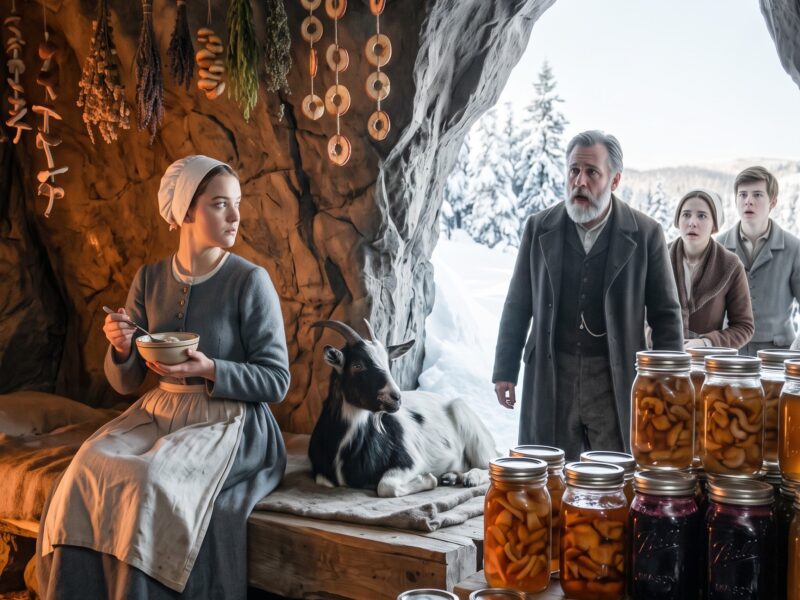
Cast Out at 17, She Stockpiled Food in a Hidden Cave—Then the 8-Day Blizzard Hit
The Reckoning of Sable Creek
The storm broke on the eighth morning. It did not end with a grand collapse, but with a slow surrender. The wind lost its edge, falling from a howl to a moan, and finally to a stillness so complete Marin could hear her own heartbeat.
She crawled to the entrance, pushed aside the drift, and looked out. The valley had been remade. Smooth white plains buried the roads. Rooftops surfaced like the spines of vast, sleeping beasts.
Behind her, the chamber woke. “Can we go out now?” Micah Wade asked, his voice cutting the silence.
The boy stumbled out into the open, sinking to his waist in the fresh drift. He tipped his head back to the white sky and laughed. The clear, ringing sound of a child’s laughter in the deadest air did something to every grown person at the cave mouth. Cade closed his eyes. Levvenia pressed a hand to her mouth. Odessa let it wash over her like spring.
Marin looked at Ransom. He looked back. There was nothing left to say.
The walk down took an hour, moving single-file through chest-deep drifts. Sable Creek looked struck by a giant fist. Windows were blown in, roofs caved, wagons overturned.
Neighbors were digging out the trapped. People emerged blinking, their stoves cold for days, their furniture burned to keep their children warm.
But it was the general store that pulled every eye. Ambrose Thorne’s building stood completely untouched. Its walls had been braced in autumn. Its roof held clean. Its shuttered windows were reinforced. The store looked built for precisely this storm.
Cade Marsh walked toward the store, his face cold and deliberate. He stopped before the barred door.
“Ambrose, open this door!” Cade’s voice boomed.
Within ten minutes, half of Sable Creek stood clustered before the store. “Open it, or I open it for you,” Cade roared. “I bend harder things than that lock before breakfast.”
The bar lifted. The door swung inward. Ambrose Thorne stood in the opening, thinner, his face drawn. He looked at the crowd, his pale eyes calculating.
“You locked this door,” Cade’s words carried flat and hard. “You sat inside with your flour and your salt pork, and you barred the door while folks two doors down burned their furniture.”
“I protected my inventory,” Ambrose’s voice was steady, though his hands shook. “Every man has the right to protect what belongs to him. I offered supplies to several families through the worst of it.”
“The families you chose,” Corbin Wade said, pushing through the crowd. The quiet widower had become something forged and edged. “You chose who ate by who owed you. The Coles are into you for a plow; the Harnetts signed a note against their field. You fed your debtors and called it charity. My boy was cold on my back while I carried him up a mountain because the only door with food behind it was barred against him.”
The crowd shifted. Recognition rippled through them. They all saw the truth of the system Ambrose had trapped them in.
Marin stepped forward. She did not raise her voice; she had no need to.
“You refused to sell to me three months ago,” Marin said, her eyes level on Ambrose. “You told me I was hoarding in a way that harmed the community. Then you locked your store against the worst storm we’ve ever seen, parceled out food to the people who served you, and left the rest in the dark.”
She let the silence hang. “So I’ll ask you the only question that matters. In front of everyone you tried to keep it from: Which one of us harmed this community, Ambrose?”
The silence was total. Ambrose’s mouth opened and closed without sound. Behind him, the shelves stood fully stocked, visible to everyone. The proof of his greed was laid bare.
Corbin turned to the crowd. “I’m calling on the council to strip Ambrose Thorne of his seat overseeing winter supply. Here, now. Every soul in favor, raise your hand.”
Levvenia Reed’s hand went up first. Then Cade’s. Then, one by one across the crowd, the hands rose. Even the families Ambrose had fed raised theirs, having seen what the feeding cost their neighbors. At the back, Emory Stag raised his hand. Wesley raised his at the same instant. Father and son looked at each other, their lifted arms a bridge toward future forgiveness.
Every hand was a nail driven into the coffin of Ambrose’s power. He looked at the crowd, realizing the control he had spent a lifetime building was undone in a single frozen morning. His gaze found his daughter. Dela stood beside Marin, meeting her father’s eyes with a twist of grief and resolve.
Ambrose looked at the girl he had cast out. The calculation drained from his face, leaving him entirely alone. He stepped backward and closed the door with a quiet click.
Cade and Corbin opened the store an hour later. They distributed the supplies equally, with no preference and no ledger. Marin organized the distribution with the exact precision she had used in the cave. Standing at her elbow, helping her weigh the flour, was Dela Thorne—working in her father’s store not as his daughter, but as a girl who had chosen the right side of a locked door.
Ransom Teal did not come to the store. When Marin looked for him, he was already gone.









