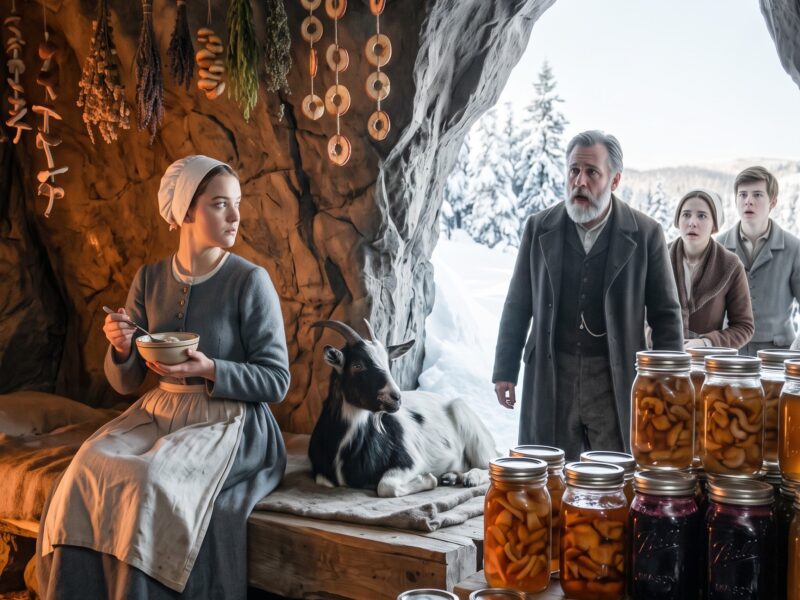
Cast Out at 17, She Stockpiled Food in a Hidden Cave—Then the 8-Day Blizzard Hit
The Architecture of Defiance
She returned the next morning carrying the first load. Potatoes, because hunger remained her greatest terror. Then canned peaches, bought with nearly the last of her coins from a farmer’s wife on the outskirts who hadn’t yet heard that Marin was someone to be shunned. Then blankets, stiff with dust and mouse-gnawed at the edges, scavenged from a collapsed trapper’s shack near the creek.
Every trip drained her. The cave sat the better part of a mile from town, uphill through terrain that would only turn crueler as the snow deepened. By the third day, her shoulders had bruised purple beneath the rope. Her hands had cracked open across the knuckles. A blister on her right heel burst, reformed, and burst again until the skin hardened into leather.
But each time she set down a load and looked at the growing rampart of supplies against the stone, something hard and certain settled deeper into her chest. It was a foundation being poured beneath a house no one else could see.
People noticed quickly. Cade Marsh spotted her first. Cade was the settlement’s blacksmith, thirty-one years old, broad through the shoulders, and absolutely certain about every subject the Lord had ever created. He used his booming voice the way some men use their fists—to fill a silence before anyone else could claim it.
“What in the world are you doing out there?” Cade’s shout rolled up the slope as Marin hauled a makeshift sled piled with grain sacks.
She kept pulling. “Preparing.”
“For what, exactly?” He let his eyes travel up to the low gray belly of the sky. “For winter?” He looked at the overloaded sled, and his certainty curdled into contempt. “You planning to live out in the woods like a wild thing?”
“If I have to.”
Cade shook his head, turning back toward his glowing forge. “Girl’s gone half-feral already,” he muttered, pitched loud enough to ensure it reached her.
Marin kept walking. She realized, with a small, dark satisfaction, that she had completely stopped caring what Cade Marsh thought. Somewhere between the freezing root cellar and the mountain slope, their opinions had lost the power to wound her.
Every day she hauled more. Flour, salted meat, lamp oil, matches sealed in waxed cloth, empty buckets for melting snow. She organized the chamber with startling precision. Food sat along the colder rear wall. Firewood was stacked near the entrance where the moving air kept it dry. Blankets were raised off the stone floor on a low platform of lashed branches so the ground could not steal her body heat. She notched shelves together from fallen timber, working the joints with her father’s bone-handled knife.
Ambrose Thorne noticed the change in her buying habits before anyone else.
Ambrose owned the only general store within thirty miles. He sat on the three-man town council, which meant Ambrose governed the whole of Sable Creek. He was lean in the face, with pale eyes that appraised the worth of everything they landed on. He wore pressed shirts even in the mud of autumn, as though respectability were a garment he could not afford to let wrinkle.
He caught her outside the store one morning. “You’ve been buying a good deal more than a girl in your circumstances has any call to.” He leaned in the doorframe, blocking the warmth leaking from within.
“Other families lay in stores for winter,” Marin said. “I’m paying your full price, same as any of them.”
He lowered his voice to the register men use for threats they want to sound like reason. “I hold the right to refuse a sale if I judge someone is hoarding in a manner that harms the community’s supply. The council stands behind me on that.”
Marin looked at him steadily. She understood exactly what she was seeing. Ambrose Thorne did not care one whit for the community’s welfare. He cared for control, and his control ran entirely through the shelves behind him. If Marin proved she could survive without crossing his threshold, she existed outside his system. And a person outside the system was a crack in a foundation Ambrose assumed was solid.
She bought her flour that day, knowing the supply line could be cut at his whim.
As she stepped back into the bitter cold, a hand caught her sleeve. It was Dela Thorne, Ambrose’s nineteen-year-old daughter, the closest thing to a true friend Marin had owned before her life came apart. Where Ambrose’s face was a locked drawer, Dela’s was a window with the curtains drawn back.
Dela pulled Marin out of the sightline of the store’s front glass and pressed a heavy cloth bundle into her hands.
“Salt pork,” Dela whispered. “Take it and don’t argue. He counts the flour and the sugar down to the ounce, but he’s never once counted the pork. He won’t miss it.”
Marin hesitated. “He doesn’t hate you, Marin,” Dela continued, her voice trembling slightly. “He’s afraid of you. If a girl he cut off can live through a winter on her own two hands, folks might start to wonder whether they need him half as badly as he’s spent his whole life making them believe.”
Marin took the pork. She held Dela’s cold hand a moment before letting it go.
Two days later, Marin saw the reality Dela’s words had pointed toward. Filling her water buckets at the creek behind the store at dusk, she peered through the small rear window of Thorne’s stockroom. Ambrose was not tending the public shelves. By lamplight, he was stacking massive sacks of flour and thick slabs of salt pork into a separate pile behind a false partition of new lumber. He was sealing a private store within the public one, working with the furtive economy of a man who believed he was the valley’s only deserving survivor.
Marin watched him build a wall between what the valley thought it could count on and what he had set aside for himself. She said nothing.
There was only one person in Sable Creek who never laughed at Marin. Odessa Kel, a sixty-eight-year-old widow thin as a split rail, approached Marin one evening as she bought dried beans from a farmer.
“Have you found shelter, child?” Odessa asked.
Marin hesitated, then gave a single nod. “Underground.”
The word landed heavy. Odessa studied her, reading her the way a woman reads a sky she has studied for sixty hard years. “How could you know that? Because underground is a great deal smarter than freezing.”
Odessa handed her two extra jars of peach preserves. Before turning to go, the old woman offered a memory. “The winter I was twelve years old, my family got caught out on the trail west. Snowed in, three weeks short of anywhere. My mother kept the four of us breathing by burning the wagon down to its axles, one board at a time. The sideboards first, then the seat, then the wheels themselves.”
Odessa’s eyes, pale as creek ice, settled on Marin without an ounce of pity, only a hard, useful clarity. “I have never in my life been afraid of winter, child. I am afraid of people who refuse to prepare for it.”
Two weeks before the first true snowfall, Ambrose made it official. He refused to sell to Marin outright. Council decision, he claimed across the empty counter. Priority goes to established families.
The door swinging shut behind her sounded like a lock turning. She was cut off entirely.
Marin solved the problem the way her father would have. She set snares for rabbits along the ridgeline. She dug for roots beneath the thin early snow—cattail, burdock, and wild bulbs. It was knowledge drawn from the deep well of her childhood, idle afternoons in these same hills with Tomas Pasco.
“Won’t win any prizes for flavor, but it keeps a body upright,” he would say, breaking a root open to show her the pale flesh. She could almost hear his tuneless humming in the freezing wind.
Then, the gifts began to appear.
A week after she settled into the cave, she woke before dawn to find large bootprints frozen into the frost outside the entrance. Hanging from a low branch was a rabbit, freshly killed, dressed, and faintly warm. Beside it sat a coil of good hemp rope.
The gifts came three more times. A square of tanned, supple deer hide. A box of matches sealed in waxed cloth. A small hatchet with a short handle. Each time, the same large bootprints. No note. No face.
When she asked Odessa about the tallies on the cave wall, the old woman went quiet. “Could be Ransom Teal did that. A fur trapper lived up in these mountains alone for more years than most men could stand before he ever came down to the valley. Folks say he’s odd, and folks aren’t wrong. But there’s not a living soul in this country who understands a hard winter better than he does.”
“Is he dangerous?” Marin asked.
“He’s lonely,” Odessa’s mouth pulled sideways. “That’s a different kind of dangerous, and I’d not care to say which kind is worse.”









