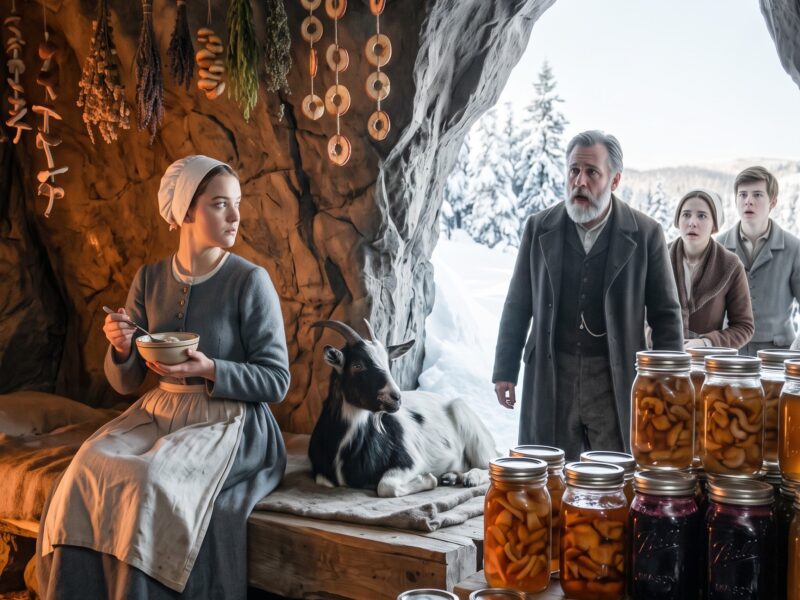
Cast Out at 17, She Stockpiled Food in a Hidden Cave—Then the 8-Day Blizzard Hit
The Ash in the Stove
Marin climbed back to Hearthstone near dusk, bone-tired but devoid of fear. She found Ransom’s corner empty. His blanket was folded neatly; his coat was gone.
The only trace of him was the short-handled hatchet sitting on the shelf, and across it lay a torn scrap of paper. Five words, marked in a cramped, laboring hand:
Cave is yours now. Paid.
Marin read it twice, folded it, and placed it in her pocket beside the lock of her father’s hair. Two men had shaped the course of her life: one by dying in the dark, the other by choosing to step back into the light.
She showed the note to Odessa the next day. “He didn’t leave because he stopped caring,” Odessa said. “He left because he’s finished. Thirty years he hauled that question. You answered it for him by digging the snow away from your door.”
“Will I see him again?”
Odessa smiled. “You’ll see his bootprints in the frost every winter. That’s how a man like that says good morning.”
Two weeks later, the drifts slumping into heavy heaps, Marin walked down the hill to the house she had been thrown out of. Cade Marsh came with her, hauling a sled loaded with fairly distributed supplies.
The path to Silas Rener’s door had been poorly cleared. Marin stood before it, listening to the drip of the eaves. Silas opened the door slowly. He had aged a decade. The hollows beneath his eyes were dark; his shirt hung loose. The house smelled of boiled turnips and cold ash.
Silas looked at the loaded sled, then at Marin. “You came back,” he said softly.
Marin looked past him to the kitchen table, where the ledger had lain three months ago. She waited to feel the old anger or triumph. Neither came. There was only a strange, level clarity. The hunger to have her worth acknowledged had simply burned away.
“No,” she said. “I came to see whether my mother needs supplies.”
Silas watched her. The calculating machine in his head labored to understand how the girl he subtracted had returned as the strongest thing in the valley.
“I’m not angry with you, Silas,” Marin said. “Your figures were sound. But you were wrong about the only thing that mattered. You looked at me and saw a burden the numbers couldn’t carry. I wasn’t one.”
Silas’s mouth worked. “I didn’t think you’d…” The word came out like a splinter. “…survive. Let alone come back the strongest thing in this valley.”
It was not an apology, but it was an admission. For Silas Rener, admitting his numbers were wrong was the hardest sentence he had ever forced past his teeth. Marin accepted it. People give what they are able to give.
Then Ruth appeared in the dim kitchen. She looked smaller, her eyes red, but she did not look at the floorboards. She looked directly at Marin with unflinching steadiness.
“The night you left,” Ruth said, her hands folded before her, “I watched you walk down the road until the dark took you. Then I came back to this kitchen. I took Silas’s paper off that table, and I put it in the stove, and I burned it.”
Silas turned to his wife, stunned. The gap in his ledger was suddenly revealed.
“I burned it because I could not stand to see my daughter’s name crossed out on my own table every morning,” Ruth said. “It was the only answer I had the strength left to give. But I gave it.”
Marin understood at last. Her mother’s silence had not been consent. Ruth had not been empty; she had been shattered. And she had resisted in the only way left to her. A single sheet of paper burned in a cold stove. But Marin had learned that the smallest acts are sometimes the loudest declarations.
Marin reached out and took her mother’s hand. Ruth gripped back fiercely.
“I know,” Marin said. Not full forgiveness yet, but a fragile bridge laid across the space between them, built from both banks at once.
She left the supplies on the table. At the edge of the porch, she looked back. Ruth stood tall in the doorway. Beside her, Silas stared at the empty tabletop, saying nothing at all. The winter had already spoken for him.









