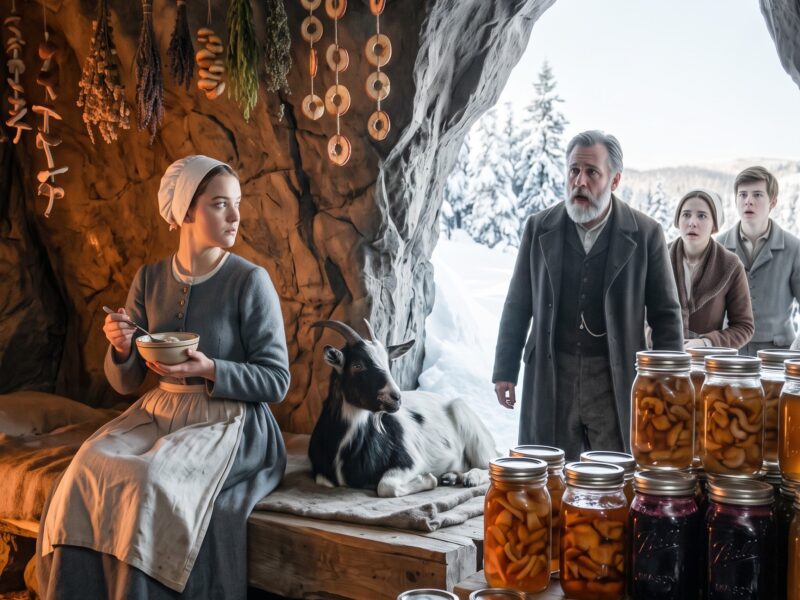
Cast Out at 17, She Stockpiled Food in a Hidden Cave—Then the 8-Day Blizzard Hit
The Breathing Stone
The first three nights very nearly finished what Silas’s arithmetic had started.
She spent the first night in an abandoned equipment shed near the mouth of the old mine. It was cold enough that her breath crystallized in the faint light of the little grease lamp she nursed. The wind whistled through the gaps between the wall planks while mice scratched in the corners, her teeth chattering in a violent rhythm she could not stop.
The next night, she slept under a wagon behind the feed lot. Something with a cold, hairless tail ran across her legs at midnight, and the frozen ground seemed to reach up through the burlap sacks she lay on, pulling the warmth straight out of her bones.
The third night was spent in a root cellar someone had forgotten to bar. It was damp, lightless, and stank of rotting turnips. She slept sitting upright against the earthen wall because the floor was too wet to lie down on.
Each morning, the cold crept a little deeper into her core. Each morning, she woke more exhausted than she had lain down. Her joints stiffened. Her thoughts came slower, arriving late and leaving early. On the third morning, she caught herself standing in the middle of the road with her mind gone entirely white, staring at nothing, unable to remember which direction she had meant to walk.
That realization frightened her more than the frost. The cold was reaching past her skin into the room where decisions lived, walking along the walls, turning down the lamps one by one. She had watched a trapped animal do the same thing once—simply sit down in the snow and let go. She understood now what that stillness was. It was not peace. It was the mind consenting to its own ending because thinking had become too much work.
She had tried to ask for help before it came to that. On the second evening, she had knocked on Corbin Wade’s door. Corbin was a quiet widower raising a seven-year-old boy named Micah. He had gentle eyes and hands cracked and darkened from splitting other men’s cordwood for pay. He looked genuinely sick with sorrow when he told her he had no room to give. She could see past him into the cramped, single room where Micah sat at the table, working sums on a slate by lamplight. She knew Corbin was telling the plain truth.
But he had pressed a wedge of cornbread into her hand before she turned to go, still warm from the iron pan. The heat of it against her freezing palm nearly undid her right there on his doorstep.
She had tried the church next, but Reverend Absalom Reed had gone to Boise to secure winter supplies before the passes closed. His wife, Levvenia, opened the parsonage door and allowed Marin to sleep one night on the wooden bench beside the stove. Levvenia was a careful woman of fifty, her steel-gray hair pinned back tight, her voice carrying the settled authority of someone long accustomed to being the moral compass in a settlement of rough men.
In the morning, Levvenia brought Marin a cup of black coffee and spoke plainly over the rim of her own. “If I let you stay past one night, others will ask why I didn’t do the same for them. Then every family down on their luck will form a line at this door. I cannot shelter the whole valley, so I cannot shelter only one.” She set her cup down with the finality of a woman closing a ledger. “You understand me?”
Marin understood. It was the exact same logic Silas had used, only dressed in kinder clothes and served with coffee. She thanked Levvenia for the warmth and left before the sun cleared the ridge.
On the fourth morning, hunting the hillside above town for fallen branches dry enough to burn, she found the crack in the rock.
It was a narrow seam, half-hidden behind a leaning slab of stone and a curtain of dead brush, a third of the way up a slope that overlooked the entire valley. A hundred people could have walked past it and never turned their heads. But Marin noticed what stopped them from noticing: the air near the seam was wrong.
It was not warm—nothing so generous as warm—but it was less cruel. A faint breath of something other than the frozen world exhaled from between the stones, as though the hill itself were breathing slow and shallow in its sleep.
She thought of her father. Tomas Pasco had told her once, when she was perched on his knee, that the deep places of the earth kept their own weather. Underground doesn’t care what the calendar says, he had told her, tamping his pipe with a thumb stained the color of coal dust. Summer or the dead of January, the rock holds whatever warmth it wants, and pays no mind to any of us up top.
She had been too young then to do anything with the knowledge. Now, standing before a breathing hillside, she understood it perfectly.
She crawled inside with her grease lamp held out ahead of her. The passage was tight for the first ten feet, close enough to scrape both her shoulders raw. Then, without warning, it opened. The chamber beyond ran deeper than the lamplight could reach. It was dry and still, the ceiling arching high enough overhead that she could stand upright with room to spare.
Along the curve of stone above her, faint black smudges marked where fires had burned long ago. Flat stones had been arranged into a fire pit, shaped by human hands. Directly above the pit, a narrow fissure ran up through the ceiling. When she held the lamp beneath it, she felt the faint, steady upward pull of a natural chimney drawing air toward the open sky.
Someone had lived here. Someone who had understood winter.
She sat on the cold stone floor for the better part of an hour, doing nothing but listening. No wind found its way inside. No exposed corner leaked warmth into the dark. There was only still, dry air and the faint mineral smell of deep rock—the same smell that had clung to her father’s clothes.
In that profound stillness, a realization settled over her that was equal parts salvation and sentence. She could live here. She could actually survive.
The thought frightened her. Surviving in a cave above a town that had cast her out meant stepping outside the boundaries of every ordinary future she had ever imagined. It meant taking her own existence into her own two hands.
Before she crawled back out, she noticed one last thing. On the far wall, where the lamplight barely reached, someone had cut marks into the stone with a blade. Hundreds of small vertical lines, grouped patiently in sets of seven. Beside them, scratched faint but legible, was a date: November 1853. Thirty years gone.
Whoever had sheltered here had counted the weeks, one careful stroke at a time. Marin stared at the marks and felt a surge of hope, followed instantly by a colder dread. The person had survived. But eventually, they had stopped making marks, and she had no way of knowing why.









