Cast Out at 17, She Stockpiled Food in a Hidden Cave—Then the 8-Day Blizzard Hit
The Beacon in the Whiteout
Morning came gray and howling.
Marin crawled to the passage, pushed through the snow wall, and looked out. The valley had vanished. Smooth white plains, sculpted by the wind into towering drifts, had erased the roads and fence posts. Rooftops were mere dark patches beneath swelling mounds. From half the chimneys, no smoke rose at all.
Through the narrow gap, she spotted movement on the slope below. A figure, barely visible, struggling uphill through waist-deep drifts. It fell, rose slower, and fell again.
Marin was moving before the thought finished forming. She snatched her lamp, pulled her coat tight, and shoved out into the full teeth of the blizzard.
The cold struck her so hard her eyes watered themselves to ice. She fought downhill, plunging through drifts that grabbed at her legs like living hands. She found Odessa face-down in the snow.
The old woman’s mittens had frozen into solid white stones. One side of her coat was stiff as a board. Her lips were colorless.
Marin dropped to her knees and rolled her over. “Odessa! Can you hear me?”
Pale eyes cracked open, unfocused. The cracked lips moved. “Knew you’d gone underground,” Odessa breathed, the ghost of satisfaction in her frail voice. “Told you. Smarter than freezing.”
Marin hauled the old woman’s arm over her shoulders and stood. Odessa weighed almost nothing—the terrible lightness of a body that had given so much to hard living there was scarcely enough left to carry.
“You’re coming with me. Don’t you dare quit on me now.”
Getting back up the hill nearly finished them both. Twice the wind tore Odessa clean out of her grip. Twice Marin went back, lifted her, and kept climbing. Her lungs tore at the frozen air. The third time Odessa slipped, Marin caught her by the collar and held on with a strength pulled from the deepest, most stubborn root of her soul. She would not let this winter take one more thing she had the power to keep.
She found the entrance, guided by a split boulder, and dragged them both inside. The wind’s roar dropped to a murmur. The warmth reached out like a living hand.
Ransom took Odessa and carried her to the fire. He stripped her frozen mittens and worked the blood back into her white fingertips. Marin fed the fire until it blazed high, sense and caution be damned.
Odessa’s eyes found their focus. She took in the shelves, the wood, the stores. “You truly prepared for this.”
“Somebody had to,” Marin said, chafing the old woman’s forearm.
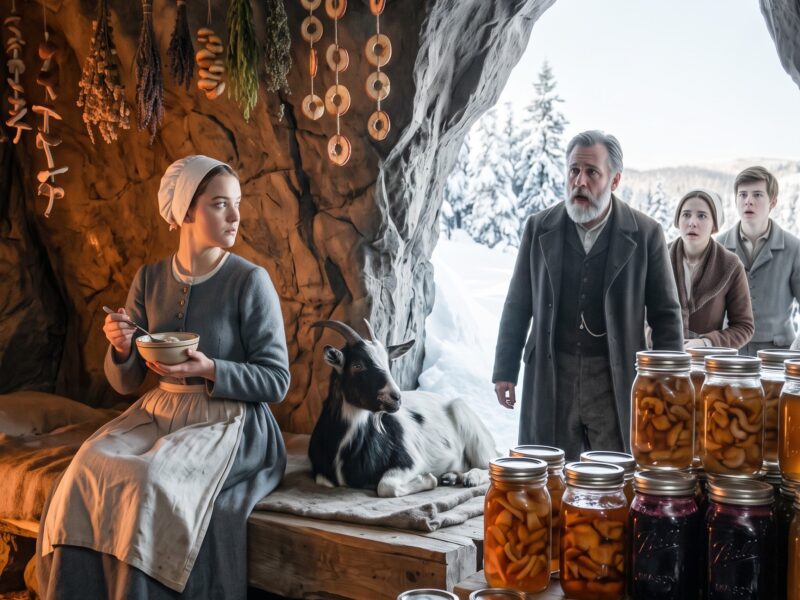
The storm sealed them inside for two full days. They settled into a quiet rhythm. Marin tended the fire. Ransom melted snow. Odessa managed the food with the sharp economy of a survivor. On the second evening, Odessa divided a pot of potato soup into three exact portions without a word.
“You know what this place puts me in mind of?” Odessa said, firelight softening thirty years off her face. “Just plain good sense dug into a hill.”
Marin laughed. It was a short, surprised sound—her first laugh in months—and it startled her. Ransom watched from his corner, the deep lines at his eyes shifting into the equivalent of a grin.
On the third morning, the storm eased just enough to see out. The sight was devastating. The drifts had climbed to the eaves of the buried houses. Barns were folded flat.
“They’re in trouble down there,” Odessa said, her jaw set.
Marin knew it. But no one who needed the cave knew where it was. She had hidden it too well. She turned to Ransom. “The Wades know where I am. Corbin can lead people up from the low end, but he doesn’t know the upper slope. When the wind drops, you take the high traverse. I’ll go down the direct line to the marker and light a fire in the mouth of the cave. That black smoke will be the beacon.”
Ransom studied her, a new respect dawning in his weathered face. “You just told the smoke to stop being your enemy and start being your flag. Your father teach you to think like that, or did you come by it yourself?”
“Both, I think. He started it. The winter finished it.”
Marin built the fire high and green. It smoked thick and black, a dark thumbprint smeared on the low white clouds. Then she plunged downhill, packing a trail with her body.
She met Corbin Wade halfway up. He had his seven-year-old son, Micah, bundled on his back. Corbin looked like a man who had been losing ground for three days, his coat torn, his boots soaked black. When he saw Marin breaking trail toward him, he stopped and stared. Shame, relief, and exhaustion folded together on his face.
“You’ve been living up there this whole time,” Corbin breathed.
“Warm and dry,” Marin said, getting her shoulder under his free arm.
“The chimney gave out two nights back,” Corbin’s breath was ragged. “The little one’s cold, Marin. I didn’t know where else in this world to carry him.”
“He’s about to be the warmest he’s been all winter. Follow my track.”
When they brought Micah into the cave, the boy’s shivering caught, then eased as the deep cold gave way to the radiant stone. Marin peeled his frozen blanket off, wrapped him in one heated by the coals, and fed him warm water sip by sip. Within fifteen minutes, color climbed back into his cheeks. He drank Odessa’s soup and curled against a grain sack, sleeping safely.
Corbin sat beside his son. He glanced at the shelf where Marin kept the dried corn. He recognized it. Marin looked at him. Neither mentioned it. Some things kept better in silence.









