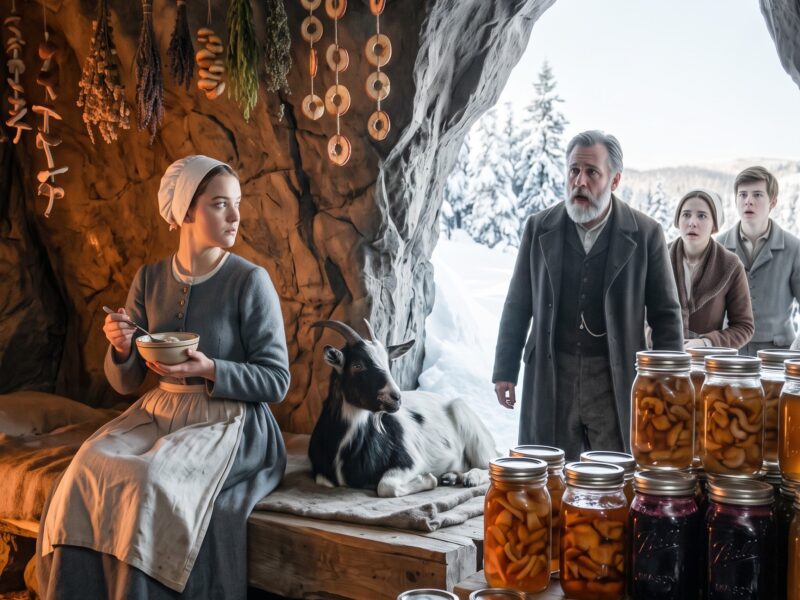
Cast Out at 17, She Stockpiled Food in a Hidden Cave—Then the 8-Day Blizzard Hit
The Ghost of '53
Marin decided to learn the truth of it for herself. She rose in the pitch black before dawn, tucked her folding knife into her coat, and waited outside the cave mouth.
Two hours later, she heard the heavy crunch of a tread on frozen ground. He came up through the trees without hurry and stopped thirty yards short of the entrance. He lowered himself onto a flat rock near the frozen creek bed, set his bundle down, and waited. He expected her to come to him.
She approached with one hand resting on the knife in her pocket.
Ransom Teal was older than she had pictured. Fifty-seven, perhaps, thin and weathered as a fence post left out through a decade of harsh seasons. His gray beard had grown wild. He wore a coat of worn deerskin, patched at both elbows. He did not turn his head as she drew near.
“You’re using the rope to snare rabbits,” his voice came out rough and rusted, like a hinge gone years without oil. “That’s good. Most folks would have hanged themselves with it by now.”
“Why are you helping me?”
Ransom turned. His eyes were calm, but they harbored a sadness worn so deep it had stopped being sorrow and had simply become the shape of the man. It was the look of an old dog left alone one season too many.
“Thirty years back, I was the first person to live in that cave. The tallies on the wall are mine. Every mark is a week I made it through.” He tipped his head toward the hillside. “The winter of ’53, and the one that followed it. Two winters I counted out on that stone. One line at a time.”
“Then why did you leave?”
Ransom looked at her for a long, still moment. “Because when a man lives alone long enough, he starts talking to the stone. And after a while longer, the stone starts answering him back.” He let the silence stretch. “I got no wish to watch that happen to you.”
He taught her one thing before he left that morning. He showed her how to lay the firewood in a fan shape around the pit, so the surrounding stone drank the heat evenly and gave it back slowly through the long hours after the flames died.
“The rock holds warmth the way a good iron skillet holds it,” he told her, his voice methodical. “Build small. A small fire throws less smoke and burns less of what you can’t replace. Smoke’s the enemy, girl. Always. Smoke tells the whole valley where you are. And worse, smoke steals the very air you’re trying to breathe.”
By the tail end of autumn, Sable Creek had grown intensely uneasy. The frost killed the standing crops overnight. The men at the diner discussed the coming snowfall in low, worried voices. Feels wrong this year. Too quiet by half.
Marin heard them from the corner where she sat warming her raw hands at the stove, invisible. She climbed back to the cave and doubled her firewood.
Cade Marsh saw her loading another sack of potatoes. “Stocking food enough for an army up there,” he scoffed, though the certainty had leaked from his voice. “You can’t hide in a hole in a hill till spring, girl.”
Marin looked past him toward the mountains, where the peaks had vanished behind a wall of iron-gray clouds. “Watch me.”
The blockade on her supplies tightened, but the Wades held out. Corbin Wade and his boy left a small sack of dried corn beside the trail marker at the base of the hill every Thursday, without a word, without ever being thanked to his face. Marin meant to remember that debt for the rest of her life.
One evening, Odessa stopped her on the road. The old woman’s eyes were fixed on the pale north, where the clouds were stacking in dark, heavy layers unlike anything Marin had seen.
“Big storm coming,” Odessa whispered. “Big enough I can feel it in the old break in my wrist. And that bone has never once lied to me.”
Marin thought of her ramparts of supplies. Her shelves. Her firewood. Three months of agonizing labor. Then she thought of the two hundred people in the valley, still going about their evenings as though winter would arrive gently. She felt a sickening mixture of relief that she was prepared, and a low, unwelcome guilt for that very relief.
The next morning, she walked into the crowded diner. She stood near the door, frost still dusting her coat, and spoke loud enough to carry to every table.
“A bad storm’s coming. Not an ordinary one. You should double your wood and your food stores now, today, before the roads get worse.”
Ambrose sat near the window, his coffee cooling. He smiled the smile a man gives a stray dog. “The girl who lives in a hole in the ground has come to teach us all how to keep house for the winter. And her without so much as a roof.”
Cade Marsh chimed in. “We’ve got timber houses and cast-iron stoves down here. What have you got up there? A crack in a rock?”
A few men laughed. Not Corbin. Corbin stared down into his coffee, shame moving across his quiet face like a cloud shadow crossing a field. Levvenia Reed offered her measured, reasonable correction. “Marin, dear, the men in this room have lived through more winters than you have been alive to see.”
Marin looked around the room, resting her eyes on every face in turn. She wanted to remember exactly how sure of themselves they looked before the sky proved every one of them wrong. She turned and walked out. No one followed. She climbed the hill through the first thin flurries of the deadliest storm the valley would ever record.









