Cast Out at 17, She Stockpiled Food in a Hidden Cave—Then the 8-Day Blizzard Hit
Equal Portions
That was the shape of the third day. Just the five of them. Corbin, rested and grateful, began working without being asked—restacking wood, clearing snow, carrying water. He worked with the quiet dedication of a man whose labor was the only currency adequate to his gratitude.
That evening, Corbin spoke to Marin. “I was in that diner. The morning you warned the room. I sat there and didn’t say a word to back you. I chose my credit line at Ambrose Thorne’s store over your good name. That’s the ugly truth. I’ve had three days snowed in with it.”
“You left corn at the marker every Thursday,” Marin said softly.
“It doesn’t square the diner, Marin.”
“It fed me the week Ambrose leaned on the farmers. It made a real difference.”
From that hour forward, Corbin Wade stood behind Marin’s every decision without a flicker of hesitation.
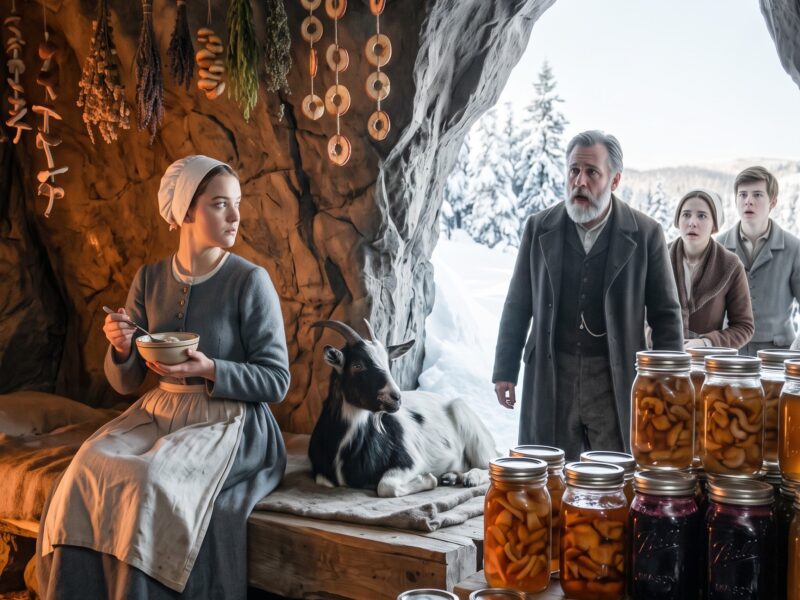
On the fourth morning, following the packed trails and the black smoke, the others began to arrive. A mother and her two daughters. A young married couple, half-frozen. By noon, the chamber held nine. By dusk, eleven.
Cade Marsh came through the passage just before dark. Frost caked his beard like a white mask. He straightened up, stared at the stacked shelves, the dry wood, the warm air holding the storm at bay, and his booming voice went entirely small.
“You built all of this yourself.”
“I did.”
Cade pulled off his frozen mittens. “I laughed at you. I stood in the road and I laughed.” He swallowed hard. “Reckon I was the fool of the two of us.”
He had not come alone. Cade carried his six-year-old sister, Posie. She was cold clear through, her nose red, shivering violently. Marin took her instantly. She and Odessa stripped the wet layers, wrapped her in a fire-warmed blanket, and spooned honeyed warm water into her mouth. Cade sat pressed against the stone, his enormous blacksmith hands resting feather-light on his sister’s hair, watching silently as the women coaxed the chill from the child.
When Posie finally stopped shivering, burrowed sleepily into the blanket, and asked for soup, a sound tore out of Cade Marsh that was half a laugh and half a sob. He pulled her to his chest and breathed.
By the fifth day, nearly a dozen souls sheltered inside the mountain. The chamber smelled of woodsmoke, wet wool, and potato soup. It felt less like a refuge and more like a home. Levvenia Reed arrived on the fourth day, shaking. She accepted her bowl of soup and watched the seventeen-year-old girl govern the cave with quiet, unquestionable competence.
Then Emory Stag arrived with his teenage son, Wesley. Emory, a broad-chested farmer with a voice that demanded space, immediately complained about the cramped quarters and the poor fare. Pacing like a penned bull, he muttered about the indignity of sheltering in a hole.
That night, when Marin handed out the evening rations, Emory heaved himself up. “I’m twice the size of half the folk crammed in here. I need more than a child’s share.”
“Equal portions,” Marin said, not looking up from the ladle. “No exceptions.”
“And who handed you the right to make the rules? It’s a crack in a rock.”
Cade Marsh was on his feet instantly, his bulk forming a wall between Emory and the fire. “She built this place while the rest of us laughed. She stocked every shelf. She is the entire reason you and your boy aren’t shut up cold tonight. You want to argue portions, Emory? Argue them out in the weather.”
Ransom’s low voice echoed from the shadows. “I have watched grown men come to blows over half a loaf of bread. Equal shares is the only law that keeps a shelter from turning on itself. It’s the only rule nobody can twist into a reason to take from the person next to him.”
Emory hunted the room for support. Not one face met his eyes.
Then, his own son spoke. “Pa, stop.” Wesley’s voice was quiet but steady. “She’s right. Sit down.”
Emory looked as if he’d been struck. Father and son stood locked in the firelight. It was the moment a boy sees his father choose selfishness in a crowded room and finds him small. Emory sat down and took his portion without another word.
Later, Wesley crossed to Marin. “I’m sorry about my father.”
“You don’t have to carry someone else’s apology.”
“I know,” Wesley crouched beside her. “But somebody in that room needed to say it.”
On the sixth night, a soft sound at the entrance pulled Marin to the passage. She pushed the snow aside and found Dela Thorne, shaking violently, her hair matted with ice, clutching a small cloth sack to her chest.
Marin dragged her inside. When Dela could finally speak, she opened the sack: flour, dried corn, salt pork.
“I took it from the stockroom,” Dela gasped. “He saw me. He stood in the doorway and told me if I walked out with it, I was no daughter of his.”
“Why did you come?” Marin asked, holding the shivering girl.
“Because he’s got the stockroom locked. Two hundred pounds of flour, salt pork to feed the valley, forty jars of preserves. He’s parceling it out only to families who owe him money or favors. I couldn’t sit in that warm store one more hour and watch my father decide who eats while good people freeze.”
Marin drew Dela close. Two girls thrown out by their families—one for being surplus, one for keeping a conscience.
By the seventh day, the stores were critically low. Marin counted the remaining rations in the dead of night. Fifteen pounds of flour. Twenty softening potatoes. Three pieces of salt pork. The preserves were gone. Silas would say the numbers had proven him right; she had run herself empty feeding a dozen mouths instead of one.
But Silas would never understand the sound of a small girl asking for soup in a clear voice, or the look on Corbin’s face when his boy slept safely. These things did not fit in a column. There were things that mattered more than arithmetic.
“If this storm doesn’t break by the ninth day, we go out,” Ransom told her quietly. “A slim chance in the open beats a sure thing in here with empty shelves. But I felt the edge go soft the last two hours. Listen.”
Marin listened. Beneath the wind, she heard a deep, intermittent groaning from the far mountains, as though the ranges had grown weary of the weight and begun to shift.
Dela sat beside Marin at the entrance. “Are you afraid?”
“I’m afraid that when this is over, they’ll thank me, and then forget,” Marin confessed. “I’ll be the girl who got thrown out again. Right back where I started.”
“That won’t happen,” Dela said with absolute certainty. “They’ll look up at this hill every winter for the rest of their lives and remember what the girl they threw away built while they were laughing.”
When Dela went to sleep, Ransom took her place. He looked out at the dark. “You’ve got one thing wrong. You’re just as afraid of being remembered. Because being remembered means you belong to this place now. It means these people are a part of you. And you haven’t let yourself belong anywhere since the day they carried your father out of that mine.”
Marin could not answer. Ransom had reached past her walls and touched the deepest wound. Belonging was more dangerous than a blizzard, because you could lay in wood against a blizzard, but you couldn’t stock a shelf against the moment someone you loved decided you weren’t enough to keep.
The tears froze on her cheeks. Ransom did not comfort her. He simply sat beside her in the dark—two people who understood loneliness in their bones, waiting for the morning to come.









