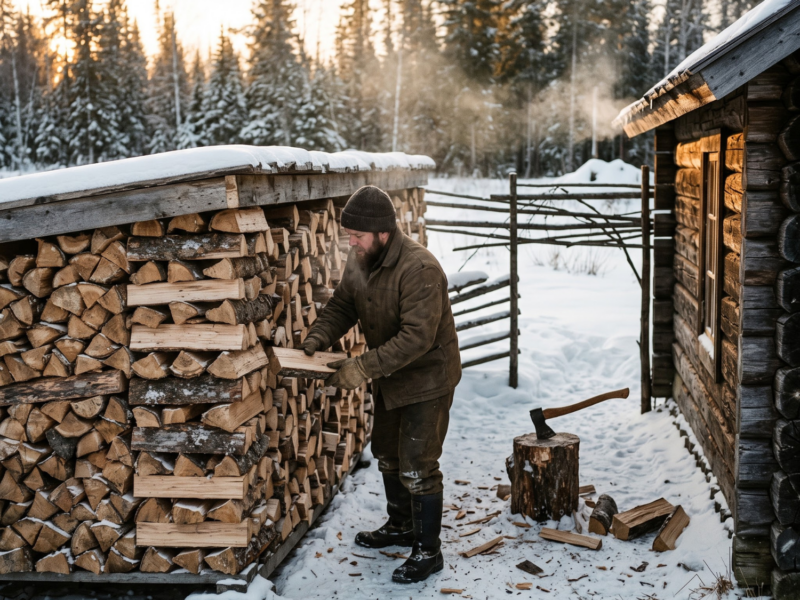
He Stacked His Winter Fuel Into a Wall — The Wood Broke the Wind Before It Ever Reached the Stove
The Anatomy of a Fort
The dry fuel borrowed from Matti did not magically solve the entirety of Walter’s miserable winter. And Matti’s wind wall could never have solved it either, not without the foundation of dry stock, a fundamentally sound roof, good clay chinking between the logs, and constant, vigilant maintenance.
Matti’s system was never intended to be a magical substitute for a well-built, well-maintained cabin. It was simply a strategic way to make an exposed cabin work far less hard to keep its inhabitants alive.
By the end of that brutal January cold spell, another distinct limitation of the system became visibly apparent.
The west rack, which took the brunt of the weather, had thinned out significantly. As Matti consumed the fuel, the wall naturally became more porous. The wind began to find its way through the gaps more easily.
To combat this, Matti had to spend a grueling afternoon physically shifting heavy pieces of wood from the less-exposed north rack to reinforce and preserve the most vulnerable section of the west face. He learned a hard lesson that day: he needed to harvest and store significantly more reserve fuel than a normal homesteader might expect, specifically because fuel being actively used as a structural windbreak could not be consumed in any random, convenient order. It had to be dismantled strategically.
Inside the warm cabin, Aino opened her blue-ruled notebook. Next to her meticulous calculations for “Winter Fuel,” she drew a bold line and added a second, new category: Wind Face.
The phrase was not scientific, nor was it elegant, but it instantly became a core part of how the Leto family planned their survival for the years to come.
By the time the March thaws arrived, turning the frozen ruts of the road into rivers of mud, the racks no longer looked like a majestic fort. They looked exactly like what they had always been: a practical fuel supply that was being steadily, relentlessly used up to keep a family alive.
When the genuinely warmer weather of spring finally broke over the cutover, Matti did not pat himself on the back and leave the remaining structure in place. He was far too meticulous for that.
He spent a week pulling the remaining sections completely apart. He carefully inspected the cabin logs for any signs of trapped moisture or insect rot. He swept and cleared all the accumulated bark, splinters, and debris from the ground in the alleyway. He repaired one of the rack foundations where the winter settling of the earth had pushed a spruce post slightly out of vertical alignment.
The method, he realized, demanded unyielding attention.
A neglected, lazily built stack could easily lean over and crush a wall. A crowded, unventilated gap could hold spring moisture and breed rot that would spread to the cabin. A poorly placed barrier, like his first ‘L’ corner, could dump tons of snow exactly where a person desperately did not want it.
Dry, combustible fuel placed near a human dwelling always had to be treated with the utmost respect and caution. Those strict limits, those inherent dangers, were a fundamental part of the idea itself; they were not evidence against it.
Walter Keane understood that implicitly by the time the following autumn arrived.
He did not stubbornly copy Matti’s exact structural shape. Walter’s cabin faced a slightly different geographical direction and sat much lower on the rolling land. So, instead of building two long, intersecting racks, Walter built one massive, heavily roofed timber crib straight across the single side of his house that took the strongest winter wind. He made sure to leave more than enough space to inspect the wall and swing a snow shovel between the crib and his home.
Another family, living two miles farther down the logging road, heard the stories and built a much shorter, squatter version exclusively beside their kitchen wall to protect their pantry from freezing.
The physical forms of the walls changed because the physical sites changed. The wind moved differently across every acre of the cutover.
That adaptability mattered deeply to Matti. He had never believed for a second that the ultimate answer was a particular shape of wood, or a patented design. The true answer, the real breakthrough, was a shift in philosophy.
The answer was to stop treating “The Cold” as one single, monolithic enemy that had to be fought with just a hotter fire.
The Cold was a complex alliance of enemies. There was the absolute outside temperature, yes. But there was also the velocity of the wind. There was the moisture in the air. There was the internal condition and cellular structure of the fuel. There was the compass direction the cabin faced. There was the unpredictable way snow moved and dropped only after it collided with an obstacle.
Change just one single part of that intricate environmental equation, and the rest of the entire system fundamentally changed with it.
That holistic way of thinking was exactly what his laughing neighbors had missed when they first laid eyes on his strange wall the previous autumn. They had looked at the structure and seen only stored firewood, foolishly left out in the cold.
Matti had looked at the exact same timber and seen a versatile material that possessed a crucial, life-saving job to perform long before combustion ever occurred.
The exact same split of seasoned white maple could serve as thermal mass, as physical shelter, as an emergency reserve, and finally, ultimately, as heat. Its true value did not lie merely in its existence; its value depended entirely on exactly where it was placed, and precisely when it was utilized.
Epilogue: The Weight of Attention
There was no inherent magic in the wind wall of St. Louis County. There was no miraculous frontier technology, no secret Finnish engineering passed down through generations.
There was only attention.
It was the quiet, enduring attention to the invisible flow of the wind at a noisy sawmill yard. It was the desperate attention to the creeping white frost on the interior of a cabin wall. It was the tactile attention to the vast difference in weight and sound between dry and wet fuel. It was the humble attention to the suffocating snowdrift that instantly proved his first, proud corner design was fatally flawed.
And, above all else, it was the profound attention to the fact that a solution could completely fail in one specific place, yet still contain the vital seed of a much better, more elegant solution within it.
Near the end of that long, transformative winter, another fierce northwest gale crossed the open cutover long after the sun had gone down.
Inside the cabin, the fire was burning low. Matti Leto stood up from the table, pulled on his coat, and opened the heavy front door. He stepped out into the dark, sheltered service alley.
High above him, and just beyond the outer face of the racks, the wind roared across the darkness like a freight train, tearing at the sky. But inside the narrow gap, standing between his home and his wall, there was only a low, gentle rush of air. It felt almost peaceful.
Matti reached his bare hand into the thinning west rack. He felt the cold, rough bark of a dry split of maple. He pulled it out, testing its light, perfect weight in his palm. He turned, carried it inside, and firmly closed the door against the night.
He walked to the stove, opened the iron door, and fed the fire with a piece of the wall that had already spent the entire winter keeping his family safe from the wind.









