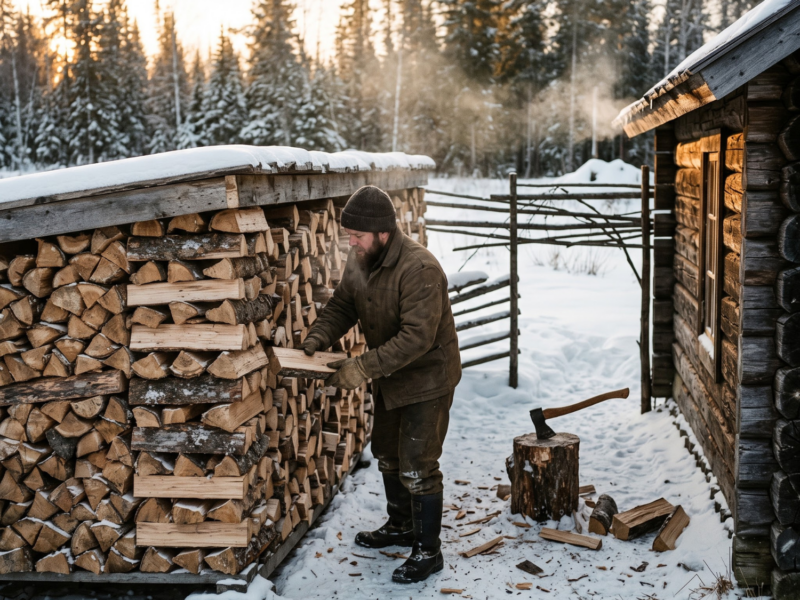
He Stacked His Winter Fuel Into a Wall — The Wood Broke the Wind Before It Ever Reached the Stove
The Memory of the Sawmill
Matti had spent the majority of his American working life in the fuel yard of a massive commercial sawmill, handling endless cords of slabwood and cordwood destined for the boiler rooms. That brutal, repetitive work had taught him two fundamental truths that rarely appeared on the deed of a homestead.
The first truth was that wood was not simply wood.
A man might pick up a freshly cut split of maple or birch and marvel at its heavy, solid feel. But Matti knew that much of that weight was water. If you threw green, fresh-cut fuel into a hot firebox, the heat had a preliminary job to do before it could warm a room: it had to boil and drive away the moisture trapped in the wood’s cellular structure. Wet wood hissed like an angry snake. It smoked thick and black. It burned stubbornly, fighting the flame rather than feeding it.
Properly seasoned wood, however, behaved like a willing partner. It caught readily, crackling with dry enthusiasm, giving up its stored solar heat instantly and with far less waste.
The second truth Matti had learned at the mill had nothing to do with fire at all.
At the lumber yard, towering, chaotic stacks of discarded slabwood were piled everywhere. On the bitterest days of January, the mill workers would cross the yard, their bodies bent double, leaning into the punishing gale just to stay on their feet. But the moment a man stepped behind the lee side of one of those massive slabwood stacks, he would suddenly stand upright. He could breathe. He could open his eyes.
The ambient temperature of the air had not changed a single degree. But the wind had been broken. The aggressive theft of body heat stopped.
Matti had noticed this physical phenomenon long before he owned a single acre of land. He did not think of it in terms of thermodynamics, aerodynamics, or engineering. He was not a man of academic science. It was simply a physical fact that his muscles and skin remembered.
His first brutal winter on the cutover gave that memory a desperate purpose.
Late in February, exhausted from fighting frozen logs, Matti began watching the snow. He noticed the patterns it made around the property. Behind the small outhouse, there was always a calmer patch where the snow lay flat and undisturbed.
Near the abandoned sawmill spur line, a derelict wood wagon sat rotting. On the lee side of that wagon, the powder simply settled gently to the earth, entirely ignoring the chaotic race of snow streaking horizontally across the open ground. A long, forgotten pile of discarded slabwood cast a distinct, narrow band of utter stillness, even as the loose snow screamed over its top like water over a smooth stone.
One evening, as the dusk turned the landscape a deep, bruising purple, Matti walked out to that pile of slabwood. He stepped into the narrow band of stillness. He stood there for almost a full minute, listening to the roar of the wind above his head, feeling the sudden, strange calm against his face.
Slowly, he turned and looked back up the slight rise, toward his shivering, vulnerable cabin.









