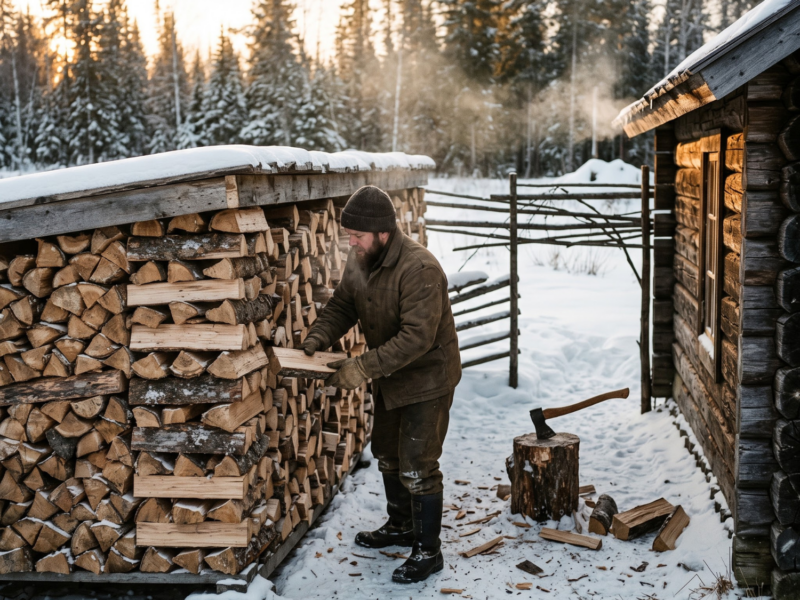
He Stacked His Winter Fuel Into a Wall — The Wood Broke the Wind Before It Ever Reached the Stove
The Epiphany of Walter Keane
Walter carried the three dry splits of maple back to his homestead, clutching them to his chest. Matti followed closely behind, carrying a massive armload of his own dry stock to help his neighbor through the night.
When they stepped into Walter’s cabin, the temperature difference was stark. The air was bitterly cold, and the room smelled overwhelmingly of wet, smoldering bark and thick smoke.
The difference between the two fuels became glaringly obvious long before the difference between the structural designs of the two houses did.
For the past three days, Walter had been desperately feeding his expensive stove with pieces of wood violently hacked from the frozen, icy center of his outdoor pile. He could eventually coax them to burn, but only after they sat precariously near the hearth for hours, slowly thawing and drying at the surface in a puddle of dirty meltwater.
This agonizing process filled the entire cabin with the damp, acrid smell of boiling sap and forced Walter to meticulously plan every single armload hours in advance, robbing him of sleep and peace of mind.
Matti’s dry splits behaved entirely differently. The moment Walter tossed them onto the struggling coal bed, they caught fire instantly. They burned fiercely and steadily, throwing immediate heat. Within ten minutes, Walter was able to finally close the heavy iron door of the stove, rather than sitting on his knees nursing the pathetic fire with constant, desperate attention.
Of course, the dry wood did not magically turn Walter’s completely exposed cabin into Matti’s sheltered one. The west wall of Walter’s home was still freezing to the touch. The brutal draft near the floorboards was still slicing through the room.
But for the very first time that night, Walter finally had enough dependable, steady heat emanating from his stove to allow him to view his two problems separately.
His fuel had been completely failing him. And, simultaneously, the geographical siting of his cabin on the open land was forcing his stove to work infinitely harder than it needed to.
Walter sat on a wooden stool beside the roaring iron stove for a very long moment. He stared quietly toward his own west wall, listening to the wind hammer against the exterior logs.
“I thought you built one foolish thing,” Walter said, his voice quiet, devoid of its usual bluster.
Matti stood near the door, rubbing his calloused hands together to warm them before his walk home. “I built two ordinary things, Walter. I just put them in one place.”
“Dry wood,” Walter muttered, nodding slowly. “And a windbreak.”
Matti nodded once.
Walter looked down at the final, unburned split of Matti’s maple resting on the hearth. The grain was tight, clean, and perfectly dry. That was the exact moment the running joke of “Leto’s Fort” officially ended in the township.
The very next morning, long before noon, Walter Keane came back to the Leto homestead in the bright, freezing daylight. He did not come to borrow more fuel. He came with a measuring string and a notebook. He came to measure the angles, the distance, and the direction of Matti’s racks with his own eyes.
Matti, harboring no resentment, walked him through the entire system. He showed Walter the offset corner that allowed the snow to escape, pointing out the faded drift line from the catastrophic first storm. He proudly pointed out the bare, dry inspection space beside the cabin logs.
He also showed Walter where the west rack had begun to thin out dangerously from winter consumption.
“If you are going to copy this next summer, Walter,” Matti warned him, leaning against the timber, “do not just copy the shape I built. Every piece of land is different. Watch your wind first. See where it hits your house. Build for your wind, not mine.”
Walter didn’t bother to write the sentence down in his notebook. He knew he would remember it for the rest of his life.









