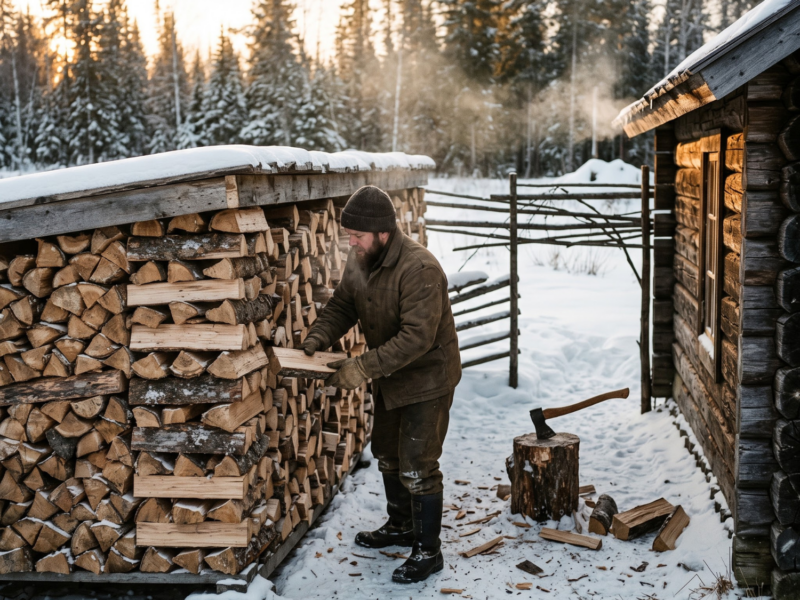
He Stacked His Winter Fuel Into a Wall — The Wood Broke the Wind Before It Ever Reached the Stove
The Corner Trap
The first serious storm of the season arrived in the second week of December.
It did not snow gently; the sky simply opened up and hurled ice horizontally across the cutover. The wind howled like a wounded animal, shaking the bare branches of the remaining trees.
At first, sitting inside the cabin, Matti thought he had been proven unequivocally right.
The wind struck the west fuel rack with a deep, resonating, rushing sound—like a river hitting a dam. The snow hit the bark caps and lifted up and over the structure. Inside the narrow service alley between the rack and the cabin, the air was noticeably, miraculously calmer.
Inside the cabin, Aino held her strip of cotton cloth near the usually drafty west corner. The cloth barely moved. It hung almost perfectly still. Matti allowed himself a small, rare smile.
But before midnight, as the storm intensified into a blizzard, a new, unforeseen problem manifested.
The wind, hitting the wall, had to go somewhere. The snow carried by the wind began piling up aggressively at the exact corner where the north and west racks met to form the tight ‘L’ shape. The aerodynamics of the tight corner acted as a trap.
By morning, when Matti pushed his front door open, he was greeted by a massive, concrete-hard drift of snow that had formed inside the angle. It pressed violently into the service alley, completely choking off the walkway, and had climbed halfway up the lower logs of the cabin itself.
The wall had successfully broken the wind, yes. But in doing so, it had inadvertently created a dead zone where the moving air dropped its heavy payload of snow directly against the house.
Walter Keane happened to be passing by on his sleigh that afternoon, wrapped in furs. He pulled back on the reins and laughed as he saw Matti chest-deep in the snow, furiously digging out the alleyway with a wooden shovel.
“How’s your weather fence holding up now, Matti?” Walter called out cheerfully.
Matti paused, leaning heavily on the handle of his shovel. He looked at the massive drift, then at his neighbor. He did not get angry.
“Wrong at the corner,” Matti said simply.
That blunt, honest answer disappointed Walter far more than a heated argument would have. He had wanted a fight; Matti gave him an engineering assessment. Walter clicked his tongue at his horses and drove on.
Matti did not waste a single moment defending the flawed design to himself. He changed it.
The very next morning, under a sky the color of lead, Matti began dismantling the last ten feet of the north rack. It was agonizing, freezing work. He shifted the entire end of the rack farther east, breaking the tight ‘L’ shape and leaving a deliberate, offset opening—a gap between the two walls.
The new gap would allow some of the pressurized air and blowing snow to escape cleanly past the outer corner of the cabin, rather than curling back and suffocating the alleyway.
It cost him the majority of the daylight hours. Aino, bundled in her thickest shawl, helped carry the heavy split pieces while Oscar, his hands wrapped in mittens, cleared the snow and ice off the stone base so his father could rebuild. By dark, “Leto’s Fort” looked decidedly less complete, less fortified.
But it worked better.
Matti did not blindly trust the improvement just because the alley felt subjectively calmer. He was a man of observation. He spent the entirety of the next two winter storms checking exactly what had changed and what had not.
On brutally windy evenings, when most men were huddled as close to their stoves as they could get, Matti would light a kerosene lantern and walk the perimeter of the racks in the dark. He watched intently how the loose snow moved along the frozen ground.
At the west face, the powder struck the stacked fuel, compacted slightly, and lifted over the roof. At the newly created open offset near the corner, a stream of air and snow rushed through the gap and continued harmlessly past the side of the house, dissipating into the yard instead of curling aggressively into the service alley.
Along the physical logs of the cabin wall, the snow no longer ran sideways in a continuous, abrasive sheet.
Inside the cabin, Aino proved to be the better, more sensitive observer.
She consciously maintained the exact same routine with the stove that she had used during the miserable previous winter. She kept meticulous notes in her mind.
She noticed which mornings required her to immediately fetch a massive armload of wood just to bring the room to life, and which mornings the embers held enough ambient heat to simply require a few kindling sticks.
She noticed that the floor near the west wall still became cold to the touch—they were, after all, living in a log cabin in Minnesota—but the sharp, knife-like draft that used to race across the floorboards and bite at their ankles had weakened considerably.
She noticed, with a deep sigh of relief, that Elsie’s bed could safely remain on the north side of the room where it belonged, instead of having to be dragged to the center of the floor toward the stove whenever the wind rose in the night.
None of these observations were exact laboratory measurements. But together, they formed a undeniable body of evidence that told the family the wall was fundamentally changing the cabin’s behavior.
One particularly vicious evening in late December, Matti decided on a final test. He stood by the front door, grabbed the iron latch, and threw the door wide open to the storm for several seconds. The icy air rushed in, sweeping across the room. Then, he slammed the door shut, threw the latch, and watched the room recover.
During the previous winter, a hard wind opening the door seemed to invite a cold that kept pushing inward, lingering for an hour long after the door was closed, as if the walls themselves had been compromised.
Now, the iron stove still had to work to replace the lost warmth of the air exchange, but the room settled and neutralized much sooner. The outer wall of the cabin was no longer being aggressively scrubbed of its heat by the full, unabated force of the gale.
That was the result Matti trusted above all else. Not absolute comfort by itself—that was an illusion in this country—but recovery. A thermal system that recovered faster required significantly less frantic, desperate work from the people living inside it.
The subsequent storm still left small drifts, but they formed much farther away from the cabin logs and were infinitely easier to clear with a few tosses of a shovel. The service alley remained passable and usable. Matti rigorously kept the ground beneath the racks clear of debris and constantly checked the physical distance between his fuel and his walls.
The system had officially acquired its first, unbreakable rule: The wall could slow the wind, but it could absolutely not be treated as a solid, unmoving box. It had to breathe.









