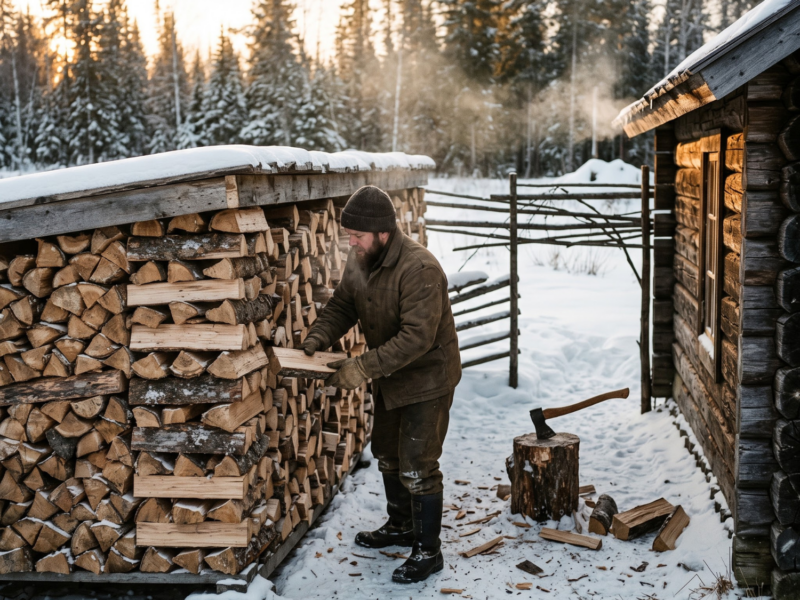
He Stacked His Winter Fuel Into a Wall — The Wood Broke the Wind Before It Ever Reached the Stove
The Quiet Difference
True, punishing winter settled over the cutover just after Christmas.
For long, agonizing stretches of January, the northwest wind ran across the stripped land without a single tree to obstruct its path. Snow moved in thin, fast-moving sheets across ground frozen as hard as iron. Touching a bare iron door latch burned a man’s fingers. Metal tools left inadvertently outside became painful to handle, cold enough to bite right through heavy leather work gloves.
This was the exact, unforgiving weather that Matti Leto had spent his summer preparing for.
The effect inside the small cabin was not dramatic in the theatrical way people often expect inventions to be dramatic. The room did not magically transform into a balmy summer afternoon. No one walked around in their shirtsleeves, wiping sweat from their brows, pretending the brutal Minnesota cold had ceased to exist.
The difference was much quieter. It was the difference between survival and living.
The stove recovered the room’s ambient temperature much faster after the door was opened for chores. The north and west walls no longer felt violently cold to the touch; they were simply cool. Aino finally stopped stuffing an old, ragged wool scarf into the exact same crack in the corner every single night. The strip of test cloth hung perfectly still during howling winds that would have kept it snapping and fluttering endlessly the winter before.
And, crucially, the fuel itself stayed bone dry.
Matti had stacked it with such care that the ambient air could pass freely through the rows, continuing the seasoning process even in the dead of winter. The pitched roof caps kept the direct, heavy snow off the top layers. The raised stone sleepers elevated the lowest courses of wood out of the reach of freezing ground moisture and occasional meltwater.
Because the piles were not pressed flush against the cabin, the sheltered service alley could be routinely inspected, cleared of snow, and utilized.
Most importantly, Matti did not consume his wall carelessly. He treated it with the respect of a structural engineer dismantling a bridge. During the absolute coldest weeks, when the stove demanded constant feeding, he pulled his fuel exclusively from the inner, cabin-facing side of the racks, and from the naturally protected ends of the stacks.
He worked tirelessly to preserve the continuous, outer windward face of the wall for as long as he possibly could. The wall was slowly eating itself, yes, but in a highly controlled, strategic manner. Every single log he carried inside to the stove had already spent weeks, months even, actively helping to protect the cabin before it was ever touched by a flame.
The physics at play were simple enough that Matti could explain them to Oscar without knowing a single academic scientific term.
Moving air carries heat away from an exposed surface significantly faster than still air. A strong, relentless wind also creates severe pressure differences around the rough exterior of a log cabin, creating vacuums that make tiny, microscopic leaks in the chinking much more devastating. By slowing the air velocity around the most exposed, vulnerable walls, the cabin simply loses its internal heat less aggressively.
Then, there was the matter of the fuel itself. Wood containing a high percentage of moisture spends a massive portion of the fire’s potential energy just heating, boiling, and evaporating that trapped water up the chimney. Seasoned, dry fuel does not eliminate every inefficiency of a cast-iron stove, but it gives the stove a fighting chance to actually do the job the family needs it to do: radiate heat into the room.
Matti had successfully attacked both sides of the frontier equation. He had drastically lowered the demand for heat by reducing the cabin’s wind exposure, and he had simultaneously protected his supply of heat by keeping his fuel perfectly ventilated and dry.
The grand breakthrough was not in the sheer volume of wood he had harvested. The breakthrough was entirely in the arrangement.









