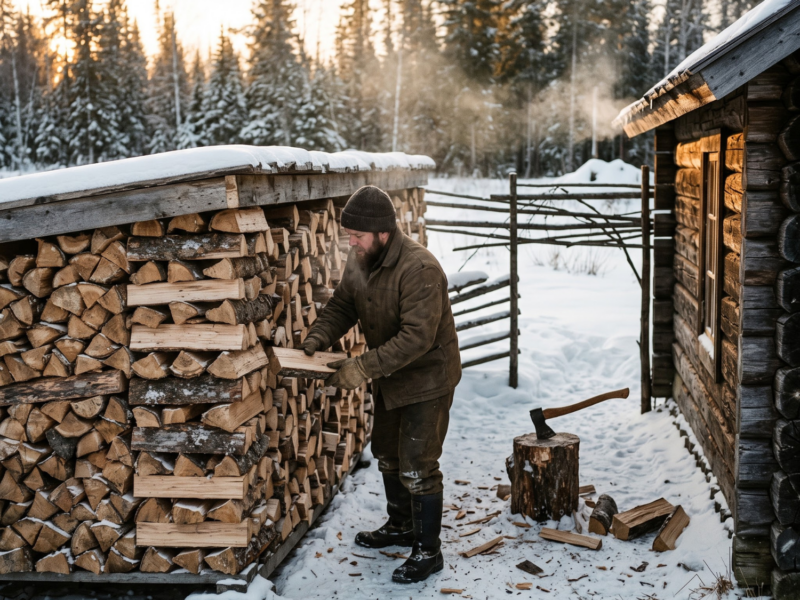
He Stacked His Winter Fuel Into a Wall — The Wood Broke the Wind Before It Ever Reached the Stove
The Architecture of Breath
The following summer, the cutover came alive with desperate, frantic activity. Settlers were rushing to cut wild hay, clear stumps, and repair broken fences before the cold could return.
Matti Leto began hauling stone.
He took his wagon down to the creek bed and loaded it with heavy, flat river rocks and glacial till. He hauled them up the rise to the cabin.
He did not pile them against the cabin walls. That was a deliberate, calculated choice. Instead, he measured out a line several feet away from the north wall, and laid down a row of short, sturdy stone sleepers. He did the same, creating a second line several feet out from the west wall.
On top of these stone foundations, Matti began to build two long, crib-like racks from rough-cut spruce poles.
Aino stood on the porch, drying her hands on her apron, watching him. “What are you building, Matti?” she asked, her brow furrowed. “A fence?”
“A rack,” Matti replied quietly, pausing to wipe the sweat from his forehead. “For the wood.”
He designed each rack to be open enough for the summer air to move freely through the stacked wood, but stout enough to hold a massive, deep, cross-stacked weight of split fuel. At the top, he fashioned small, pitched caps made of scrap boards and thick bark, angled perfectly to shed the majority of the autumn rain and winter snow away from the stacks.
The north rack and the west rack stretched toward each other, almost meeting at the northwest corner, creating a broad, protective ‘L’ shape that shielded the two sides of the cabin that took the heaviest beating from the wind.
Between these new fuel walls and the cabin itself, Matti left a deliberate “service alley.” It was wide enough for a man to walk through, wide enough to swing a shovel, wide enough to inspect the chinking of the cabin logs. Most importantly, it kept the fuel physically separated from the dwelling.
That empty space mattered immensely to Matti. He had seen what dampness could do to timber. He did not want damp, rotting wood touching the walls of his home. He did not want hidden rot, and he did not want a massive pile of heavy fuel pressing structurally against his cabin walls. He wanted distance. He wanted flowing air. And he wanted a break in the wind.
The stacking itself was a slow, agonizingly meticulous process. Matti was not trying to create a solid, impenetrable timber wall. A solid wall would have been easier to explain to his confused neighbors, but it would have made for terrible wood storage. Matti needed the air to reach the fuel from multiple directions to season it properly.
He built the ends of each rack with alternating cross-stacks—one layer north-to-south, the next east-to-west—creating structural pillars. Then, he filled the middle sections in long, careful courses, intentionally leaving irregular, jagged breathing spaces between the individual splits of maple and birch.
The resulting pattern was highly stable, yet profoundly porous. It was a wall that breathed. The morning sun from the south and east could penetrate the open ends. The dry summer wind could pass completely through the pile, wicking away moisture. Yet, rain falling from above had a difficult time entering due to the bark caps.
This new system forced Matti to become ruthless about his fuel selection. He refused to bury green, heavy wood in the middle of the wall simply because it fit the gap. Fresh pieces were banished to a separate, temporary seasoning stack farther out in the yard. The wind wall only received wood that had already had time to dry.
He placed the heaviest, thickest splits low to the ground for a low center of gravity. Crooked, knotty pieces were strategically used where they could lock a course together rather than pry it apart. He took a hatchet and knocked away loose, hanging bark that might trap moisture and invite rot or insects.
Oscar, eager to help his father, learned very quickly that Matti’s idea of “stacking” was not the same as simply throwing wood into a pile.
One hot afternoon in August, the boy eagerly filled a gap in the rack with short pieces, shoving them in until the face of the pile looked perfectly flat and neat. He stepped back, proud of his work.
Matti walked over. He looked at the neat stack, then gently but firmly began pulling the pieces back out, dropping them to the grass.
“Why?” Oscar asked, his shoulders dropping in disappointment.
Matti crouched down to his son’s eye level and pointed directly through the center of the rack. “Look closely, Oscar. Can you see the light from the other side?”
Oscar squinted through the jagged gaps in the wood. He nodded slowly.
“If you can see the light,” Matti said softly, placing a hand on the boy’s shoulder, “then the air can find a way through, too. Wood needs air to stay dry. Dry wood gives us heat. Wet wood gives us smoke.”
The project consumed Matti. It devoured evenings that, logically, should have gone into repairing the perimeter fence to keep the deer out. It used up heavy iron nails that Matti had been hoarding in a tin can. The roof caps took good, straight boards he might have traded at the general store for sugar or coffee.
Even before the winter arrived to prove if the idea had any merit, the wall was demanding a heavy payment in labor, materials, and difficult choices.
That was why Aino kept asking for the numbers. Sitting at the table under the glow of the kerosene lamp, she would open her little ruled notebook, her pencil hovering over the paper. She was not trying to stop him. She loved him, and she trusted his hands. But she was the guardian of the family’s survival. She needed to make sure that this grand idea still belonged to the practical needs of the household, rather than to a man’s stubborn pride.
“How much of our time is in this wall, Matti?” she asked one evening, tracing a line on the paper. “How many cords?”
Matti didn’t answer right away. He walked outside, took a piece of charcoal from the fire pit, and stood before the towering west rack. He reached up and marked a thick black line at the very top of the corner post, indicating the height of the completed stack.
Then, he measured down roughly one-third of the way, and made a second, heavy mark on the timber.
He walked back inside and sat across from her. “We stop calling it a wind wall when it hits the second mark,” he told her.
That lower mark, he explained, was his reserve threshold. If the brutality of the winter consumption ate the stack down to that lower mark before the worst of the February weather had passed, the family would abandon the experiment. They would stop trying to preserve the shape of the wall, and they would simply use the remaining wood as fuel to survive.
Shelter mattered. But heat mattered more.









