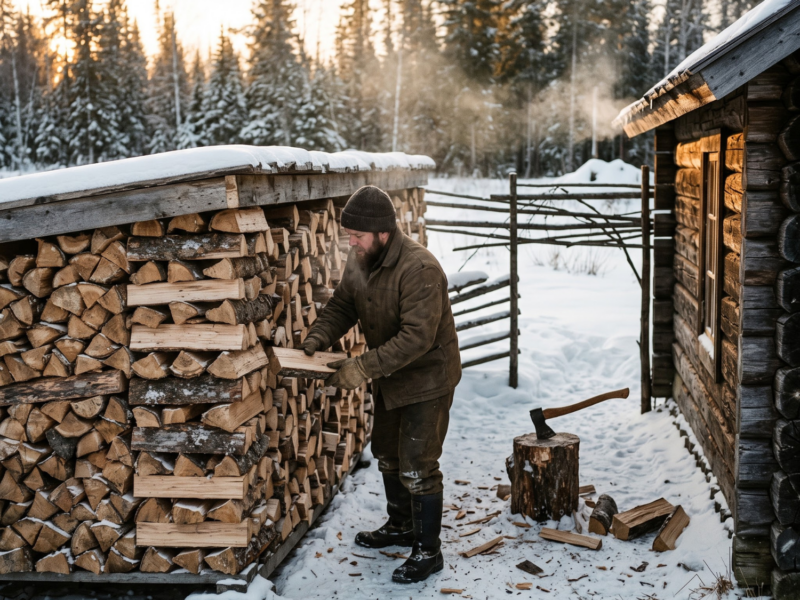
He Stacked His Winter Fuel Into a Wall — The Wood Broke the Wind Before It Ever Reached the Stove
Leto’s Fort
By late September, the birch leaves had turned a violent, beautiful yellow, and the structure surrounding Matti’s cabin looked utterly ridiculous to almost everyone in the township.
It stood several feet away from the cabin walls, taller than a man on horseback, thick and imposing. To a passerby on the dirt road, it looked as if a paranoid immigrant had started building a wooden fortress to defend against an invisible army.
Walter Keane, an American-born settler who farmed a small, struggling clearing half a mile to the south, stopped his wagon one afternoon. He chewed on the end of a unlit pipe, staring openly at the massive, stacked walls.
“You’re building a fence for the weather, Matti?” Walter called out, a smirk playing on his lips.
Matti didn’t stop working. He lifted a heavy split of seasoned maple, rotating it twice in his hands until he found the perfect angle, and wedged it into a cross-stack.
“For wood,” Matti answered briefly.
Walter laughed loudly, the sound echoing across the stump-filled fields. “Wood goes in the stove, Matti! That’s where it stops the weather. You’re leaving it out here to freeze!”
Matti stopped. He rested his hands on his hips and looked out over the vast, open cutover beyond Walter’s wagon. The wind was already picking up, carrying the sharp, metallic bite of impending frost.
“Before it goes in the stove,” Matti said, his voice carrying clearly on the wind, “it can still stand somewhere useful.”
That single sentence traveled faster through the township than any lengthy, detailed explanation Matti could have given. Within a week, the men gathered around the potbelly stove at the general store were calling the project “Leto’s Fort.” They laughed at the stubborn Finn who thought he could build a castle out of kindling.
Some of the criticism spoken behind his back was entirely fair. Building a massive wall of dry fuel in close proximity to a wooden house carried obvious, terrifying risks. If Matti grew lazy and let tall, dry weeds grow around the base of the racks; if a stray spark from the chimney caught the roof caps; if the stacks were built poorly and leaned over into the alleyway; or if he stacked the wood too tightly and trapped rot… he could very well be trading the problem of cold for the devastating catastrophe of a house fire.
The racks also represented a staggering concentration of sheer physical labor. Every single split of wood in that wall had been felled, bucked, split, hauled, seasoned, and meticulously stacked by hand.
As the days grew shorter and darker, Aino asked the question that mattered most, the one that kept her awake at night.
“How much wood do we actually have tied up in this, Matti?” she asked, her hands wrapped tightly around a mug of hot tea.
Matti did not give her a heroic, confident answer. He looked out the window at the dark silhouette of the wall against the starlit sky. “Too much,” he admitted softly, “if it does nothing.”
The fall of 1904 proved to be exceptionally lean. The lumber mill down in the valley cut its operating shifts due to a drop in timber prices. Matti’s cash work disappeared for days at a time. The pantry shelves began to look sparse.
In early November, a buyer for a large boarding house in Duluth came through the settlement in a heavy wagon. He was looking for dry, seasoned fuel to feed the massive boilers of the boarding house through the winter. He took one look at Matti’s beautifully seasoned, meticulously stacked wind wall and offered a sum of cash that made Matti’s breath catch in his throat.
The money offered would have covered a massive sack of flour, gallons of lamp oil, pounds of coffee, and easily paid the balance on a pair of thick, insulated winter boots for Oscar, whose current boots were patched with scrap leather.
Aino stood on the porch, looking at the man, then at the cash in his hand, and finally at Matti. She did not say a word. The choice was his.
Matti walked to the back of the property. He sold the buyer the loose, unstacked reserve of wood sitting behind the tool shed. But he absolutely refused to touch the windward face of the wall.
That single decision solidified the stakes. The experiment was no longer a theoretical project; it was terrifyingly real. If Matti was wrong about the physics of the wind, he was not merely going to look foolish to his neighbors. He was going to enter the deadliest months of the year with his family’s survival money locked inside a wooden structure that might completely fail them.









