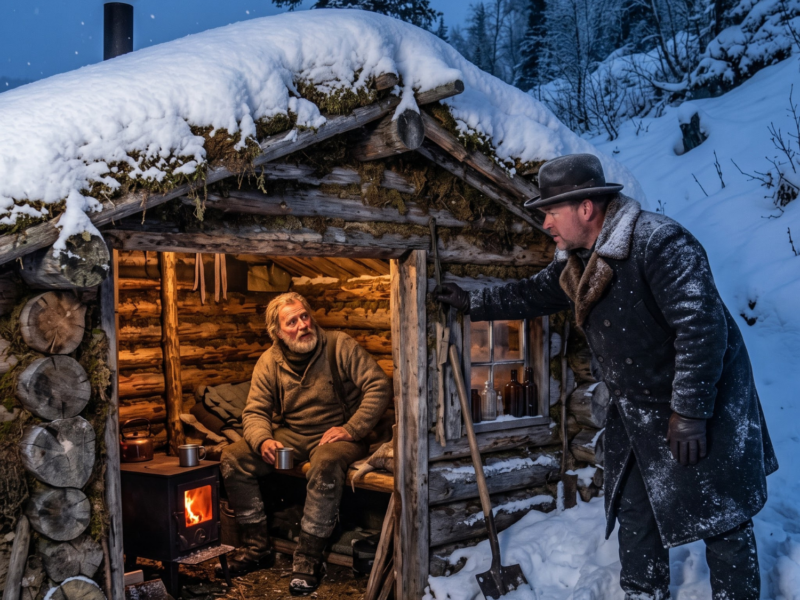
How an Old Klondike Miner Slept in His Undershirt at Sixty Below in a Cabin Called a Hole
The Groundhog and the Mansion
Niels Baka was born on a rocky farm perched above a deep fjord in northern Norway, a place where the sun vanished for weeks in December and the cold rolled in off the black sea like a physical blow. He had grown up in a low, turf-roofed house, its walls half-buried in the sheltering embrace of the hillside.
His grandmother used to sit by the hearth and tell him, “A house is a coat you wear together, Niels. The smaller the coat, the warmer the family.”
As a boy, Niels had laughed at the old proverb. He stopped laughing after his first Yukon winter.
At nineteen, Niels went to sea. At twenty-five, he jumped ship in the foggy harbor of San Francisco. Drawn by the magnetic pull of rumors, he followed the gold north, first into the Cassiar mountains of British Columbia, then over the arduous passes into the Yukon basin. In 1886, gold was found on the Forty-Mile River, and Niels was one of the first white men to pan its gravel.
His first winter in the high latitudes, he lived in a canvas wall-tent. He very nearly lost both of his feet to frostbite, saved only by a passing Han elder who showed him how to wrap his blackened toes in animal fat and dry moss.
His second winter, Niels did not pitch a tent. He dug halfway into a hillside, layering the roof with earth and moss, building exactly the way his grandfather had built in the fjords. He never built any other way again. In eleven savage Yukon winters, he had not lost a single finger.
In August of 1897, a month before Whitfield’s party arrived, Niels staked his claim on El Dorado. He did not immediately pan for gold. He prepared to survive.
He selected a dry patch of hillside, elevated fifty feet above the valley floor, completely shielded from the prevailing northern winds. He carefully peeled the thick, insulating tundra moss off the ground in large mats, setting them aside like precious fabrics.
Beneath the moss, the ground was permafrost—frozen as hard as granite, even in the heat of August. A steel shovel sparked against it uselessly. So, Niels used the ancient miners’ trick. Every evening, he built a roaring fire over the footprint of his cabin. Every morning, he shoveled out the fourteen inches of earth that had thawed during the night. It took him nine nights and a mountain of dead wood to carve a cavern four feet deep into the hill.
He did not cut the living, green spruce that grew nearby. Instead, he waded across the creek to a stand of timber that had been killed by a forest fire years prior. The wood was dead, silvered, and bone-dry. He hauled twenty-four massive logs on his shoulder, one by one.
He notched the corners with a master’s precision, using no nails. The front wall rose barely five feet above the ground; the rest of the cabin was swallowed by the earth. His door was fashioned from split poles, built so low that a grown man had to bend nearly in half to pass the threshold. He packed dry moss tightly between the logs in thick twists, securing it on the outside with thin sapling poles so the winter winds could not tear it loose and the ravens could not steal it for their nests.
For the roof, he laid heavy poles side-by-side, entirely flush. Over the poles went a layer of moss two hands deep. Over the moss went a foot and a half of the earth he had excavated from the hill.
Window glass was a luxury reserved for the saloons in Dawson, so Niels built his window from a dozen empty whiskey and vinegar bottles. He laid them on their sides, bottoms facing out, packing them tight with moss between the wall poles. He ran his sheet-iron stovepipe out through a square of tin set into the roof, ensuring the hot iron never touched the flammable moss. Just inside his low door, he hung a heavy, untanned caribou hide.
From a distance, the ten-by-twelve-foot structure looked like a natural swelling of the earth, an overgrown mound with a tin pipe exhaling woodsmoke.
Down on the flat, entirely exposed to the wind, Whitfield’s men were building a monument to civilized ignorance.
It was a staggering sixteen by twenty feet. The walls were constructed of freshly felled, soaking-wet green spruce, rising over seven feet tall. They laid a high, flat board ceiling. They framed in two massive real-glass windows they had painstakingly hauled over the Chilkoot Pass packed in straw.
They built in a frantic hurry. Every day spent building was a day not spent digging for gold. They hurriedly stuffed handfuls of wet moss into the wide gaps between the green logs.
One afternoon, Niels walked down the slope to observe the construction. He walked slowly around the perimeter of the mansion, his weathered face impassive. He reached out and pressed his bare palm against the weeping, sap-covered bark of a wall log.
“Green wood,” Niels said, his voice carrying the deep resonance of a ship’s hull. “It will shrink by Christmas. The gaps will open.”
Horace Whitfield, sweating in a tailored wool vest, glared at the older man. “Nobody asked for your opinion, old man. We build for comfort here.”
Niels nodded slowly, turned, and walked back up the hill to his burrow.









