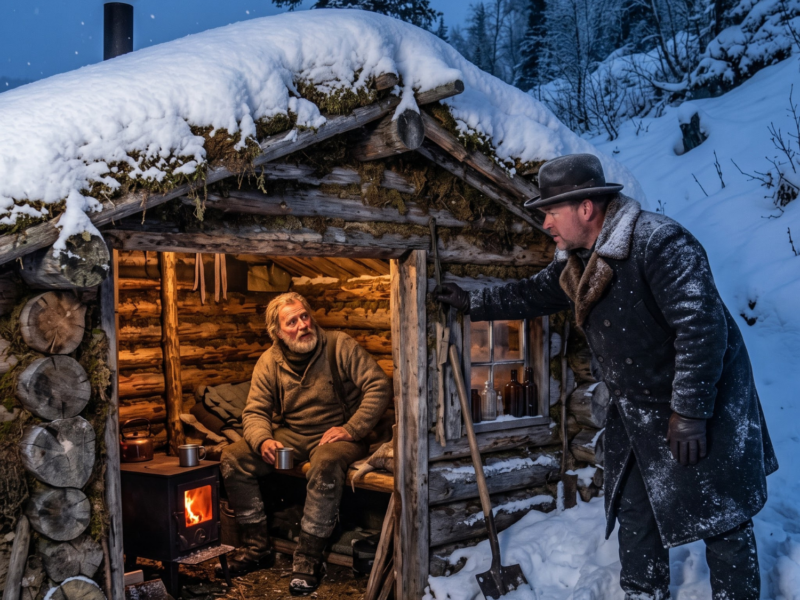
How an Old Klondike Miner Slept in His Undershirt at Sixty Below in a Cabin Called a Hole
The Womb of the Earth
Outside, the cold did not merely chill them; it assaulted them. It struck their bodies like a physical blow from a heavy wooden bat.
It physically hurt the lungs to draw a breath. The packed snow under their heavy boots squealed sharply, sounding like boots walking over broken glass. Within a dozen steps, the moisture on their eyelashes froze solidly together, forcing them to squint through slits of ice.
Tom led the agonizing march up the hill, holding the lantern high to cut through the freezing fog. Eddie Shaw gripped Tom’s shoulder tightly, blindly trusting the younger man to lead. The others followed perfectly in their footprints, conserving the energy required to break through the crust.
The fifty-foot climb up the slope, a journey of seconds in the summer, took them more than fifteen grueling minutes of gasping, agonizing effort.
Niels pulled the low door open before they even knocked. He asked absolutely no questions. He offered no lectures. He turned, threw a massive armful of bone-dry, silvered deadwood into his stove, and pushed his own canvas seabag into a corner to make room on the dirt floor.
Whitfield collapsed onto the floor by the door. He rolled his frozen fur coat into a makeshift pillow, rested his head upon it, and lay there, staring blankly at the ceiling just inches above his face.
He did not sleep for a very long time. He simply lay there, listening to the rhythmic tick-tick of the cooling stove metal, listening to the ragged breathing of his men slowly returning to normal, and listening to the profound, absolute silence of the room where the roaring terror of the cold should have been.
There were now six grown men packed into a cabin that measured ten by twelve feet. They lay shoulder-to-shoulder, packed like cordwood on the fragrant spruce boughs Niels had laid on the floor, and on the elevated bunk. It was so tight that if one man needed to turn over to relieve an aching hip, he had to tap his neighbor, and they all had to turn over together in unison.
Within an hour, the heavy winter coats came off.
Within two hours, Eddie Shaw fell into a deep, exhausted sleep sitting straight up, his back resting against the warm, packed-earth wall of the hillside. He did not wake until the smell of coffee filled the room.
Niels quietly rose and placed dry wood in the stove only twice during the entire long night.
By morning, the temperature stratification in the small room was clear. Up by the elevated bunk, the air was a balmy sixty degrees above zero. Down by the door, near the floorboards, it hovered comfortably around the freezing mark. The water in the bucket had not formed a single crystal of ice.
Near dawn, Patrick Doyle woke. For a panicked moment, disoriented by the utter darkness and the profound quiet, he did not know where he was. It was too warm. The air was too still. He looked toward the wall, where the pale, pre-dawn sky was glowing faintly through the thick green glass of the bottle window.
“It’s like being back in the womb,” Patrick whispered into the dark, a tone of religious awe in his rough voice.
From the darkness of the bunk above, Niels’s voice drifted down, calm and steady. “That is the entire idea, Patrick. Go back to sleep.”
Down below, on the valley floor, the great mansion of green spruce was dying.
Everything in the big cabin that had contained a drop of moisture was now frozen solid. The delicate white fringe of frost on the interior walls had exploded overnight, growing into jagged, terrifying ice crystals a full finger thick.
When Eddie woke up in the burrow, the very first thing he did was pull his hands from his pockets and stare at them. All ten of his fingers were a healthy, vibrant pink, and entirely warm to the touch.
He looked across the small room at Niels, who was grinding coffee beans. Eddie watched the old man for a long time.
“I’m incredibly sorry about that song I sang, Mr. Baka,” Eddie said quietly, his voice thick with shame.
Niels did not look up from the grinder. He only offered a dismissive shrug of his broad shoulders. “Songs do not keep a man warm, Eddie. Wood does.”
In the morning, the very first thing Niels checked was his shelf.
Four of the five medicine bottles had turned a milky, solid white.
He said absolutely nothing. He simply reached out and moved the bottles closer to the green light of the window, ensuring that every man in the room could see them clearly when they woke.
Patrick Doyle sat up, stretching his aching back. He reached out, picked up the glass bottle of Jamaica ginger, turned it slowly over in his calloused fingers, watching the solid block of frozen amber liquid, and gently put it back on the shelf.
“So, it dropped past sixty below,” Patrick said, his eyes wide.
“Past sixty,” Niels confirmed, striking a match to light his pipe.
Horace Whitfield woke before anyone else had spoken. He sat up, pulled his knees to his chest, and wrapped both hands around a steaming tin mug of coffee Niels handed him.
The wealthy merchant looked around the tiny, cramped cabin as if he were seeing the world for the very first time. He saw a ceiling so low he could easily reach up and touch the rough bark of the poles with his hand. He saw dry, ancient tundra moss packed impossibly tight between the logs, sealing out the wind. He saw a solid wall of earth behind the bunk, lined with simple spruce poles to keep the dirt from crumbling onto the blankets. He saw the five bottles on the shelf, three of them frozen solid white.
Whitfield reached his hand out and tentatively touched the earth wall behind him. It was cold to the touch, certainly, but it was not icy. There was absolutely no frost forming on it at all. It was protecting them.
When Niels finally climbed down from his elevated bunk, Whitfield set his coffee mug on the floor and stood up, though he had to stoop slightly to keep from hitting his head.
“Mr. Baka,” Whitfield said, his voice stripped of every ounce of its former booming arrogance. “I called your home a hole in the dirt. I said it in front of every man in the saloon, and I said it on the creek. I was profoundly, arrogantly wrong.”
Whitfield looked at his shivering crew, then back at the Norwegian. “Please. Teach us how to build, so that my men and I live to see the spring.”
Niels took his time. He packed the bowl of his pipe with dark tobacco, struck a sulfur match against the stovepipe, and took three slow, deep pulls, letting the sweet smoke fill the cabin.
“The ground outside is like solid iron right now, Horace,” Niels said finally, using the man’s first name. “We cannot dig, so we cannot build anew until the spring thaw. But today, we will go down to your place… and we will fix what we can.”









