How an Old Klondike Miner Slept in His Undershirt at Sixty Below in a Cabin Called a Hole
The Groundhog’s Apprentice
Tom Avery was the only member of Whitfield’s crew who felt a prick of shame at the merchant’s arrogance.
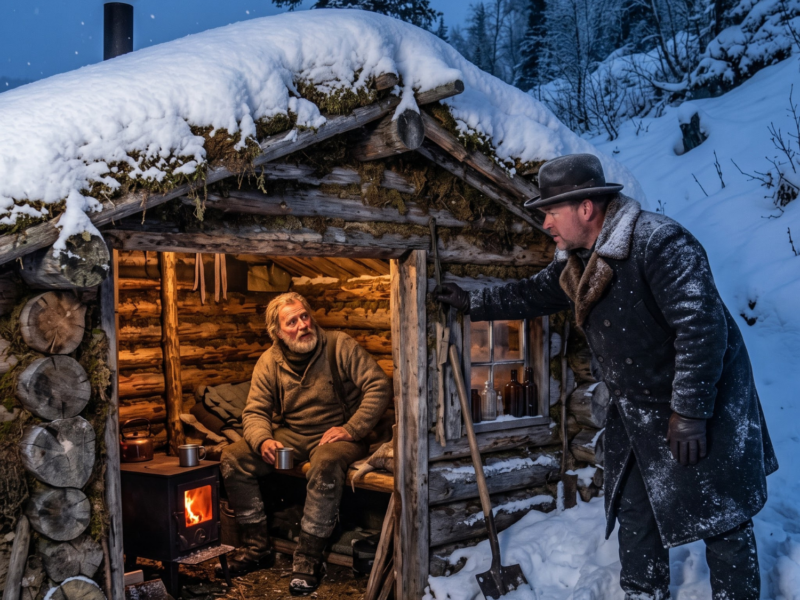
Driven by an innate curiosity, Tom climbed the fifty feet up the slope a few days later to look closely at the Norwegian’s cabin. Standing before it, he realized he had to stoop dramatically to clear the doorframe, pushing past the heavy, smelling caribou hide. Even inside, he knocked his hat against a heavy roof beam.
The light that filtered into the small space came through the bottoms of the empty whiskey bottles. It was dim, muted, and a serene, underwater green. The air smelled of dry earth, spruce pitch, and strong coffee.
“Mr. Whitfield says no decent, civilized man would live like this,” Tom blurted out, instantly regretting the rudeness of the words.
Niels sat on a low stool, whittling a snare trigger. He did not look offended. He calmly poured a tin cup of dark, boiling coffee from the stove and handed it to the young clerk.
“Mr. Whitfield,” Niels said softly, his blue eyes twinkling in the emerald light, “has only seen the cold in paintings.”
Tom returned the next week, and the week after that. He told his crewmates he was going up to prospect the old man’s ground, but in truth, he went for the coffee and the history.
Niels told him stories of the starvation winter of ’87 at Forty-Mile, when the entire camp survived on boiled shoe leather and flour dust. He showed Tom his row of medicine bottles on the shelf, explaining the freezing points of quicksilver, coal oil, and ginger.
“A man’s pride can lie to him,” Niels told Tom, tapping the glass of the Jamaica ginger bottle. “A steel thermometer can break. But a bottle cannot lie. Either it is frozen solid, or it is not. When the ginger freezes, you do not chop wood. You do not sweat. You stay inside, or your lungs turn to ice.”
Tom listened with rapt attention. He did not laugh.
Down in Dawson, in the roaring, smoke-filled log saloons lining Front Street, the story of the man living in a dirt hole flew faster than rumors of a gold strike. Nobody laughed louder than Jules Gong, a boisterous French-Canadian carpenter making a fortune building cabins for newly rich prospectors.
“A low cabin is a poor man’s cabin!” Jules would shout, slamming his beer mug on the bar. “A man who finds gold builds himself a chateau! With plank floors to dance on, not a burrow for a beast!”
But by late October, the laughter in Dawson began to quiet.
The Northwest Mounted Police posted a grim notice on the trading post door: there was not enough food in Dawson City to last the winter. The late-season supply steamers had run aground on shifting sandbars hundreds of miles downriver. The Mounties advised anyone without a full six-month supply of provisions to flee immediately to the federal warehouses at Fort Yukon.
Hundreds panicked. They fled down the river, walking over treacherous slush ice and the fragile, bending crust of the first hard freeze. Tom stood on the banks of the Klondike and watched them go. He saw men older than his mother, men wearing thin city shoes, walking into the vast white maw of the wilderness.
Tom went back to the sprawling cabin on El Dorado Creek that night and, for the first time in his young life, felt the cold touch of true, existential terror.
Whitfield, however, was supremely unbothered. He had paid extortionate prices—three times their worth in Chicago—to secure their supplies. A single can of butter cost five dollars. Salt was weighed against gold dust on the scales.
Whitfield’s men mocked Tom for his frequent trips up the hillside.
“Look, it’s the groundhog’s apprentice!” Eddie Shaw teased, slapping Tom on the back. Eddie even composed a bawdy little song about the Norwegian living in the dirt, and the men sang it heartily around their massive, roaring stove in the evenings, feeling secure in their towering wooden fortress.
In early November, the authority of the North arrived in the form of Constable Price, a hardened Mountie driving a team of malamutes. Price stopped his sled outside Whitfield’s cabin. He looked up at the towering, seven-foot walls of green spruce, looked at the massive glass windows, and slowly shook his head in profound dismay.
Price then looked fifty feet up the hill at Niels’s snow-covered mound. A slow, respectful smile broke through the Mountie’s frost-caked beard.
“That old man up there knows exactly what he’s doing,” Constable Price told Whitfield, leaning on his sled brake. “You might want to swallow your pride and ask him how to keep a cabin warm before January gets here.”
Whitfield stiffened, his face flushing red. “I did not haul a fortune over the Chilkoot Pass to take architectural advice from a squatter living in a mud hole, Officer.”
Price stared at the merchant for a long, quiet moment. “The Yukon doesn’t care about your bank account, Mr. Whitfield. It only cares about your preparations.”









