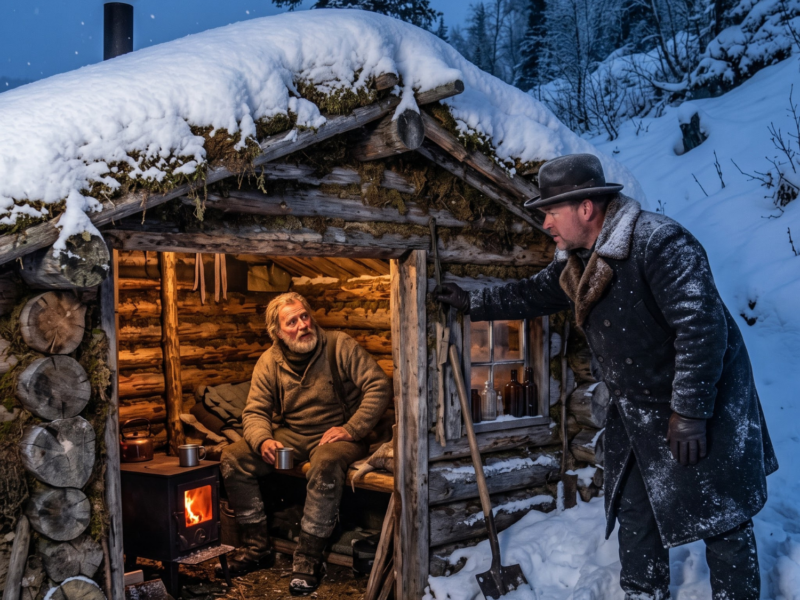
How an Old Klondike Miner Slept in His Undershirt at Sixty Below in a Cabin Called a Hole
The Scurvy and the Spring
In Dawson City, during that exact same week of the deep freeze, Horace Whitfield walked into the warm, crowded log saloon where he had spent the entire autumn telling loud, arrogant jokes about the Norwegian living in the mud.
Whitfield walked directly to the center of the bar. He ordered a whiskey, turned to face the room, and spoke loudly enough for every single poker table to hear him clearly.
“The old Norwegian up on El Dorado Creek was absolutely right,” Whitfield declared, his voice ringing over the noise. “And I was an arrogant fool. If any man in this room wants to live to see the spring thaw, I highly suggest you go up there, swallow your pride, and ask him how to stay alive.”
The rowdy saloon went dead quiet. Cards hovered mid-air. Glasses stopped clinking.
Then, from the back of the room, some drunken prospector laughed. But absolutely nobody joined in. The silence was heavy with the terrifying reality of the cold outside the walls.
By the end of the month, half a dozen desperate, freezing men had swallowed their pride and made the arduous climb up the hill on El Dorado to see the subterranean cabin with the green bottle window.
A week later, Jules Gong, the boisterous French-Canadian carpenter, made the long walk up from Dawson.
Gong was a humbled man. Two of the incredibly expensive, towering cabins he had built that fall had been completely abandoned by their wealthy owners in mid-January, deemed unlivable death traps. One of the angry miners was demanding a full refund of his gold dust at gunpoint.
Gong knocked respectfully at Niels’s low door. He removed his fur hat, stepped inside, and spent a very long time looking in absolute silence at the low ceiling, the earth-packed walls, and the row of medicine bottles on the shelf.
Then, Gong turned to Niels. “I have been building houses since I was fifteen years old, monsieur. Fine, tall houses. Not burrows. And now, I have walked ten miles through the snow to ask you to teach me how to build a burrow.”
“It is not a burrow, Jules,” Niels said gently, offering the man a cup of coffee. “It is a house designed for January.”
By the spring thaw, Gong had built two new cabins in Dawson City utilizing the “new” way: built low to the ground, heavily insulated with dry moss, with two feet of earth packed onto a reinforced roof, and featuring only one, very small, deeply recessed window. The new owners grumbled incessantly about the gloom and the darkness inside. But the following winter, when the sixty-below winds returned, neither of those men abandoned their claims.
In late February, Constable Price came up the creek with his dog team, checking welfare. He carried a heavy ledger, writing down the grim statistics: who was still alive, who had fled down the ice to Fort Yukon, who was suffering from scurvy, and who was critically running out of flour.
When Price checked Whitfield’s cabin, he noted that the men were running dangerously low on flour, rationing it to a cup a day. But to his immense relief, every single one of them was alive, warm, and relatively healthy.
“That old Norwegian saved your winter, Horace,” Price said, sipping tea under the canvas drop-ceiling.
“I know he did, Constable,” Whitfield said, his voice thick with gratitude. “And I made sure I walked up that hill and told him so myself.”
As the winter dragged on into the brighter, longer days of March, men from the surrounding creeks started making Sunday pilgrimages up the hill to the cabin.
Niels patiently showed them all the exact same things. He showed them the insulating properties of the moss, the thermal mass of the earth, the dead-air space inside the bottles, and the heat-trapping physics of the canvas under the ceiling.
The bottles, however, were what the men asked about the most. They were fascinated by the sourdough thermometer.
“You can drop a glass and steel thermometer, and it will break,” Niels would tell the gathered men, tapping his pipe. “But a bottle of Jamaica ginger always tells you the absolute truth about the sky, even when you desperately do not want to hear it.”
In late March, with the sun finally offering genuine warmth, Horace Whitfield climbed the hill carrying a small, heavy leather poke of gold dust. He set the leather bag on Niels’s wooden table.
“That is for the engineering lessons, Niels,” Whitfield said. “And for the night’s lodging when we were dying.”
Niels looked at the bag of gold. He didn’t touch it. He simply pushed it back across the table toward the merchant.
“In the North, Horace, no man takes another man’s gold for advice on how to stay alive,” Niels said firmly. “But… when the very first steamer comes up the river from Seattle in June, and they unload the fresh cargo… bring me a heavy sack of raw potatoes. For fighting off the scurvy, a potato beats a bag of gold every time.”
The ice on the mighty Yukon River finally groaned, shattered, and went out in a spectacular, violent rush in May.
In early June, the piercing whistle of the first paddlewheel steamboats echoed off the mountains as they tied up at the muddy docks of Dawson City, their decks piled high with desperately needed cargo.
Horace Whitfield was first in line. He bought potatoes at extortionate prices. He carried not one sack, but two massive, heavy burlap sacks of fresh potatoes all the way up the hill to Niels’s cabin, his back aching, a massive smile on his face.
That summer, Whitfield and his men did not build a tall wooden mansion. They dug a brand new cabin deep into the hillside directly beside Niels’s burrow. They built it to the old man’s exact, uncompromising measurements. They thawed the permafrost with fire, hauled dead, dry timber across the creek, packed the seams with moss two hands deep, and shoveled two feet of earth onto the roof.
Horace Whitfield, a man who had never done manual labor in his life, dug with a shovel alongside his men until the soft skin of his palms was nothing but thick, unyielding calluses.
Eddie Shaw went home to Kansas that fall on a steamer, carrying a modest pouch of gold dust, and all ten of his fingers. For the rest of his long life, sitting on his porch in the Midwest, he swore he could not hear the word “groundhog” spoken without violently blushing.
Patrick Doyle and Ben Carver chose to stay in the Klondike, working the rich claim with Whitfield’s financial backing. The next winter, they lived comfortably in the new cabin dug into the hill, and they never once had to sleep wearing their heavy coats.
They never bothered to tear down the towering, failed green-spruce cabin by the creek. They repurposed it as a storage shed for their picks, shovels, and wheelbarrows. The towering walls kept the interior surprisingly cool all summer long, which, as Patrick noted dryly, was the only thing the damn building had ever been good for.
Horace Whitfield eventually went home to Chicago in the fall of 1899, carrying a respectable amount of gold, though not the mythical ton the newspapers had promised. At his lavish private club, surrounded by wealthy men smoking cigars, his peers would constantly ask him about the gold strikes, the gambling, and the wild saloons of Dawson.
Whitfield rarely talked about the gold. Instead, he told the captivated men about a quiet Norwegian, a green bottle window, and a row of freezing medicine bottles on a shelf.
“The greatest treasure I found in the Klondike wasn’t in the dirt,” Whitfield would say, swirling his brandy. “It was a lesson about pride, and a lesson about walls.”
Niels Baka never left El Dorado Creek. He stayed on his claim, quietly working the gravel, until the massive corporate syndicates arrived with their giant, mechanized river dredges and bought up the entire valley.
Tom Avery stayed with Niels for two more freezing, beautiful winters. He learned everything the old man had to teach. Then, with a small stake of gold, Tom traveled south to Seattle, Washington, and became a highly successful residential builder.
Today, more than a century after the great stampede, modern architects and engineers who study passive heating and cold-climate housing essentially preach the exact same gospel Niels Baka preached with a stick in the dirt: Keep the footprint small. Utilize the thermal mass of the earth or snow against the exterior walls. Elevate the sleeping areas to capture rising heat. Minimize the surface area of the glass. And aggressively seal the envelope against wind infiltration.
Cabins built exactly like Niels’s once stood by the hundreds along the creeks of the Klondike, silent testaments to adaptation. The Dawson City Museum still keeps a faded, sepia-toned photograph of a structure said to be the smallest cabin ever built on the creeks: low logs stuffed with moss, held in place by sapling poles, a glowing window made of empty whiskey bottles, a heavy sod roof, and walls deeply banked with earth.
And during that exact same brutal winter of 1897, a twenty-one-year-old aspiring writer named Jack London was living in a standard, drafty log cabin on Henderson Creek, not far away. He suffered terribly. He came out of the Klondike the following spring ravaged by scurvy, his teeth loose, his body broken. He would later famously remark that the scurvy was the only physical thing he managed to bring back with him from the goldfields.
In the late 1960s, London’s abandoned cabin was rediscovered in the brush and positively identified by a signature the young author had scratched deeply into the interior logs. The historical society carefully dismantled the structure, splitting the logs into two equal piles. Half of the logs were used to rebuild a replica cabin in Dawson City, and the other half were shipped south to rebuild a replica in a square in Oakland, California, honoring his legacy.
Tom Avery, the young bank clerk turned builder, never forgot the man on the hill.
He wrote a long, heartfelt letter to Niels Baka every single Christmas for twenty years. The stoic old Norwegian never once wrote a letter back. But every spring, without fail, a small, battered parcel would arrive at Tom’s Seattle office on the very first steamer out of the North. Inside, there would be a jar of pungent spruce gum for making tea, a small, gleaming gold nugget, and once, a single, empty glass medicine bottle containing a tiny slip of paper with a handwritten note that read: Still frozen.
Tom Avery built sturdy, beautiful houses in the rainy climate of Seattle for forty years. Every single one of them, his family later joked, had a significantly smaller window on the north-facing wall than the paying customer actually wanted.
And on his own office windowsill, catching the Seattle sunlight until the very end of his long life, Tom kept a row of five little glass medicine bottles.
Whenever his young grandchildren would visit his office, they would point to the dusty bottles and ask him what they were for. Tom would smile, pat their heads, and give them the exact answer Niels Baka had given him so many decades ago on a freezing hillside at the edge of the world.
“Because in the North, little ones,” Tom would say, his eyes distant, remembering the bite of sixty below, “you don’t build a house to impress company in the summer. You build a house to survive January.”









