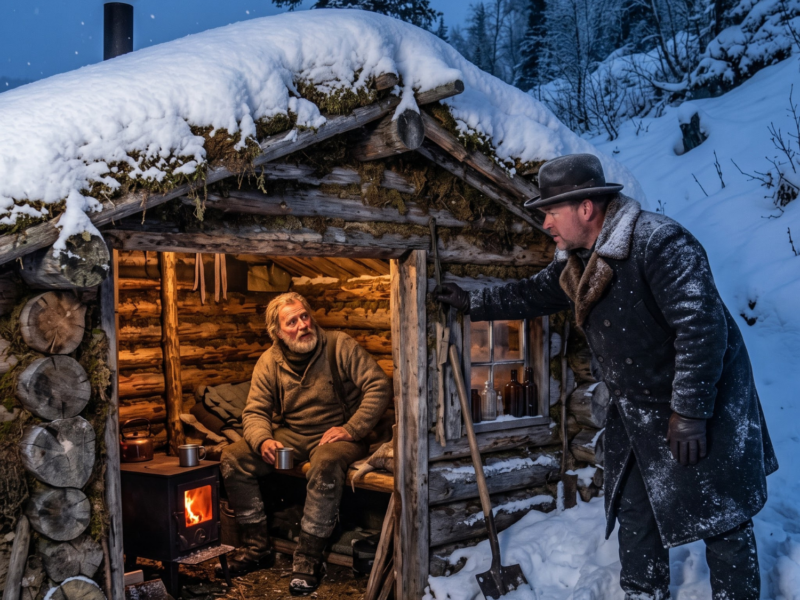
How an Old Klondike Miner Slept in His Undershirt at Sixty Below in a Cabin Called a Hole
A House for January
That exact same day, as the temperature held at a murderous fifty-five below, all six men went to work on the big cabin.
It was a masterclass in frontier survival engineering, led by a man who had learned his trade through suffering.
First, Niels commanded them to permanently seal up the cracked glass window. They boarded it over heavily from the inside using thick wooden slats scavenged from their packing crates. Then, they went outside and frantically shoveled tons of snow, banking it aggressively against the boarded window to create a massive, insulated drift.
“Then the snow goes everywhere else,” Niels ordered, pointing his mitten at the towering walls.
They worked for hours, banking the exterior walls with massive snowdrifts right up to the bottom edge of the roofline, essentially burying the lower half of the cabin in an igloo of white insulation. They climbed the roof and piled as much loose snow on top of the boards as the structural timbers could safely hold without collapsing.
Inside, Niels executed a stroke of genius that no city-dwelling merchant would ever have conceived.
He commanded them to unroll a massive, heavy canvas wall-tent. They stretched the heavy canvas horizontally across the entire span of the room, lashing it tightly to the walls exactly six feet off the floor, creating a secondary, much lower drop-ceiling.
The grand, cavernous cabin instantly became three feet lower. The radiant, warm air rising from the stove no longer escaped uselessly up into the high, freezing rafters and out through the porous roof boards. Instead, the heat gathered and trapped itself directly under the heavy canvas, right above the men’s heads.
“Tear out those bunks,” Niels ordered next, pointing to the cots resting on the freezing floorboards.
They dismantled the floor-level sleeping arrangements and built new, sturdy bunks high up on the walls, elevating the mattresses until they were tucked just inches underneath the new canvas ceiling.
“Now you will sleep nearly at the roof,” Niels explained, wiping sweat from his brow. “But up there, trapped against the canvas, the air will be ten or fifteen degrees warmer than it is down here by your boots.”
They hung two heavy animal hides over the front door to create an airlock. They spent an hour stuffing every single remaining crack in the walls with whatever material they possessed—torn shirts, oily rags, ship’s oakum, shredded scraps of canvas flour sacks.
When they were finished, Niels walked slowly along the interior perimeter of the walls, holding a lit candle in his hand. He watched the flame intently. Wherever the small, yellow tear-drop flickered or leaned away from the logs, he knew a microscopic draft was entering, and he ordered Ben Carver to pack more moss into the seam until the flame stood perfectly, completely still.
Last of all, as the brief daylight began to fade, Niels addressed the wood situation.
“You do not burn green spruce in the deep cold,” Niels instructed, pointing a stern finger at Whitfield. “You cross the creek. You cut the dead, silver timber from the old burn scar. There is enough dead, dry wood over there to last ten winters. It will burn hot, and it will burn clean.”
He pointed to the stove. “And you do not run the iron red-hot. If the pipe is glowing, you are pushing all your extra heat directly up the chimney and out to the ravens. Burn it steady. Burn it slow.”
By nightfall, when they fired the stove with dry deadwood, the ambient temperature trapped beneath the canvas ceiling rose to roughly forty-five degrees above zero.
It was not luxuriously warm. But it was profoundly, blessedly livable. When they went to sleep high in their new bunks, the water in the bucket they set up beside them did not freeze until morning.
Eddie Shaw’s frostbitten fingers healed over the next three agonizing weeks. The dead, white skin eventually blistered, turned black, and peeled entirely off, exposing raw, hypersensitive pink flesh beneath, but miraculously, the tissue survived, and he kept his fingernails.
When Eddie showed his recovering hand to Niels, thanking him profusely, the old man merely nodded. He pulled off his own left mitten and held his hand up to the light. The top joints of his index and middle fingers were cleanly missing, amputated by frost years ago.
“My first winter at Forty-Mile,” Niels said simply. “I was not as lucky as you, Eddie.”
Later that evening, as they drank spruce tea, Horace Whitfield looked across the dim room at Niels.
“Mr. Baka,” Whitfield asked, his tone genuinely bewildered. “Why didn’t you just tell us straight out, back in the fall, exactly how to build the cabin properly? Why let us make the mistakes?”
Niels took a slow sip of his bitter tea. “I did tell you, Horace. I stood by your wall and I said the green spruce would shrink. And you looked me in the eye and told me that nobody had asked for my opinion.”
Whitfield stared at the old man for a long moment. Then, for the first time in an agonizing, terrifying month, the merchant threw his head back and laughed. It was a rich, booming, self-deprecating sound.
“Fair enough, Niels,” Whitfield conceded, slapping his knee. “In a Chicago court of law, a defense like that gets the case thrown out immediately.”
That night, by the light of a single candle, Horace Whitfield pulled a piece of parchment from his bag and wrote a long, detailed letter to his wife in Illinois. The letter would not leave the frozen Klondike until the first steamer broke through the ice in June.
One particular sentence from that letter later became a legendary, repeated saying within the Whitfield family for generations:
Up here, at the edge of the world, they taught me how to live in the dirt like a groundhog… and I have never been more grateful for anything in my life.









