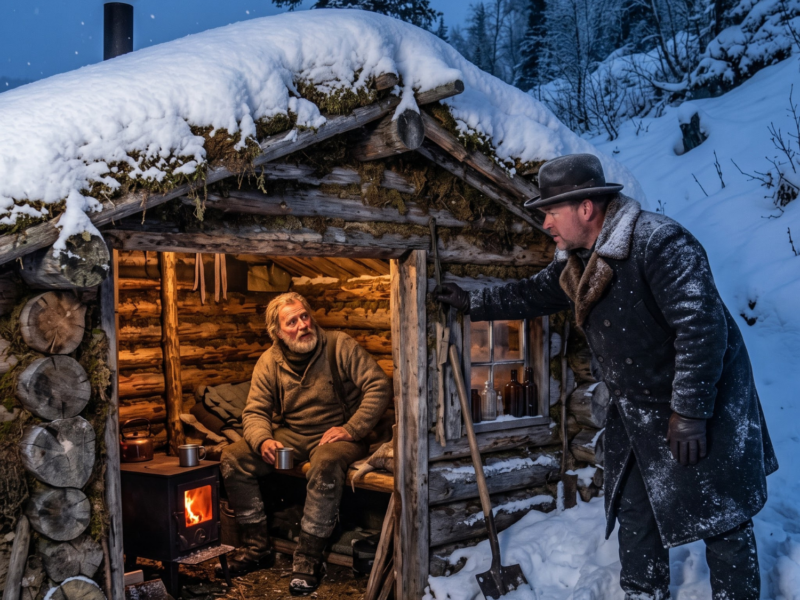
How an Old Klondike Miner Slept in His Undershirt at Sixty Below in a Cabin Called a Hole
The Wood Shrinks
In the middle of November, the temperature plunged past forty below zero for the first time.
That night, the men in the big cabin were jolted awake by a sound like a rifle firing directly next to their heads.
CRACK.
Tom bolted upright in his cot, his heart hammering. “What was that?”
“The logs,” Patrick Doyle muttered from the darkness, his voice grim. “The water inside the wood is freezing and expanding.”
It was worse than that. The green spruce, soaked with life-giving water when it was felled, was now reacting violently to the massive, dry heat radiating from the overworked iron stove. As the wood dried out from the inside, it shrank fiercely across the grain.
By morning, the nightmare Niels had predicted had come true.
Massive, jagged gaps had opened up horizontally between the logs. The green moss they had hurriedly stuffed into the seams was drying out, loosening, and falling to the floor in useless, dusty clumps.
Tom sat on the edge of his cot and pulled out a small notepad. He wrote a letter to his mother, telling her the North was colder and more terrifying than his wildest imagination. He folded the letter and put it in his breast pocket. It would stay there until spring. No mail left the Klondike during the dark months.
Why did the old man’s hole stay warm while the grand cabin turned into a meat locker?
There was no ancient magic to it. There was only simple, brutal arithmetic—the kind of math Niels had learned with the blackened skin of his own freezing feet.
Heat leaves a structure through everything that separates the inside from the outside: the walls, the ceiling, the glass, the floor, and every microscopic crack. The larger that surface area, and the colder the air on the other side, the faster the heat bleeds away into the void.
Whitfield’s mansion had over six hundred square feet of exposed wooden walls, and over three hundred square feet of high ceiling. Above their decorative board ceiling, there was absolutely nothing to trap the heat. The laws of thermodynamics dictated that warm air rose; it floated up to the rafters and bled straight through the thin spruce boards directly into the frozen sky.
Niels’s cabin had only one wall facing the lethal frost: the front wall. The back wall and half of the sidewalls were solidly buried inside the belly of the hill.
Frozen ground deep in a hillside remains at nearly the same stable temperature all winter long—a few degrees below freezing. To a man in his shirt sleeves, thirty degrees Fahrenheit is cold. But compared to the sixty-below-zero vacuum of the open air, thirty degrees is a tropical paradise. A wall backed by frozen earth loses heat exponentially slower than a wall bombarded by the open wind.
The earth acted like a massive, heavy fur coat that the cabin never had to take off.
The roof functioned identically. A foot and a half of dense moss and packed earth held radiant heat vastly better than any sawn lumber. And the heavy snow that fell on top of the mound acted as a final, perfect blanket, because fresh snow is nine parts trapped, still air.
Then, there was the fatal issue of volume. Niels’s cabin held roughly seven hundred cubic feet of air. The new cabin held nearly three thousand. A small, efficient stove could easily command seven hundred cubic feet. In the grand cabin, the same sized stove was a solitary soldier fighting an un-winnable war against an ocean of cold.
Furthermore, warm air pools at the highest point of a room. In Whitfield’s tall cabin, the air up by the decorative ceiling was as hot as a Turkish bathhouse, while down on the plank floor, the men’s drinking water froze solid in the buckets. Because they slept on low cots, they spent their nights shivering in the coldest stratum of air.
Niels did the exact opposite. His ceiling hovered a mere hand’s width above his head. His bunk was elevated to the height of his waist. He slept physically suspended in the warmest layer of air the room possessed.
The glass windows, Whitfield’s greatest point of pride, were thermodynamic disasters. A single pane of glass transfers heat outward dozens of times faster than a solid log wall. In the dead of winter, Whitfield’s two massive windows were essentially gaping holes in the wall, covered only by a thin sheet of ice.
Niels’s bottle window, by contrast, was an engineering marvel. Inside every single sealed glass bottle, a pocket of air sat perfectly still. It functioned exactly like the modern, double-paned insulating windows of the future. It let in very little light, but it allowed absolutely no cold to enter.
And finally, the location.
On a still, hyper-frozen night, cold air acts like water. It slides heavily down the slopes of the hillsides and pools deeply at the very bottom of the valley, filling the basin. The valley floor is always, undeniably, the coldest possible spot in the terrain.
Whitfield had built on the flat by the creek because it was level, visually appealing, and conveniently close to the water. Niels had deliberately climbed fifty feet up the elevation. In the Yukon, escaping the valley floor can mean a temperature difference of ten to fifteen degrees.
None of Niels’s choices were uniquely brilliant. It was simply the accumulated, hard-won wisdom of people who had lived in killer climates for millennia. From the ancient turf houses of Scandinavia to the subterranean pit-houses of the Yukon’s own First Nations peoples. Keep it low. Keep it small. Wrap it in the earth.
By late November, the big cabin was failing catastrophically.
The logs were shrinking and warping faster than the men could plug the gaps. Every morning, a brilliant, terrifying fringe of white frost outlined every single crack in the walls, highlighting the leaks like a glowing map of their doom.
Whitfield, desperate, ordered the men to nail their spare wool blankets over the interior walls to block the drafts. The next morning, when Tom tried to pull a blanket back, he found it frozen solid to the seeping moisture of the green logs. It tore away with a sickening sound, like ripping parchment.
“I did not carry expensive glass over the Chilkoot to live in a dark root cellar,” Whitfield stubbornly told Patrick Doyle one evening, huddled near the stove.
Doyle, the grizzled rail-worker, said absolutely nothing. He had seen what deep frost could do to steel; he knew what it could do to a man’s pride.
Ben Carver, the quiet carpenter, was the only one actively fighting the collapse. Every evening, he exhaustingly chinked the gaps with fresh moss. Every morning, he woke to find new gaps yawning open right beside his repairs.
“The logs are moving, Mr. Whitfield,” Carver said, his voice tight with anxiety. “The old Norwegian was right. The green wood is drying out from the stove heat. They’re pulling themselves apart.”
“Just keep chinking, Carver,” Whitfield snapped. “We have unlimited firewood.”
On the twenty-sixth of November, the true cold arrived.
The Northwest Mounted Police thermometer down in Dawson dropped to forty below zero and did not climb back above that mark for five excruciating days. On the night of December first, they recorded forty-seven below. During the peak warmth of the day, it ‘warmed’ only to thirty-six below.
Up on Niels’s shelf, the quicksilver in the first bottle had shriveled into a hard, solid silver pebble. The coal oil in the second bottle had gone as thick and cloudy as spoiled milk. The Jamaica ginger in the third remained clear.
In the big cabin that night, the five men abandoned their cots. They slept on the floor, fully dressed in their heavy canvas coats, wool caps pulled down over their ears, crowded in a desperate circle around the glowing iron stove. They fed it relentlessly, keeping the metal red-hot until dawn. The tops of their heads sweated, but their boots felt like blocks of ice.
The next morning, Eddie Shaw, the nineteen-year-old farm boy, made a fatal error in judgment.
Groggy and shivering, he stepped outside to grab a few logs from the woodpile. Because it was just a few feet away, he didn’t bother to put on his heavy fur mittens.
He was gone for exactly five minutes.
When he stumbled back through the door, the tips of his index and middle fingers on his right hand were stark, paper-white, and completely numb. The flesh sounded like wood when he tapped it against the table.
A week before, Eddie had been the loudest voice in the room, gleefully singing his song about the foolish groundhog on the hill. Now, he sat by the stove in absolute, terrified silence, holding his thawing, agonizingly painful hand inches from the iron, tears streaming silently down his cheeks.
The next morning, trying to muster courage over a breakfast of half-frozen flapjacks, Eddie forced a cheerful smile. “Well, boys. That has to be the absolute worst of it. It can’t get colder than that.”
Whitfield nodded vigorously in agreement. Every single man in the room wanted desperately to believe the boy.









