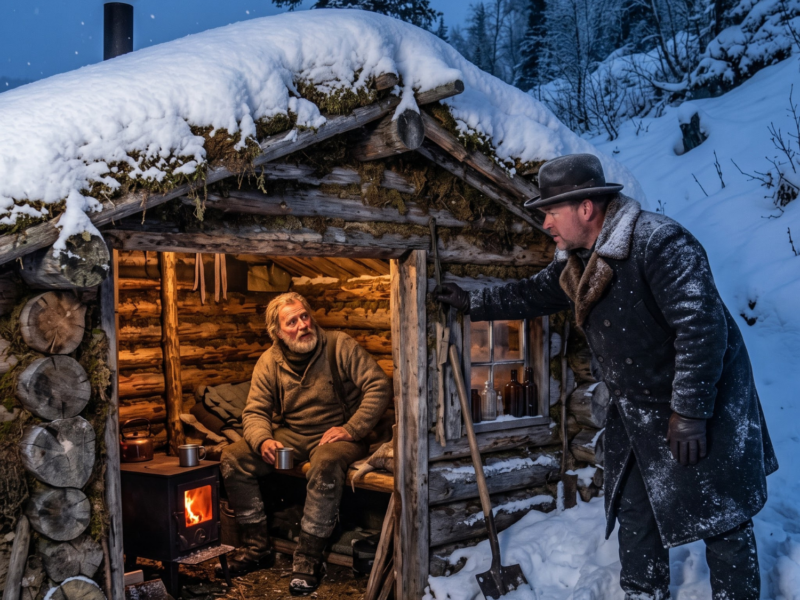
How an Old Klondike Miner Slept in His Undershirt at Sixty Below in a Cabin Called a Hole
The Blue Cold
Down in Dawson City, nobody was laughing at jokes anymore.
Men walked the icy, rutted streets with stark white patches of dead flesh on their cheekbones and the tips of their noses. The grand log saloons kept their massive barrel-stoves roaring day and night, consuming mountains of wood. Firewood, previously a cheap commodity, was suddenly selling for prices that made men weep.
Jules Gong, the arrogant French-Canadian builder, stopped making jokes about burrows. Two of the wealthy miners he had built grand, towering cabins for burst into the saloon and screamed at him in front of the town. The interior walls of their expensive new homes were coated in two inches of solid ice.
On the evening of the second of December, Tom Avery could bear it no longer. He left the shivering misery of the big cabin and climbed the fifty feet up the hill.
He knocked gently on the split-pole door, bent double, and stepped inside. He stopped dead in his tracks.
The cabin smelled of rich spruce pitch, pipe tobacco, and roasting coffee. But more importantly, it was warm.
It was not the localized, blistering, skin-scorching heat of their overworked stove. It was an even, gentle, ambient warmth that filled the entire space, from the low ceiling all the way down to the dirt floor. Niels was sitting cross-legged on his elevated bunk, wearing only a thin wool undershirt, calmly mending a torn mitten with a bone needle. The water in his drinking bucket by the door was perfectly, magically liquid.
“Show me how you did this,” Tom pleaded, his voice cracking.
Niels set down his needle. He walked Tom through the room. He showed him the earth packed behind the back wall. He showed him the dense moss twisted into the cracks. He explained the thermodynamics of the low roof poles, the insulating brilliance of the bottle window, the air-lock created by the caribou hide, and the wind-shielding placement of the outdoor woodpile. He talked about it as casually and plainly as a man explaining how to bait a fishing hook.
“Why didn’t you tell us this back in the fall?” Tom asked, a hint of betrayal in his voice.
“I did tell you, Tom,” Niels said softly. “I said the green spruce would shrink. Your boss told me nobody had asked for my opinion.”
Tom slept on the floor of Niels’s cabin that night, wrapped in a single blanket, warmer than he had been in weeks.
The next day, Tom packed his canvas seabag. He slung it over his shoulder and walked toward the door of the big cabin, explaining nothing to the shivering men watching him.
“Go on!” Whitfield shouted, his breath pluming in the freezing room, his pride stung. “Run up to the old man! Cower in the dirt! Come spring, when we wash out the gold, you’ll come crawling back begging for your share!”
Tom did not turn around. He pushed through the door and walked up the hill.
But Tom Avery was a loyal man. Despite moving in with Niels, he still walked down the hill to the big cabin every single day. He spent hours splitting their frozen firewood, carried heavy buckets of water up from the hole they had chopped in the creek ice, and checked the structural integrity of their blistering stovepipe.
Whitfield accepted the physical labor but refused to speak a single word to the boy.
“Tell him he is welcome to come up here,” Niels told Tom every evening as they drank their coffee. “He won’t come on his own. His pride is a heavy stone. But ask him anyway.”
Tom asked Whitfield twice. Twice, Whitfield sneered and answered that his grand cabin was every bit as good as a dirty hole in a hill.
December passed in a quiet, hungry blur.
On the creeks, the men lived on a punishing diet of boiled beans, flour flapjacks, and rancid bacon, with absolutely nothing fresh to eat. The lack of vitamin C began to take its gruesome toll. Men’s gums softened and began to bleed freely. Their teeth loosened in their sockets. Joint pain became agonizing.
On the Klondike, they called the terror scurvy, and they feared it vastly more than the cold.
Niels, drawing on the ancient wisdom of his ancestors and the First Nations people, ventured out and gathered fresh spruce needles. He boiled them into a pungent, astringent tea, and he forced Tom to drink a large tin cup of it every single day.
“It is bitter,” Niels commanded, watching Tom grimace. “But you will keep your teeth to chew your meat.”
Down in Dawson, the situation was apocalyptic. The small, desperate hospital operated by Father William Judge completely ran out of beds. Men lay dying of scurvy and catastrophic frostbite on the rough wooden floorboards, weeping for their mothers.
At Christmas, Whitfield, desperate to maintain morale and the illusion of control, threw a lavish supper in his freezing cabin for the neighboring claim owners along the creek. He deliberately did not invite Niels.
They drank expensive French brandy Whitfield had carefully carried over the Chilkoot Pass, shivering in their heavy coats, and mutually agreed, with forced cheer, that the absolute worst of the winter cold must surely be behind them.
Toward the end of the long, drunken night, Eddie Shaw raised his tin cup toward the ceiling. “May the old groundhog stay warm in his burrow, and we in our fine house!”
Everyone laughed uproariously. Everyone except Patrick Doyle, who stared silently at the frost creeping up the walls.
Up on the hill, sitting outside the door to get some fresh air, Tom heard the toast echo through the valley. Sound carries a terrifyingly long way in hyper-frozen, dense air. He said nothing to Niels when he went back inside, but the old man, smoking his pipe in the dim light, had likely heard it himself.
“Let them laugh while they still have the breath for it,” Niels said quietly, tapping his pipe against his palm. “January treats every man exactly the same.”
In early January, Constable Price made his grim rounds of the creeks again. In every single cabin, he delivered the same stern, repetitive warnings: Keep your wood dry. Do not step outside to relieve yourself without mittens. In the hard cold, do not sleep alone; share body heat.
At Whitfield’s mansion, the Mountie stayed longer than usual. He looked at the massive pile of hissing, green wood sitting by the stove. He looked at the thick, glacial frost conquering the corners of the room. He looked at the two massive, ice-coated windows.
On his way back to his sled, Price met Tom on the trail. The Mountie grabbed Tom by the shoulder, his grip like iron.
“Keep an eye on them, son,” Price whispered urgently. “They are living in a coffin.”
On the creeks, men stopped counting the days by the calendar. They counted the days by Niels Baka’s bottles. Somebody always knew what the Norwegian’s shelf read that morning, and the dire news leaped from cabin to cabin faster than a telegraph wire.
Then, in the exact middle of January, the true, apocalyptic cold arrived.
The sky cleared to a hard, ringing, merciless blue. The wind died completely, and a thick, suffocating white fog of woodsmoke and frozen human breath settled heavily over the valley floor, trapped by a thermal inversion. Smoke no longer possessed the thermal energy to rise from the chimneys; it tumbled out of the pipes and laid down flat on the snowpack, crawling in long, gray, ghostly ribbons through the trees. The air was so dense you could hear an axe strike wood a mile away, the sound sharp as a gunshot.
On the fourteenth of January, the Jamaica ginger in Niels’s third bottle turned cloudy.
On the fifteenth, it froze solid.
The brown Perry Davis’s Painkiller in the fourth bottle began to turn a sickly, opaque white.
By the absolute, infallible law of the bottles, the ambient air temperature outside the cabin was dropping past sixty degrees below zero. In the spring, when the records were tallied, they would learn that on the sixteenth of January, the official government thermometer at Fort Yukon had bottomed out at sixty-two below.
On days of that incomprehensible magnitude, Niels did not even approach his mining shaft. He split wood only during the brief, anemic hour when the sun crested the southern ridge, and he never, for a single consecutive minute, gripped the handle of his axe with a bare hand.
Down in the big cabin, the nightmare Niels had warned them about culminated in disaster.
The dry wood was entirely gone. They had burned through their massive, carefully stacked woodpile back in December, forced to keep the stove red-hot around the clock just to survive. Now, desperate, they were cutting green, frozen spruce trees right beside the cabin.
The green wood was a tragedy. Packed with frozen sap and water, it hissed, screamed, and smoked violently in the firebox, giving off almost zero radiant heat. To raise a flame hot enough to ignite the green logs, they had to burn dry wood.
They fed their wooden packing crates into the stove. Then they dismantled their wall shelves. Then they chopped up the wooden benches they sat on.
Whitfield, driven by panic, ordered them to keep the stove glowing at maximum capacity. The thin iron stovepipe running up through the ceiling and above the roof shone a terrifying, bright cherry-red in the dark. Twice during that endless night, Ben Carver had to climb the icy roof in the lethal cold, throwing handfuls of snow against the wooden roof boards to ensure the radiant heat of the pipe hadn’t ignited the structure.
That winter on the Klondike, more cabins burned to the ground than men froze to death. A red-hot pipe would easily ignite the dry moss and rags stuffed frantically into the ceiling cracks, and a cabin would burn to ash in thirty minutes, vaporizing a crew’s entire winter supply of food and gear, leaving them to die in the snow.
On the night of the fifteenth, the physics of the cold claimed its first structural victory.
One of the two massive glass windows, contracted beyond its breaking point by the sixty-below-zero air, cracked violently. The jagged fissure ran from the top left corner to the bottom right. The frozen vacuum outside instantly began to whistle through the crack, sucking the ambient heat from the room.
Patrick Doyle tore off his heavy fur coat and jammed it forcefully against the glass, sacrificing his own garment to plug the breach.
The drinking water in the tin bucket, sitting a mere two steps from the roaring stove, froze solid. They had to chop their sourdough bread with a heavy hatchet. The black ink in Whitfield’s writing bottle had shattered its glass container weeks ago.
Around midnight, the heavy wooden door was shoved open without a knock.
It was Tom. He stood in the doorway, holding a brass storm-lantern, his breath rolling off him in massive white clouds.
The four men were hunched in a tight, desperate circle around the stove, wearing their heaviest coats, scarves, and fur caps pulled low. The fire behind the iron door was low, sputtering, and burning a sickly yellow.
“Niels says to bring everyone,” Tom said, his voice cutting through the hiss of the green wood. “From the hill. He saw your smoke go thin. He knows the fire is dying.”
Patrick Doyle, his face gray with exhaustion, was the first to speak aloud the terrifying truth they had all been silently harboring.
“We won’t last until morning in here,” Doyle rasped, standing up stiffly. “Let’s go.”
Horace Whitfield sat in his chair, staring at the failing fire. The silence stretched. The arrogance of Chicago, the wealth, the pride—all of it was being crushed by the weight of the Yukon winter.
Finally, the merchant stood up. His shoulders slumped.
“Let’s go,” Whitfield whispered.
Nobody heard another word from him for the rest of the night.









