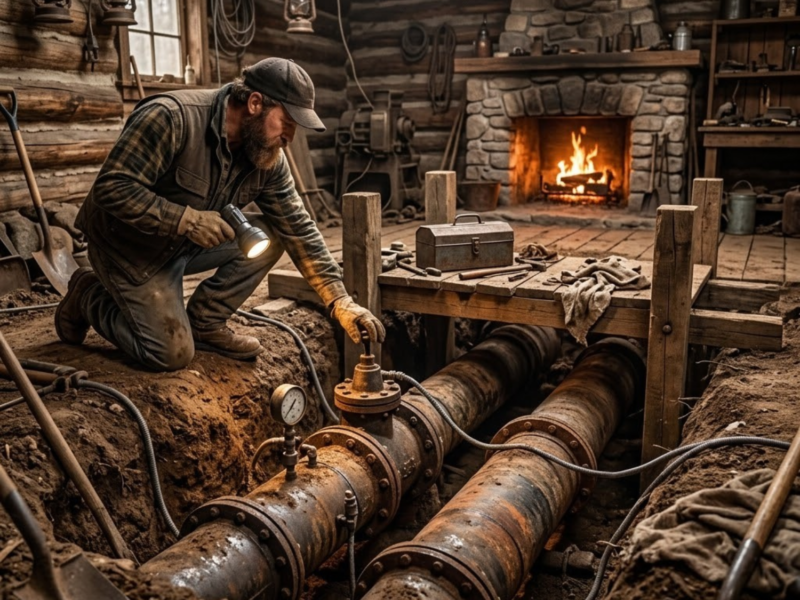
Settlers Laughed at His Underground Heat Recovery Duct — Until It Kept His Cabin 71°F Warmer
THE GRAND DIFFERENCE
When Mary and the children stepped through Thomas Mercer’s cabin door, the difference was immediate and undeniable.
The interior was warm enough that Mary loosened the heavy buffalo robe within minutes. The children, who had been shivering uncontrollably, gradually stopped trembling. Robert looked around in absolute confusion.
Thomas’s fireplace was noticeably smaller than his own. The fire burning within it was modest—consuming perhaps a quarter of the wood Robert had been sacrificing to the wind. Yet the temperature inside felt at least forty degrees warmer than the Henderson cabin.
Robert walked over to the hearth and held his hands toward the modest flames. The heat was pleasant, but not searing. This fire should not be capable of warming the entire cabin to this degree, he thought. He examined the walls, looking for an obvious difference in construction. Thomas’s cabin used similar notched log construction and standard moss chinking. The door was well-fitted, but not remarkably different from standard builds.
The mystery deepened when Robert realized that the warmth was not radiating primarily from the fireplace. The entire cabin felt evenly heated. Even the corners—traditionally the coldest, most frost-bitten spots in any frontier structure—maintained a comfortable, steady temperature.
Mary settled the children near the hearth and accepted the tin cup of coffee Thomas offered. She asked the question her husband was already turning over in his mind: “How is this cabin staying so warm with such a small fire?”
Thomas had been expecting that question since the moment Robert knocked on his door. He had known that eventually, someone would notice. The system he had built was entirely invisible from casual observation, but its effects were impossible to miss once you spent time inside during winter.
He gestured for Robert to follow him and walked to the exact center of the cabin floor. The floorboards beneath their feet were made of split logs, smoothed flat on top and fitted tightly together—standard construction for a quality home. But Thomas knelt and pointed to a section near the interior wall.
“Put your hand here,” Thomas said.
If you paid close attention, you could feel warmth radiating upward from the floor itself. Not an intense, blistering heat, but a steady, constant, benevolent warmth. Robert knelt beside him and pressed his palm flat against the wood. The boards were noticeably warm to the touch—warmer than any floor he had ever felt on the open prairie. The heat wasn’t coming from above; it was coming from below.
Thomas explained that what Robert was feeling was the result of eighteen months of planning, four months of grueling construction, and a system that most frontier settlers would consider absolute madness if they understood how it worked. He had built something beneath this cabin floor that recovered heat normally lost up the chimney, storing it safely in the dense earth and stone below the living space. The floor itself had become a radiating surface, releasing warmth continuously, even hours after the fire had died down to gray coals. It was this stored heat, this thermal mass, that kept the cabin comfortable while using a fraction of the wood other cabins consumed.









