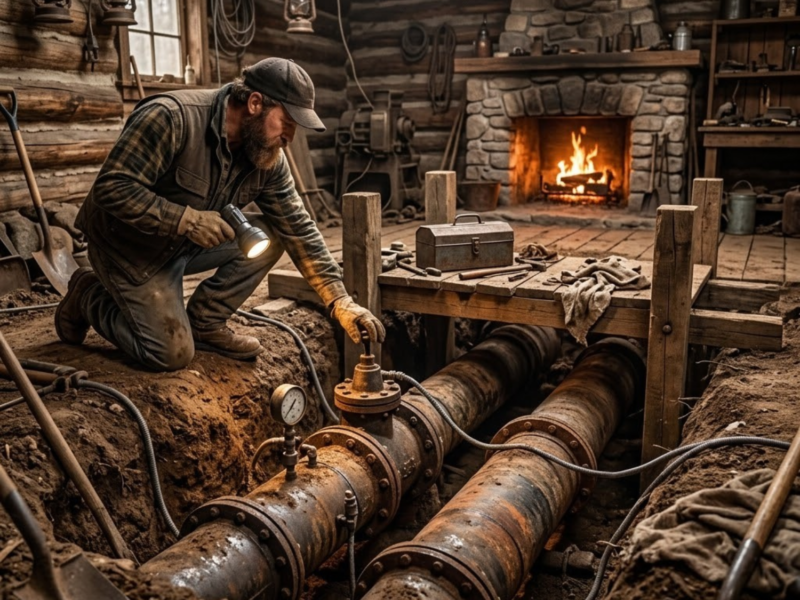
Settlers Laughed at His Underground Heat Recovery Duct — Until It Kept His Cabin 71°F Warmer
THE FRENCH ROMAN RUINS
Thomas had not invented the concept of heating from below. The foundational idea had lived in his memory since childhood, planted there by his grandfather during a winter evening in Pennsylvania twenty-eight years earlier.
Thomas had been eleven years old, sitting quietly beside the stone fireplace in his grandfather’s farmhouse, listening to the old man tell stories of his time in Europe as a young soldier under Napoleon. The grandfather had served briefly in the French army during the final years of the empire and had spent one winter billeted in an Italian town whose name Thomas had long since forgotten.
What Thomas remembered with absolute clarity was his grandfather’s description of the Roman bathhouse ruins the soldiers had explored. The ancient stone buildings had channels built beneath their floors—passages that once carried hot air from central furnaces. The Romans had heated entire public buildings by warming the floors, creating comfortable, tropical spaces even in the dead of winter. His grandfather had described standing in those crumbling ruins, marveling at the sophisticated engineering that allowed heat to spread evenly through sprawling rooms without requiring massive, smoky fireplaces in every corner.
That story had seemed like sheer fantasy to an eleven-year-old boy in Pennsylvania—interesting, certainly, but utterly irrelevant to the hard realities of American life. He had filed it away alongside other tall tales his grandfather told and thought little of it for years.
But when Thomas moved west at age twenty-four, and when he built his first crude cabin in the Dakota Territory at age twenty-six, the memory resurfaced with a vengeance. Spending his first winter watching a massive stone fireplace consume cord after cord of wood while cold air leaked through every log gap, the childhood story of the Roman ruins took on new meaning.
He began thinking about the core principle his grandfather had described: heat rising from below rather than radiating from one wall; warm floors instead of scorching fireplaces; even heat distribution instead of burning heat near the hearth and freezing cold in the corners.
The more Thomas thought about it, the more sense it made for frontier conditions. Wood was not an unlimited resource. Cutting, hauling, and splitting timber consumed enormous time, sweat, and energy. A system that used less wood while providing superior heat would be valuable beyond measure.
There was only one problem: Thomas had no engineering training. He knew basic carpentry from helping his father build barns and sheds. He understood how to notch logs and build a functional cabin. But designing an advanced heating system based on a childhood memory of Roman ruins was far beyond his knowledge. He would need to learn principles he had never studied, experiment with unconventional materials, and convince himself that the immense effort was worthwhile before he could ever build it.









