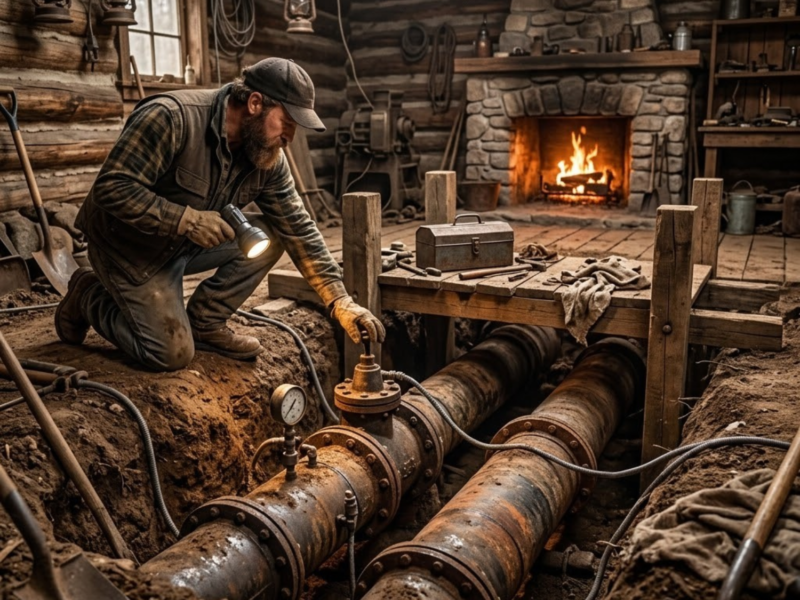
Settlers Laughed at His Underground Heat Recovery Duct — Until It Kept His Cabin 71°F Warmer
THE HUNT FOR CEDAR
Thomas returned to the Dakota Territory in late May of 1841 with supplies that utterly confused every trader and settler who saw them. Instead of the usual black powder, lead, coffee, and salt that trappers routinely purchased, Thomas had invested his savings in three large augers with bits ranging from two to six inches in diameter, twenty pounds of fire clay packed in wooden crates, a set of specialized chisels, two carpenter’s levels, fifty feet of hemp rope, and a collection of iron measuring tools, including a folding rule marked in increments of an eighth of an inch.
The total cost of these items exceeded what most trappers spent on supplies for an entire year.
When Thomas arrived back at his cabin site, he found three other settlers camped nearby. James Burton, William Cass, and Henry Thorne had all established homestead claims within five miles of Thomas’s location. They were building cabins for the coming winter and had stopped by to see if Thomas wanted to partner on a group hunting expedition.
Instead, they found him unloading equipment that made no sense for frontier living. James picked up one of the heavy augers and asked what possible use a trapper had for a tool designed to bore holes through thick timber.
Thomas explained that he planned to hollow out massive logs to create subterranean air passages for a revolutionary heating system.
The three men looked at each other with expressions that mixed profound confusion with open amusement. William asked why anyone would hollow out perfectly good logs instead of burning them outright for heat. Thomas began explaining the principles of thermal mass and heat recovery, but he could easily see them losing interest before he finished three sentences.
Henry interrupted, saying that if Thomas was cold, he should simply build a bigger fireplace like sensible people did. The idea of burying heat underground struck all three men as the kind of impractical, fancy-pants nonsense that got people killed on the prairie.
James was more direct. He told Thomas that frontier survival required focusing strictly on proven methods, not experimenting with complicated systems that would undoubtedly fail. A man could freeze to death while trying to reinvent the wheel. The smart approach was to build a solid cabin using standard techniques, cut adequate firewood, and tend the fire properly through the winter. Anything more complex was dangerous self-indulgence.
Thomas listened to this unsolicited advice without arguing. He had expected skepticism. The system he planned to build would seem counterintuitive to anyone who had not studied heat transfer principles. Over the following weeks, as Thomas began his construction work, other settlers stopped by periodically to observe his progress. Each visit brought fresh mockery.
The logs Thomas needed could not be random timber cut from convenient trees. Every piece of wood that would become part of his underground duct system required specific characteristics that most frontier builders never considered. Thomas spent two full weeks surveying the forest within two miles of his cabin site before cutting a single tree.
He was looking for eastern red cedar logs with particular properties that would determine whether his heating system succeeded or failed.
-
The first requirement was straightness. Most trees grew with some degree of curve, acceptable for standard cabin construction where logs could be notched and fitted. But Thomas needed logs straight enough to create continuous air passages without restrictions. He walked through stands of cedar, rejecting nineteen trees for every one that met his standard.
-
The second requirement was consistent diameter. Taper was natural in trees, but excessive taper would create ducts with varying interior dimensions. Thomas could work with logs that tapered no more than one inch over a twelve-foot length.
-
The third requirement was size. The logs needed to be large enough that hollowing them out would still leave walls thick enough to maintain structural integrity. Minimum diameter: fourteen inches.
-
The fourth and most critical requirement was wood quality. Cedar was naturally rot-resistant, containing aromatic oils that prevented decay. Thomas tested each candidate tree by cutting a small sample, looking for dense, fragrant heartwood that indicated high oil content.
By the end of his two-week selection process, Thomas had identified eight cedar trees that met all his requirements. He felled them carefully, cutting them to exact twelve-foot lengths. Each raw log weighed approximately four hundred pounds. Moving them from the forest required building a simple wooden sled and using his horse to drag them one at a time—a process that consumed three grueling weeks of work before he could even begin the hollowing.









