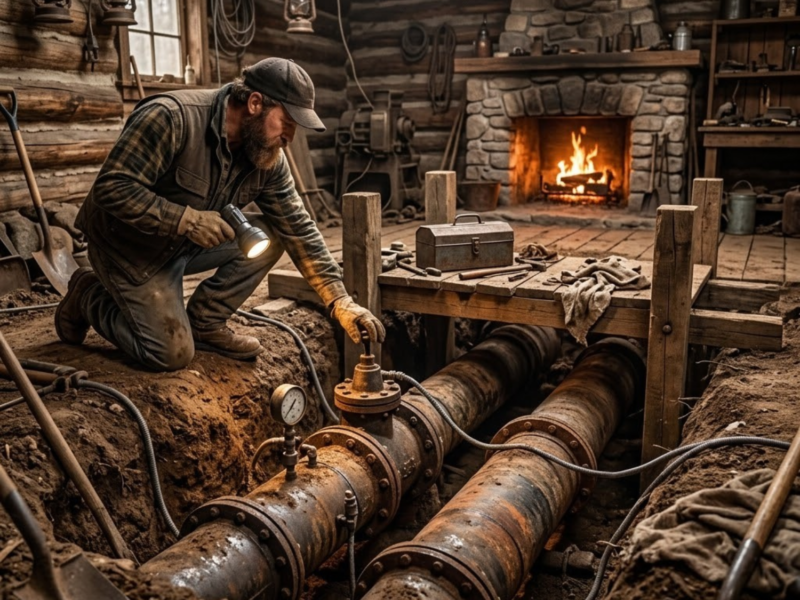
Settlers Laughed at His Underground Heat Recovery Duct — Until It Kept His Cabin 71°F Warmer
THE FIRST TEST BURN
On September 23rd, 1841, Thomas lit the first full-operation fire in his modified fireplace.
The morning temperature was a crisp forty-eight degrees. He started a moderate fire of split oak. Within minutes, he saw the visual distortion of shimmering hot air entering the secondary base passage.
He walked to the far end of the cabin, knelt by the stone platform, and held his hand near the gaps between the rocks. Warm air was flowing upward—not intensely hot, but steadily producing a gentle, pervasive warmth.
Over the next four hours, Thomas monitored the system. The floor slowly became warm across its entire surface. The stone platform absorbed the heat, acting as a thermal battery. The cabin’s interior temperature rose significantly, achieving a comfortable differential using half the wood a standard fireplace required.
The real test came that evening. Thomas let the fire die down to coals around sunset. In a traditional cabin, the room would have grown frigid within the hour.
Instead, the cabin behaved differently. The floor remained warm beneath his stockinged feet. The stone platform radiated stored energy. By midnight—six hours after the fire had effectively gone out—the cabin interior remained comfortable enough that Thomas needed only a single blanket for sleeping.
William Cass arrived at Thomas’s cabin on an October morning when frost covered the ground. Shivering in his heavy coat, William stepped inside to return a borrowed augur—and stopped dead in his tracks.
The cabin was warm. Not the marginal, drafty warmth of a space barely fighting off the frost, but a deep, encompassing heat. Thomas was working in his shirtsleeves.
William walked the length of the cabin, felt the warm floorboards, examined the stone platform, and listened in stunned silence as Thomas explained the principles of thermal mass, air convection, and buried wood ducts. Skepticism warred with undeniable physical reality on William’s face. He could not deny what his senses reported: this small cabin stayed warmer while burning a fraction of the wood required by his own drafty hearth.









