Settlers Laughed at His Underground Heat Recovery Duct — Until It Kept His Cabin 71°F Warmer
THE HOCKEY-STICK BORE
Thomas began hollowing the first cedar log on June 17th, 1841. The process combined three distinct techniques to create a smooth, consistent passage through twelve feet of solid wood.
-
Centerline Marking: Using a string coated in charcoal dust, he snapped a straight line down the length of the log to guide all drilling.
-
Initial Boring: Using his two-inch auger mounted on a two-man handle, he bored a pilot hole through the entire length—requiring thirty to forty full rotations to advance a single inch. This took six full days.
-
Enlargement: He switched to the four-inch auger, repeating the grueling process, which took another nine days.
-
Charring and Scraping: To smooth the interior and expand it to six inches, he built controlled small fires inside the passage, charring the wood, then scraping it away with long-handled iron straps.
-
Clay Sealing: He brushed a thin slurry of fire clay over the interior surface to seal imperfections and prevent smoke seepage.
With four hollowed logs completed by mid-August, Thomas began the heavy excavation beneath his cabin floor.
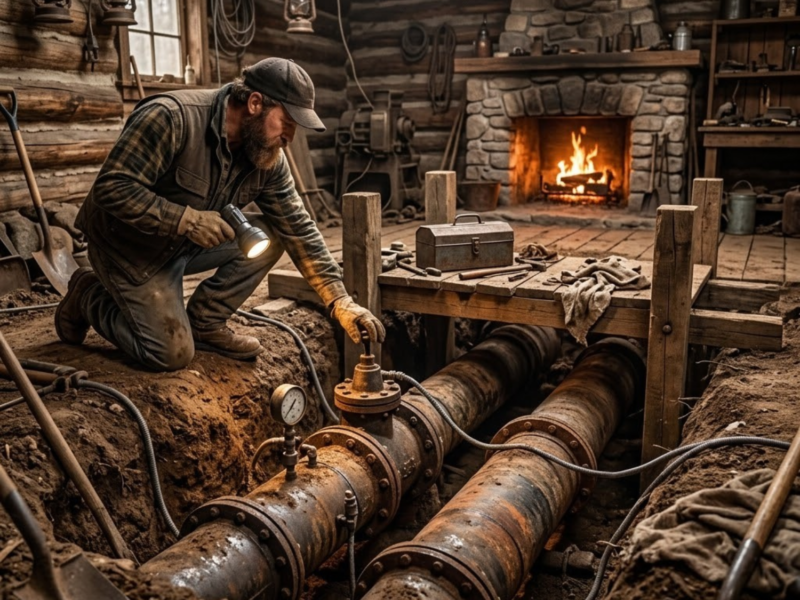
The design called for two parallel trenches running the length of the cabin: twelve feet long, four feet apart, two feet wide, and eighteen inches deep at the fireplace end, sloping gradually to twenty-four inches deep at the far end. This six-inch drop over twelve feet would create natural convection, encouraging hot air to flow through the system without mechanical assistance.
He excavated eight cubic yards of earth by hand, carefully checking his level every six inches. Before installing the logs, he lined the bottom of each trench with a four-layer of crushed creek stone to provide drainage and prevent the cedar from resting directly in damp soil.
The fireplace modification required tying the secondary passage at the base of the firebox into the head of the underground ducts. Thomas engineered a sliding stone damper that could control the volume of hot air diverted underground, ensuring the main chimney never lost its essential draw.
Sealing the joints between the twelve-foot logs required a custom compound: fire clay, fine sand, shredded horsehair, boiled pine resin, and linseed oil, kneaded to the consistency of thick bread dough. Packed deep into every joint, it formed an airtight, heat-resistant collar that flexed slightly with thermal expansion.
Finally, he constructed a 700-pound thermal mass collector at the terminus of the ducts: an 800-pound stack of flat river stones stacked openly in layers, allowing hot air to permeate the pile before radiating into the cabin above. Loose split-log floorboards laid over a two-inch air gap turned the entire floor into a massive, warm radiating blanket.