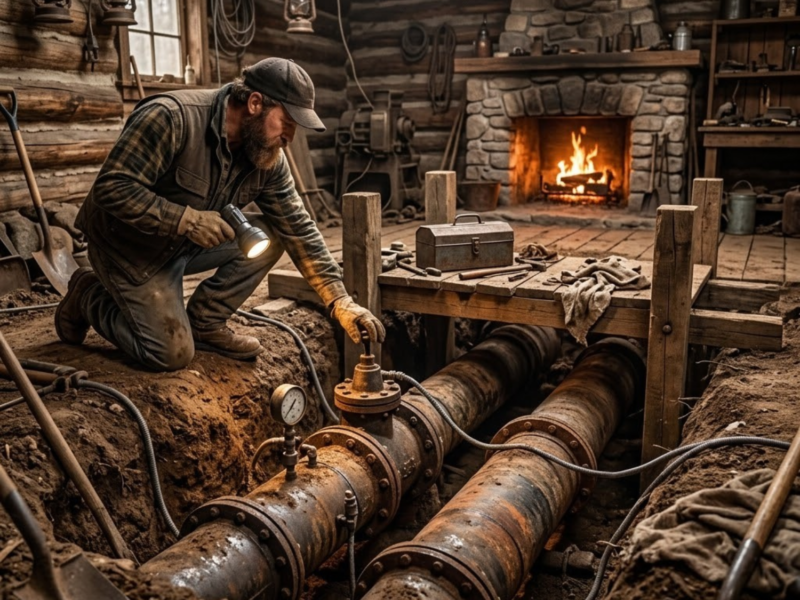
Settlers Laughed at His Underground Heat Recovery Duct — Until It Kept His Cabin 71°F Warmer
THE MERCANTILE LIBRARY
Thomas left the Dakota Territory in April of 1841 with a specific, singular purpose. While other trappers and settlers traveled south to St. Louis primarily to sell furs, buy ammunition, and spend money on whiskey and entertainment, Thomas went to learn. He had saved modest wealth from two years of successful trapping and intended to invest that money in knowledge rather than goods.
The city held libraries, technical workshops, and men who understood engineering principles that were completely unknown on the frontier. Thomas planned to extract every piece of information relevant to his obsession with underground heating.
The St. Louis Mercantile Library allowed visitors to read technical books and journals for a small daily fee. Thomas spent twelve grueling days there, reading everything he could find about thermodynamics, thermal mass, and building construction. Most of the books were written for educated audiences, filled with complex mathematics and terminology Thomas barely understood, but he worked through them methodically, taking copious notes in a journal he had brought specifically for this purpose.
He learned that heat moved through three mechanisms: conduction, convection, and radiation. He learned that different materials stored heat differently, with dense stone and earth holding warmth far longer than wood or ambient air. He learned that the Romans had indeed built hypocaust systems exactly as his grandfather had described, and that these systems had operated efficiently for centuries across the ancient world.
Yet, reading about theoretical principles was vastly different from understanding practical application. Thomas needed to see real heat systems in operation.
He visited a foundry on the western edge of St. Louis and spent an afternoon watching how workers managed heat from their massive industrial furnaces. The owner, a German immigrant named Friedrich Hess, was initially suspicious of the rugged frontier trapper asking technical questions. But Thomas’s genuine interest and surprisingly intelligent inquiries eventually won him over.
Friedrich explained how they used brick channels to route hot air from the central furnace to different parts of the foundry floor. He showed Thomas how they controlled airflow using iron dampers and how they prevented smoke from backing up into work areas.
Later, Thomas visited a commercial brewery and studied their cooling system, which used subterranean chambers to maintain stable temperatures year-round. He examined a wealthy merchant’s townhouse that had been built with a basement furnace and metal ductwork routing warm air to upper floors.
Each example taught him something vital about moving heat, controlling airflow, or utilizing thermal mass. He filled his journal with cross-section sketches and mathematical notes, building a mental library of techniques that might be adapted to raw frontier conditions.
The critical insight came during his final week in St. Louis. Thomas was examining a brick kiln used for firing pottery when he realized that the physical principle he needed was simpler than he had been imagining. He didn’t need elaborate metal ductwork or expensive manufactured components. He needed passages that could contain hot air long enough for that heat to transfer outward into surrounding material.
On the frontier, he had abundant access to one material perfectly suited for creating such passages: timber.









