Settlers Laughed at His Underground Heat Recovery Duct — Until It Kept His Cabin 71°F Warmer
THE WEEPING COLD
The winter of 1841 to 1842 was severe, bringing sub-zero temperatures and howling blizzards that tested every homestead in the territory.
While William Cass and James Burton struggled to keep their families warm, burning through cord after cord of split timber while fighting drafts through their chinking, Thomas’s cabin maintained a stable, comfortable sixty to sixty-five degrees with minimal stoking.
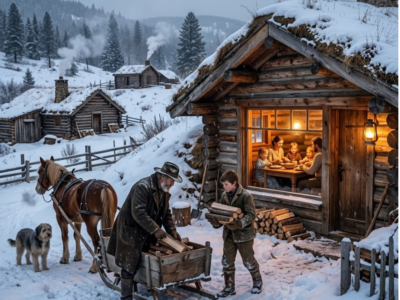
During the height of a three-day January blizzard that dropped temperatures to minus-eighteen, Robert Henderson—whose oversized stone fireplace had utterly failed—dragged his freezing wife and children across the snowy 50-yard gap to Thomas’s door.
The Henderson family spent four days sheltered in Thomas’s cabin. Despite six people occupying a space designed for one, the heating system maintained stable, life-saving temperatures throughout the emergency. Robert watched in silent awe as the small firebox consumed a fraction of the wood he had wasted in his own failed hearth.
When the storm cleared, Robert asked Thomas to help him construct a similar underground duct system for the cabin he intended to rebuild.
Thomas agreed, establishing a strict rule: I will teach you the principles and help with the critical phases, but you will do the heavy labor yourself.
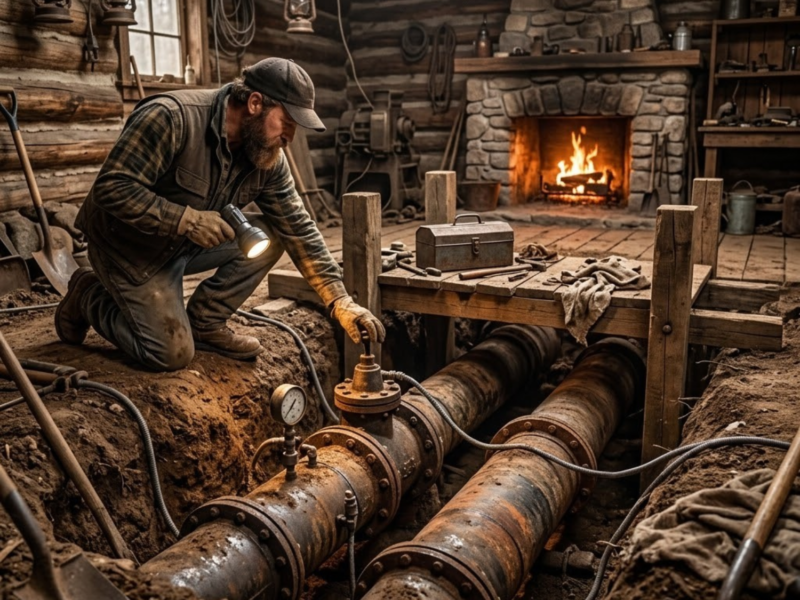
Robert spent weeks selecting cedar logs, boring them out with augers, and digging trenches. Through his stubborn sweat, the technology crossed the threshold from an eccentric hermit’s experiment into practical frontier knowledge.
Over the next five years, the Mercer System spread organically across the northern Dakota Territory, Montana, and Minnesota. Settlers adapted the design using available materials—some substituting hollowed logs with dry-stacked stone channels, others building heated sleeping benches directly over the duct runs.
Thomas never promoted his innovation, never sought patents, and never charged a fee. To him, the knowledge belonged to the land and the people who fought it.