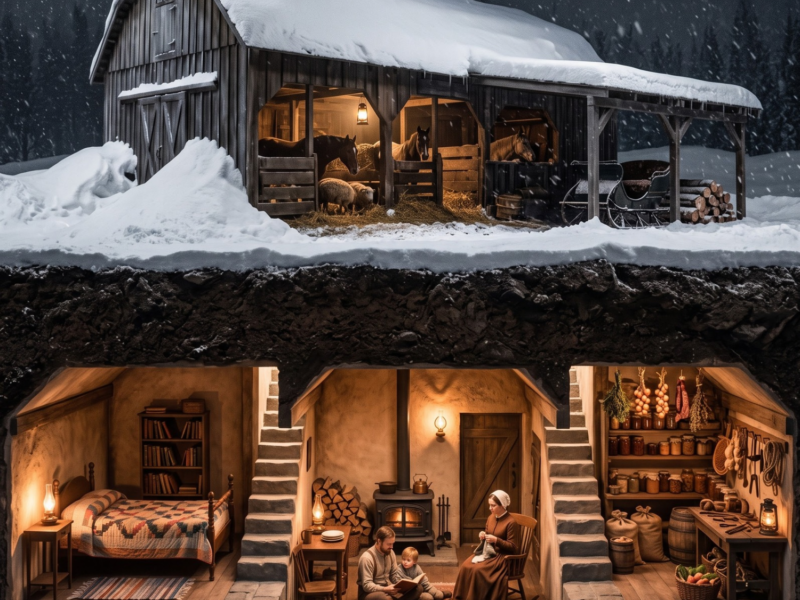
They Called Her the “Buried Barn Woman”—Until the Blizzard Proved Her Right ❄️
THE KILLING FROST OF ’87
The morning of January 7th, 1887, arrived without sound.
The horses stood wrong in their stalls—unnaturally still, heads low, ears pinned back against the north wall. The air lay heavy and thick over the valley.
Elizabeth read her thermometer by the flat gray light of dawn: 9° above zero. By midday, the mercury slid below zero and kept falling. By nightfall, the blizzard struck.
The snow came sideways, driven by thirty-mile-per-hour winds, turning the world into a blind, roaring whiteout. Out on the range, cattle drifted before the wind until fence lines stopped them, bunching and dying by the hundreds, frozen upright in the drifts with frost thick as fur across their backs.
In his fine cabin, Gideon Ashford burned wood around the clock, yet his thermometer refused to climb past thirty-four degrees. His wife heated smooth riverstones on the stovetop, wrapping them in wool to tuck beneath their children’s feet, but the stones went cold within the hour.
Up the road, old Ezra Coleman watched helplessly as the dry, killing cold invaded his large, drafty cabin, worsening the deep rattle in his aging father’s chest.
And down below the barn floor, Elizabeth Carol kept her small, disciplined evening fire burning for two hours, then let the bank stone carry the rest.
Outside, the temperature hit thirty-one below zero. Inside the underground chamber, the thermometer read a steady, beautiful fifty-six degrees. The animals above breathed their patient heat into the oat straw; the earth wrapped its ancient arms around the stone walls; and the small family slept in peace.
Then came the crisis in the dead of night.
Elizabeth woke to a wrongness in the air—a thickness, a heaviness. The kerosene lamp guttered low, its flame shrinking to a thread, starving for oxygen. Eda stirred on her pallet, clutching her head. “Mama, it hurts. The room feels small. I can’t get a breath.”
Elizabeth knew the nightmare instantly: Carbon monoxide. The vent was blocked. The snow outside had packed the leeward mouth of the clay tile, and the room’s own rising breath had frozen it solid into an ice plug.
She scrambled up the ladder, throwing her shoulder against the hidden hatch. It held fast—sealed shut by a solid sheet of frozen snow drifted across the barn floor above.
For one white, terrifying instant, she saw the arithmetic: if she did nothing, they would simply fall asleep and never wake up.
With desperate strength, she braced her legs against the rungs and heaved once, twice, three times. On the third heave, the frozen seam cracked like a gunshot. The hatch gave way, spilling loose snow down into the chamber alongside a magnificent, life-saving rush of freezing outdoor air.
Cold! The sweetest thing she had ever felt.
Directing Silas to keep his sister’s head high near the opening, Elizabeth scrambled out into the howling dark of the barn. Shielding a wick flame with her cupped hand, she navigated the drifts to the outer leeward wall where the clay tile emerged.
The pipe was choked white with ice.
She heated the iron head of the fireplace poker in her guttering tin wick-lamp, thrust it hissing into the throat of the pipe, and worked it furiously against the ice plug—withdrawing it, reheating it in the flame, driving it back in—until at last the plug blew outward with a wet, popping sigh.
Far below her, the room drew its first deep, shuddering breath of fresh air.
When she climbed back down, Eda’s color was returning, and the lamp burned straight and tall. They had stared directly into the mouth of the trap, and they had beaten it back.









