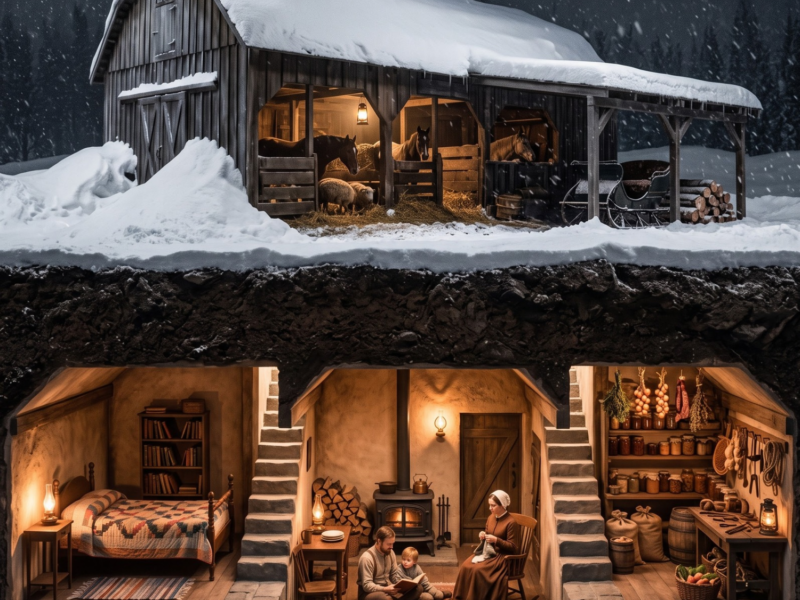
They Called Her the “Buried Barn Woman”—Until the Blizzard Proved Her Right ❄️
THE RECKONING IN THE BARN
When the storm finally broke its grip three days later, Gideon Ashford wrapped a wool scarf across his face, bound a flask of hot water against his chest, and set out across the drifted prairie toward the Caro homestead.
He moved with a heavy heart, steeling himself for the tragedy he was certain awaited him: a cold, hidden hole in the ground, and a mother frozen over the bodies of her children.
He forced the heavy barn door open against the drift and stepped into the dim interior.
The horses lifted their heads, breathing normally. Fresh hay filled the racks. Someone had broken the ice on the water troughs not long ago.
And then, from beneath his boots, a small, clear voice floated up: “Mama, is that Mr. Ashford up there?”
A narrow panel swung open in the floor, and Elizabeth Carol climbed out of the earth holding a lantern. Her face was worn down to the bone, but her cheeks were flushed and warm.
Gideon followed her down the ladder into the chamber. The warmth met him instantly—not the desperate, dry heat of a stove fighting a losing battle, but a steady, profound envelopment that made his shoulders drop.
He pressed his bare hand against the western wall. It was warm. He checked the thermometer on the shelf: 56°.
Outside, his own family was shivering in a thirty-degree house; down here, fifty-six degrees reigned while the world outside stood at thirty-one below zero.
Gideon stared at her, the guilt rising in his throat like floodwater. He reached into his coat, pulled out his notes, and could find no words grand enough.
“I told you winter would measure it,” he finally whispered, his voice cracking with hard-earned respect. “And it did. You passed, and the rest of us failed. And I have lived too long, and buried too many, to be too proud to say so out loud.”
EPILOGUE: THE DOOR LEFT UNLOCKED
The valley’s attitude shifted like the turning of the seasons.
The Reverend Amos Ror arrived soon after to inspect the premises, braced for a righteous rescue; he climbed down into the pit, looked at the thriving children, felt the radiant stone walls, and climbed back up into the daylight without speaking a single word of condemnation. He quietly dropped the matter of custody forever.
Vera Appawite visited with a notebook and a sharpened pencil, copying down the dimensions and venting angles to share with struggling families.
Levi Straoud began stocking clay drain tile and fire brick in quantities he had never imagined selling.
One by one, the homesteaders of Dunore Culie adjusted their perspective. Root sellers were deepened; back walls were battered; wool curtains were hung at ladder bases. The valley stopped whispering about the “barn-buried woman” and began asking quietly if the widow Carol might come and inspect their foundations.
Years passed. Eda grew into a sharp-eyed young woman who taught school in the valley; Silas raised a family of his own on an adjacent homestead, building his own refined version of the underground chamber for his children.
Elizabeth Carol never became famous beyond the horizon of her own Montana hills, nor did she desire to.
She lived out her days in the shadow of the great hill, watching the seasons roll across the prairie. When curious travelers asked her how she had managed to conquer the most terrifying winter in the territory’s history, she would always offer them the exact same plain, unpretentious truth:
“I never tried to outrun the winter,” she would say, wiping her hands on her apron. “I hadn’t the wood for it, nor the strength. I only ever refused to let it steal the little warmth I’d managed to make.”
And if you ever travel through that high Montana pass today, long after the original barn has weathered into history and modern steel furnaces hum in every cellar, you will still find people who point toward a certain green-painted door set flush into a rise of earth.
They will tell you about the woman who dug her way down into the dark to save her children.
And they will remind you of the fundamental rule that carried them through the ice: The winter measures everything you build. So build a little deeper than the trouble can reach, keep your doors unbolted for whoever is cold, and let the earth keep you safe.









