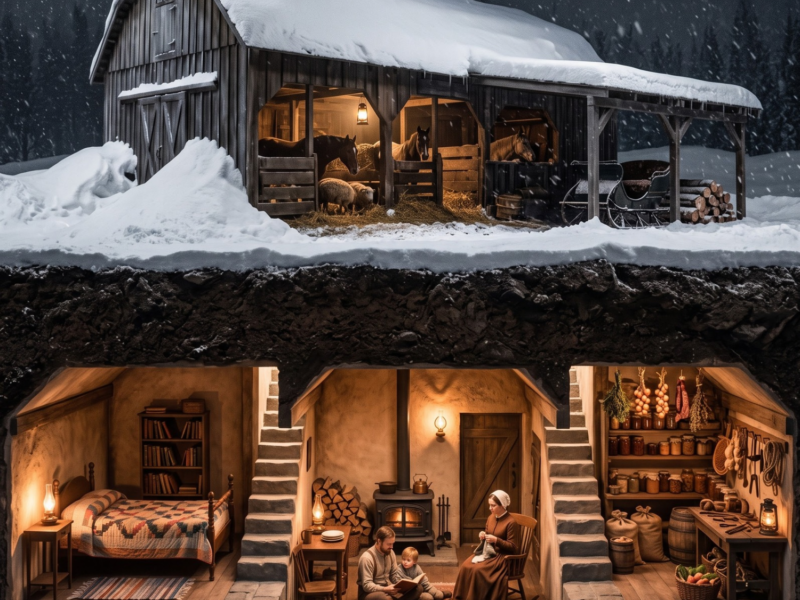
They Called Her the “Buried Barn Woman”—Until the Blizzard Proved Her Right ❄️
THE REALIZATION IN THE LITTER
That one sentence changed the whole shape of her nights.
Once she had written it, she could not stop seeing it. The room will not keep it. Every hour she spent feeding the stove became an hour spent carrying water in a cracked bucket.
It was on an errand late in October that the barn told her its secret. She had crossed the frozen yard after supper to look in on the animals. The wind cut across her face like a drawn razor, but the moment she hauled the heavy plank door shut behind her—with the wind’s teeth on the far side of it—the air changed against her skin.
It was not warm, but it was air that did not lunge and did not retreat. It was air that simply sat, holding a temperature of its own that had nothing to do with the killing cold ten feet away.
The three horses stood dozing in their stalls, their big bodies giving off a slow, patient animal heat into the dark. The old mule breathed softly near the back wall. Above them all, the oat straw loft sat thick and dry, packed nearly to the roof beams, holding warmth up against the underside of the roof like a folded quilt. Along the north side, Tobias had banked earth against the foundation sill years ago, breaking the wind and sliding it away without ever reaching the floor.
Elizabeth pulled off one glove to retie a halter. Her bare fingers, out here in an unheated barn on a night when the thermometer would soon drop below zero, did not go numb.
She stood very still with the halter rope in her fingers and looked down at the packed dirt floor and up at the black weight of straw overhead. And something deep in her mind turned slowly over: The barn was not making much heat at all. The barn was keeping what little heat it was given.
A family did not need a house that could make a great deal of heat. A family needed a place that would flatly refuse to let heat go.









