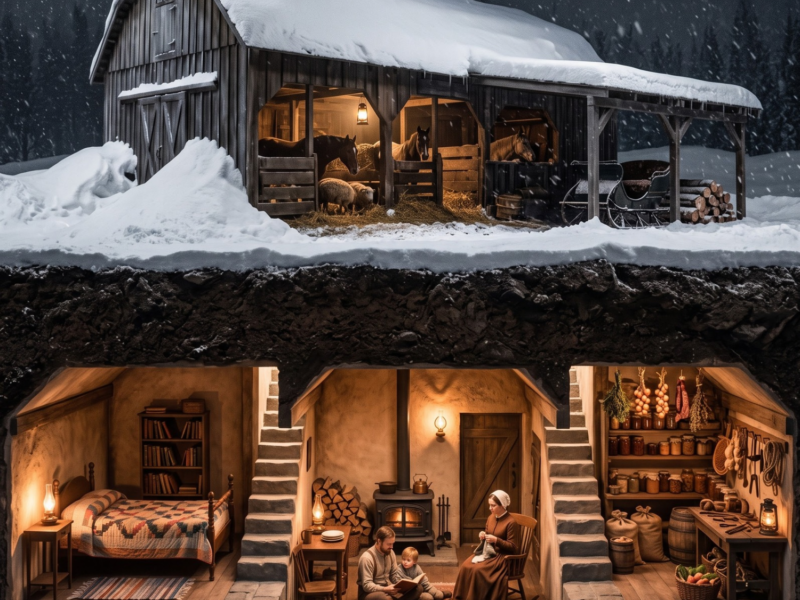
They Called Her the “Buried Barn Woman”—Until the Blizzard Proved Her Right ❄️
THE INHERITANCE OF LESSONS SILENTLY TAUGHT
Her name was Elizabeth Carol, and she was thirty-four years old the autumn she stopped believing that another ordinary winter would spare her family.
She lived at the ragged eastern edge of the Culie, where the good bottomland gave out and the sagebrush began, on a homestead that had never once turned a real profit and had never once been given up on either. She lived there with her two children. Silas was ten that year—a serious, watchful boy beginning too early to carry himself like a man because there was no man left in the house to carry it for him. Eda was seven, small for her age, quick to laugh when there was anything at all to laugh about, and quicker still to fear.
Their father had been Tobias Carol, a builder of the plain and useful kind, the sort of man a valley leans on without ever quite noticing it as leaning. He had set fence posts that did not heave when the frost came into the ground. He had raised barns that stood square and true through spring gales that flattened lesser work. He had a gift, people said, for keeping weather on the outside of a wall where a man had a right to expect it to stay.
He had died of pneumonia two winters gone, coughing red into a folded rag while his wife held his shoulders up off the tick and lied to him gently about how much stronger he sounded that day. And he had believed her, or had let her believe him—which, in the end, was the last kindness left between them.
No one had ever taught Elizabeth Carol how to build a thing. In that country, a woman was taught to cook and to sew, to doctor a fever, birth a calf, and stretch a barrel of flour across a winter. And those things she knew to the bone. Building was a man’s craft, and she had never once held a plumb line or set a stone in her life.
But she had watched. For twelve years, she had stood at the edge of Tobias’s work with a baby balanced on her hip and a dinner pail in her hand. Without ever being told she was being taught, she had absorbed the handful of truths that mattered:
-
Water needed somewhere to go always, or it would carve its own road and ruin whatever stood in its way.
-
Wind had to be broken and turned before it ever reached the place where people slept, because wind that got inside a wall could not be argued back out of it.
-
A heavy load wanted honest support directly beneath it, set square on something that would not shift, or sooner or later it came down.
Tobias had rarely spoken any of this aloud. He had simply done the thing the right way over and over, season after season, until the right way was the only way she could picture in her mind. And now that he was two years in the frozen churchyard ground, those silent lessons were nearly the whole of the inheritance he had left her—worth more than the deed to the land or the few dollars in the coffee tin, though she had not understood that yet.









