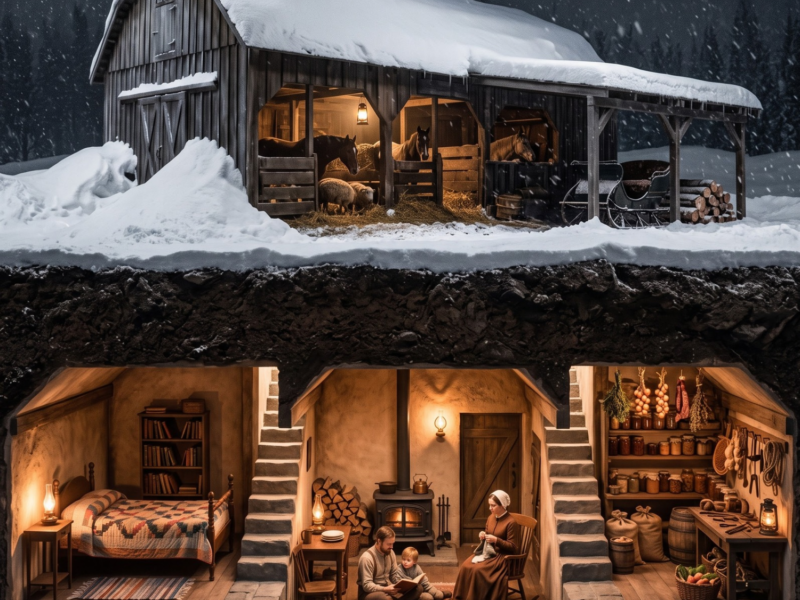
They Called Her the “Buried Barn Woman”—Until the Blizzard Proved Her Right ❄️
THE LEDGER OF THE COLD
She had begun to understand it the winter before the winter that had come within a breath of taking Eda from her as well.
The child had caught a cold in December that would not let go, and by January it had gone down into her small chest. Night upon night, Eda coughed until her lips lost their color, and her breath came in thin, whistling threads that reached across the dark cabin and woke her mother from the far edge of sleep as surely as a hand on the shoulder.
Elizabeth had fed the stove through those nights until her eyes burned, splitting kindling by lamplight when the split wood ran low. She had watched a whole season’s labor of cottonwood and pine dwindle against the cabin wall while the cold pooled along the floorboards before every dawn, gathering around the beds like something patient and hungry that the fire could push back but never drive off.
Nearly the entire winter’s woodpile was gone before the deep heart of February had even passed, and the girl still lay burning and shivering by turns. There were mornings when Elizabeth pressed her ear flat against that small chest and could not tell for one endless, suspended second whether it still rose and fell at all.
When the aspens along the creek went gold again in the autumn of 1886 and the new woodpile began once more to rise beside the cabin door, Elizabeth stood and looked at it one evening and felt no comfort at all. She understood now that no quantity of firewood on earth could save a house that would not hold what the fire gave it.
Her cabin looked proper enough to any eye that passed on the road: squared logs chinked between with clay and dried grass packed into the gaps, roofed with split shakes over a layer of treated canvas, floored with rough planks laid across earth that three years of boot heels had tamped nearly to stone. It had a low fieldstone hearth at the north end and a good iron stove. In every visible particular, it was the same kind of shelter a hundred other families in the territory trusted their lives to—trusted precisely because it looked like every cabin that had ever stood through a winter and let its people walk out alive in the spring.
But when the north wind came down the full length of the valley, the cabin turned to a sieve in her hands. Cold slit up between the floor planks like water finding a crack. Frost crept along the base logs and stood in white ferns by morning. The door shuddered and knocked in its frame all through the black hours. And when the wind swung around hard to the northwest, the smoke gave up on the chimney altogether and rolled back down into the room in a low, bitter cloud.
She had fought it the only way she knew: stuffing rags into every crack she could find with a knife blade, hanging quilts against the coldest wall, pressing damp moss by the fistful into the failing chinking, nailing a folded blanket over the window, banking snow against the north wall to the sill.
And still, night after night, the house lost heat faster than the stove could manufacture it.
So at last, in her exhaustion, she began to do a strange thing. She began to write down numbers. She kept a ledger—a plain paper account book Tobias had once used to tally lumber—and recorded the cold:
-
Outside: 18°.
-
Cabin floor before dawn: 29°.
-
Hearth still warm to the hand, but the air of the room falling all the same.
She wrote these figures by lamplight while the children slept. And one night, beneath a column of those numbers, she wrote a single flat line in her cramped, careful hand that held more quiet despair than any weeping could have: The fire works hard, but the room will not keep it.









