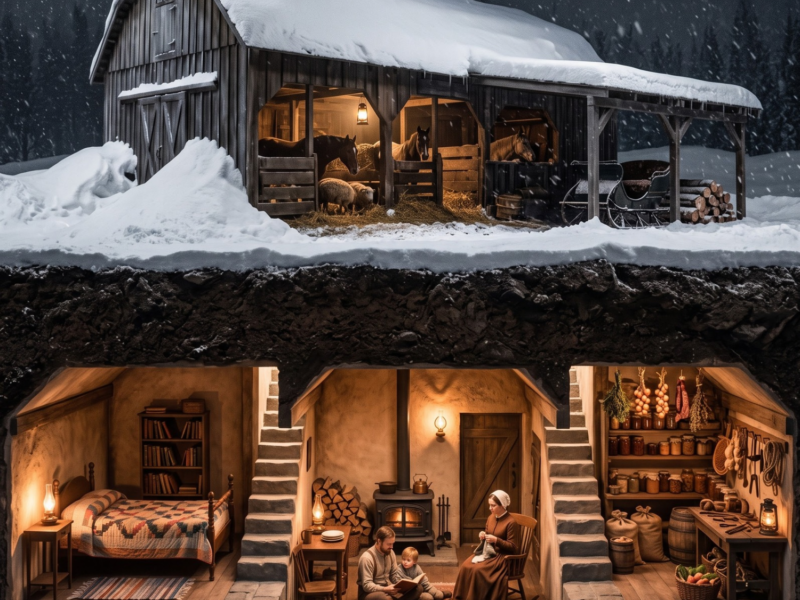
They Called Her the “Buried Barn Woman”—Until the Blizzard Proved Her Right ❄️
THE BURROW BENEATH THE HOOF
She did not sleep at all that night. She lay in the failing cabin with the two children breathing on either side of her, listening to the door knock and shudder in its frame. And for the first time in two years, that sound did not fill her with dread. It filled her with arithmetic.
The next morning she carried three things out to the barn: a length of twine, Tobias’s folding carpenter’s rule, and a stub of charcoal. She measured in silence. She would build directly beneath the deepest part of the oat loft in the center of the barn, where the earth underfoot struck firm and solid, and where the roof carried its heaviest blanket of straw overhead.
Nine feet wide, thirteen feet long, six feet and eight inches down into the clay.
Deep enough that a woman could stand upright in it, and a grown man would not have to stoop. Enough room for a rope bed, two small pallets, a narrow plank shelf, a lamp, a water crock, and a weathered trunk.
She wrote the figures in the ledger, and beside them she wrote the one word the whole thing turned upon, underlined twice: DRY.
It was not a root seller. She carefully refused that word, for a root seller was a hole to keep potatoes from freezing, and potatoes did not mind dampness. Damp was the death of people. Nor was it a raw, wretched dugout that a family lived in their first hard year and were ashamed of.
It was a sleeping room built beneath a working barn, engineered to catch and store and hold the heat that rose off living animals and the fire she would build.
The digging began in the raw first mornings of November, in the hour before light. The first foot came up as dense yellow clay packed so tight by ten thousand seasons of freeze and thaw that it was nearer to soft stone. Beneath that lay a treacherous bed of scattered rock, and through the whole of it ran the dry, stubborn roots of sagebrush.
Her instruments were thin: a spade worn bright at the edge, a mattock with a cracked helve bound in wet rawhide, a dented tin bucket, and a loop of old hay rope. She hauled the loosened earth up out of the pit one heavy bucket at a time through a temporary hinged opening cut in the barn floor.
She could not heap the diggings behind the barn where passing eyes could find them. She carried the spoil out in the dark, bucket by bucket, on a wooden stone boat, spreading it thin across shallow depressions behind the barn where spring runoff gathered, working each load into the ground with the back of the spade until the landscape looked untouched. It doubled her labor and halved her sleep, but a secret half-kept was a secret already lost.
Silas caught her at it on the second morning—not all of it, but enough. He watched her from the fence line with the careful sidelong look of a child who has begun far too soon to worry about the sanity of the one grown person left to keep him safe. And Eda, when told they would sleep in the ground, asked with wide, unblinking eyes, “Are we going to live like foxes?”
“Foxes stay alive through the hardest winters there are,” Elizabeth told her, kneeling to her level. “Because they know exactly where the wind cannot reach them, and they go there, and they let the world howl itself out overhead.”









