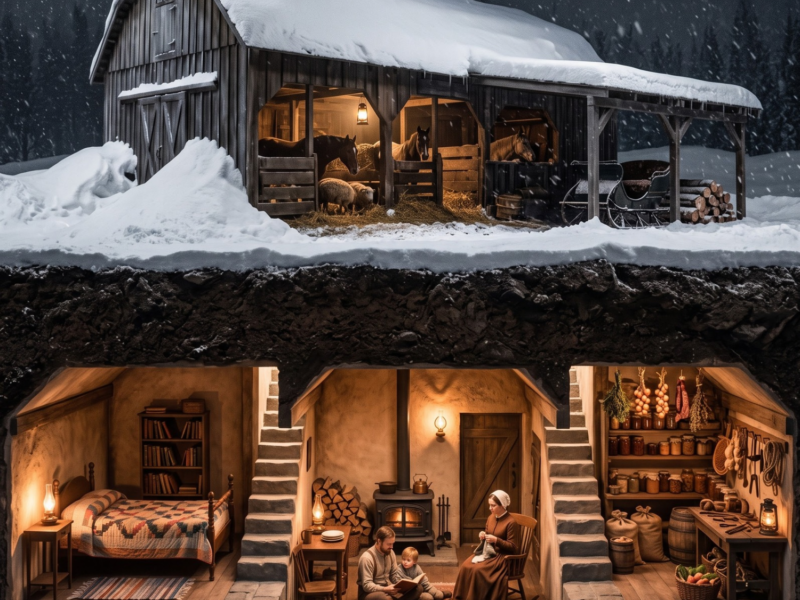
They Called Her the “Buried Barn Woman”—Until the Blizzard Proved Her Right ❄️
THE VALLEY'S EYE
The valley found her out before the first true snow fell.
Gideon Ashford, whose land ran up hard against hers, had seen her carrying bedding to the barn. Over his own hot supper, he mentioned it to his wife; his wife mentioned it to her sister; and by Sunday meeting, the story had grown legs.
“She’s taken to sleeping out in the barn,” Vera Appawite announced with the relish of a woman delivering an elegy. “Under it.”
The valley’s pity curdled into something sharper. It became an established, whispered fact that Tobias Carol’s widow had lost her mind to grief.
Then came the warnings. Levi Straoud, at the crossroads store, warned her of clay tile cellars filling with spring thaw water and rotting winter crops. Old Ezra Coleman—who had outlasted more Montana winters than any man alive—rode up to her woodpile on his old roan, looked down from his saddle, and told her plainly: “Damp ground ruins lungs. Freeze and thaw will shift a wall. Smoke will kill a family stone dead in their sleep. Winter will measure it.”
Worst of all was the Reverend Amos Ror. He rode up with two church councilmen, announcing from the saddle that he had come to inspect the premises before the deep cold arrived, to judge whether Christian children were being kept in a fit home or needed to be removed from her custody.
Elizabeth stood in the open barn door with her ledger in hand. She had a single beat of her heart to choose: bar the way and confirm their suspicions of madness, or open the hatch and expose her life’s work to hostile eyes.
“Come down and see it then,” she said, her voice flat and steady. “Come down and judge it with your own eyes, since you’ll none of you take a widow’s word. But you will judge the thing itself, Reverend. Not the story this valley has spun out of its own fear.”
They climbed down the ladder—awkward and stiff in their heavy coats.
They stood together in the low, warm chamber. And they looked.
There was no stench of animals. No dripping water. No weeping seams. The walls stood dry and true to the touch. And the warmth—steady, enveloping, radiating out of the stone itself—was unmistakable.
Hollis, the farmer whose little ones coughed through every February, crouched down without a word and laid his bare hand flat against the western wall. He felt the stone, warm as a living thing.
The Reverend Ror stood stiffly, hunting for fault. “It is warm for now,” he conceded coldly. “On a mild autumn afternoon. But the winter has not yet come. I will come back the moment the first hard storm breaks. And if I find these children suffering in this pit, the council will remove them from your keeping that very same hour.”
He climbed back up into the daylight. And Elizabeth watched him go, knowing she now had two clocks ticking against her: the oncoming winter, and the preacher waiting on its heels.









