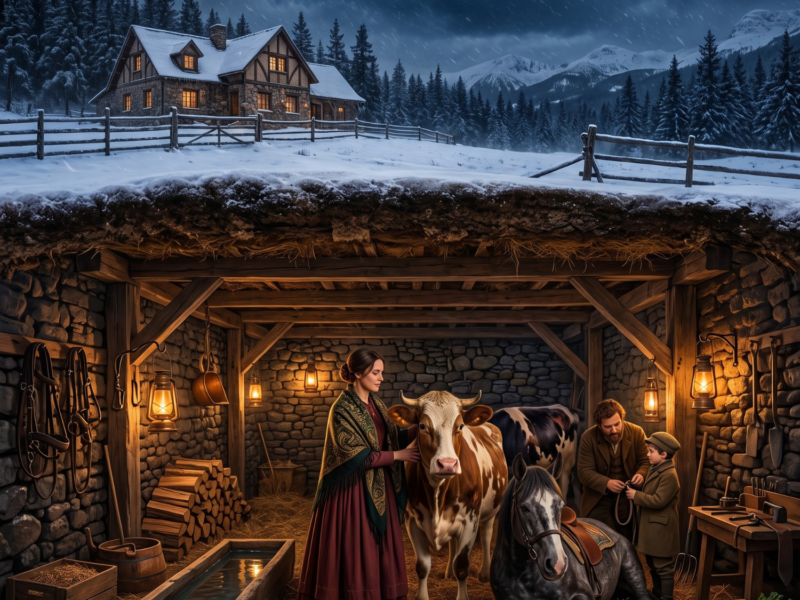
They Laughed at Her Farm With No Barn— Until Winter Revealed What She Built Below|Old west survival
The Spring Thaw
That afternoon, the brilliant sun broke through the clouds, and the brutal task of digging out began across the valley. When the main paths between the isolated farms finally began to reopen, the first rider to traverse the snow was Boone.
He rode his exhausted bay horse up the track and dismounted in front of the Hale cabin. He looked at the massive drifts, his face weary and lined with the stress of the storm.
“The cattle?” Boone asked, skipping pleasantries, bracing himself for the grim answer.
Martha, standing on the cleared porch with a cup of hot tea, simply pointed behind the house.
Elias walked out of the cabin and led Boone wordlessly to the hillside. The path to the dugout had been cleared wide.
Boone stood before the low doorway carved into the earth. He took off his hat and bent his tall frame, stepping beneath the timber frame and into the warm darkness of the shelter.
He stood there for a long time. He meticulously examined the thick support posts, testing their rigidity. He looked at the dry, straw-covered stone floor. He traced the path of the engineered drainage trench with his boot. He looked up at the clever, hooded ventilation shafts drawing the air.
Finally, he looked at the three massive, healthy animals eating calmly from the elevated hay rack inside.
He reached out and placed a bare, calloused hand flat against the packed earthen wall. He felt the stored, radiating warmth of the planet itself.
The mocking, arrogant smile he had worn outside the general store in November was entirely gone.
Boone turned to Elias, his eyes filled with a profound, quiet awe. “Did you come up with this, Hale?”
Elias crossed his arms. He was a proud man, but he did not take credit for a victory that was not his own. He turned toward the doorway, looking up at Martha, who was standing at the entrance.
“Ask her,” Elias said simply.
Boone stepped out into the blinding sunlight. He studied Martha for a long, heavy moment. The skepticism of twenty brutal winters was warring with the undeniable, living proof standing in the dirt before him.
Then, he asked a completely different question.
“How deep did you dig?”
Boone did not apologize for his mockery at the store. He did not offer empty praise. Martha did not need him to. His highly technical question about the depth of the excavation had already said everything that needed to be said between them.
A week earlier, he had wanted to buy her freezing cows for almost nothing, certain of their death. Now, he was intently studying the slope of her drainage trench, the spacing of her support posts, and the aerodynamic draw of the two ventilation shafts. He was asking for her knowledge as an equal.
Martha answered what she knew precisely. When he asked about the load-bearing capacity of the clay, something she did not fully know, she did not guess or boast. She simply said, “I don’t know yet. We’re still learning.”
Boone nodded slowly. He respected that honest admission more than any arrogant boast. He put his hat back on, mounted his horse, and rode back to his own farm to check his damaged roofs.
Over the following days, as the roads cleared, several people from Dry Creek visited the Hale farm. The story of the underground barn had spread rapidly.
Not everyone wanted to dig underground. The soil composition and the terrain were vastly different on every property; a hillside in Dry Creek might be solid clay, while a mile away it might be shifting sand or impenetrable bedrock.
But no one laughed at Martha Hale anymore. No one made jokes outside the general store before taking a much closer look at her hillside.
Winter was far from over. The blizzards returned in January and February. Martha and Elias remained vigilant. They continued daily inspections of the ceiling for cracks, constantly clearing ice from the drainage outlet, and venturing out in storms to ensure the ventilation shafts remained open and drawing air.
But the system held. The earth did the work.
The two cows continued producing rich milk through the darkest, coldest months, providing vital calories for the family. The draft horse remained strong and healthy, ready for the plow. And the Hale family did not have to go to the bank, take a ruinous loan, or sell their land to survive.
By early spring, the last, stubborn patches of snow had finally melted from the southern slope of the hillside. The valley turned a vibrant, muddy green.
Caleb ran outside in the warm morning air and threw open the low wooden door of the shelter. Brilliant, warm sunlight poured into the entrance, casting a bright golden streak across the dry, straw-covered floor.
He turned and looked up at his mother, standing on the porch.
“An underground barn,” Caleb said, shaking his head in wonder.
Martha laughed, a sound free of the heavy dread that had plagued her since August.
The legacy of that winter took root slowly in the valley, but it took hold. The following year, a struggling rancher near the edge of Dry Creek dug a massive feed storage chamber directly into a limestone hillside, keeping his grain dry and safe from pests. Another homesteader built a traditional livestock shelter, but built it significantly lower to the ground, positioning its heavy timber windbreak according to the natural, aerodynamic shape of the land, rather than fighting the wind head-on.
Even Boone, the stubborn veteran, did not copy Martha’s design completely, but that summer, neighbors watched as he spent a week digging deep, meticulously angled drainage trenches entirely around the perimeter of his massive wooden barn.
No one turned Martha Hale into a towering frontier legend. No one raised a bronze plaque or a painted sign bearing her name in the center of town. The harsh reality of frontier life simply went on, moving from one seasonal crisis to the next.
But one crisp, cool morning in late April, Martha walked out to the hillside. She saw Caleb standing in the open doorway of the empty shelter. He had his small, bare hand pressed flat against the dark earthen wall, feeling the cool, solid strength of the dirt.
He heard her footsteps, turned to her, and smiled, repeating the exact words that had started everything so many months ago.
“Ma, it’s warmer down there.”
Martha looked out across the thawing, green fields of their farm, watching Elias hitching the healthy draft horse to the plow, preparing to break the soil for the new season.
This time, she did not need to answer. She just smiled, and let the earth speak for itself.









