They Laughed at Her Farm With No Barn— Until Winter Revealed What She Built Below|Old west survival
The Price of Winter
“If you’re not going to build a barn, you might as well start digging graves for your cattle now.”
The words hung in the frigid air outside the Dry Creek General Store, sharp and biting as the November wind. Boone, a man whose face was a topography of deep wrinkles and sun-leathered skin, spat a stream of dark tobacco juice into the frozen mud to punctuate his sentence. Around him, several local men—hardened farmers and ranchers who wore their survival in this valley like a badge of honor—burst into genuine, booming laughter. It was the kind of laughter reserved for fools and dead men.
Martha Hale stood a few paces away on the wooden boardwalk, her face an unreadable mask. She pulled her threadbare wool shawl tighter around the narrow shoulders of her five-year-old daughter, Ruth. The little girl buried her face in the folds of her mother’s skirt, hiding from the biting chill and the mocking eyes of the men. Martha did not look at Boone. Instead, she fixed her gaze on the northern horizon, where a bruised, heavy bank of gray clouds was beginning to gather, swallowing the jagged peaks of the mountains.
Beside their battered wagon, Elias Hale stood rigid. His large, calloused hands were clenched into fists so tight his knuckles shone white against the cold. His jaw worked, a muscle ticking violently beneath his short beard. He wanted to speak, wanted to defend his pride, but pride was a luxury they could no longer afford.
Boone was no fool, and Elias knew it. The old man had survived nearly twenty winters in this unforgiving valley. He knew the land, the weather, and the brutal arithmetic of survival.
“Sell the cattle,” Boone continued, his tone shifting from mockery to a grim, unsolicited mercy. He stepped off the porch, his heavy boots crunching on the frosted earth. “Sell ’em to me, or sell ’em to the slaughterhouse in town. At least then you’ll still have your money. Winter up here don’t care about your hopes, Hale. It only cares about what’s standing between you and the wind.”
Martha did not answer. Elias simply turned away, grabbing the leather harness of their lone draft horse.
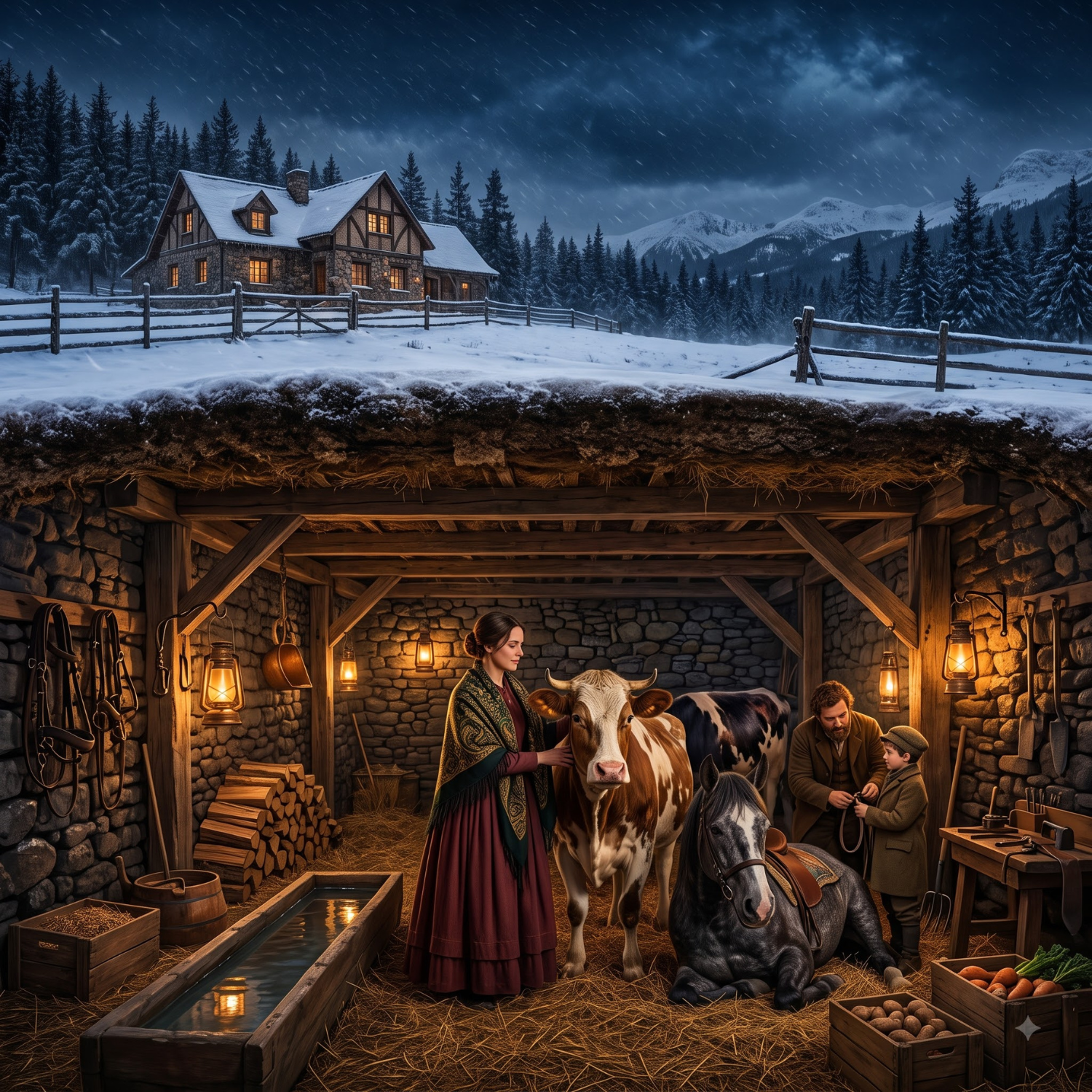
Boone had no idea. None of them did. He had no idea that behind the Hale cabin, hidden beneath the unassuming curve of a low rise, she and Elias were already digging. They were carving something unlike any barn in the history of Dry Creek. A low doorway, framed by raw timber, opened directly into the belly of the earth. Wooden support posts, stripped of their bark and smelling of fresh pine sap, disappeared into the profound, suffocating darkness of the hillside.
It was a desperate gamble. If Martha was wrong, both of their milk cows would die, suffocated or frozen in a muddy tomb. The draft horse, the very engine of their livelihood, might die with them. Without those animals, the Hale family would have zero chance of plowing the fields come spring. They would lose the farm, joining the long, ghostly procession of failed homesteaders who slunk back East.
But if she was right… the very thing these men were laughing at might be their only salvation.
“January will teach you!” Boone called out after them as Elias clicked his tongue and the wagon lurched forward, its wooden wheels protesting against the frozen ruts.
Martha sat on the hard wooden bench of the wagon, holding Ruth close, feeling the rhythmic sway of the wooden axle. She looked back at the distant, looming hillside of their property. She wondered, as the icy wind whipped tears from the corners of her eyes, if everyone else fought winter by building upward, defying the sky with thin wooden walls, what would happen if she simply surrendered to the earth and dug down?