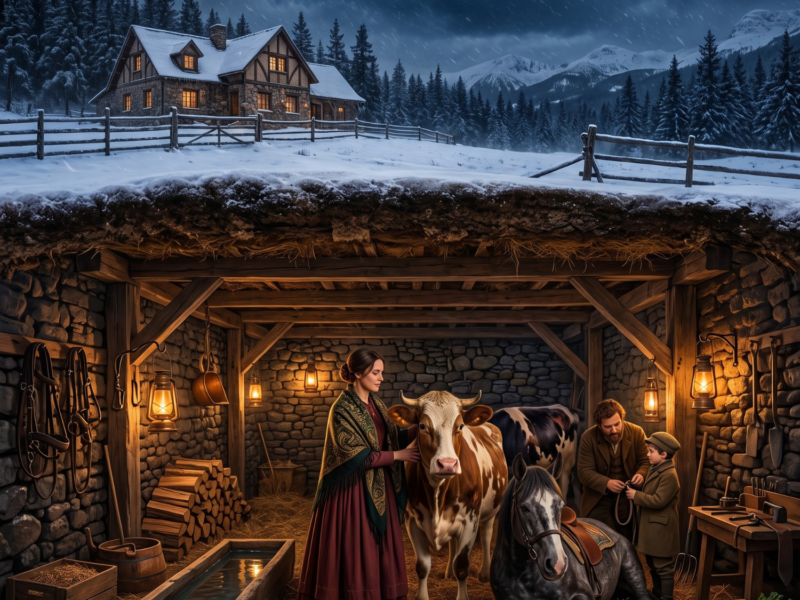
They Laughed at Her Farm With No Barn— Until Winter Revealed What She Built Below|Old west survival
The Dog and the Cellar
Martha had no blueprints. She had no architectural training. She was a farmer’s wife, accustomed to reading the sky, not engineering the earth. But she possessed something far more valuable: a quiet, relentless capacity for observation.
She gathered her clues like precious stones.
First, there was the dog. Barnaby possessed a thick coat, but he was no fool. He always abandoned the wooden porch and chose the foot of the earthen hill whenever the north wind began to howl.
Second, there was the grass. A narrow strip of wild prairie grass growing directly beside the slope of the hill had stayed a vibrant, living green weeks longer than the exposed, frost-bitten pasture just fifty yards away. The earth was radiating a subtle, sustaining warmth.
The third clue came from the old root cellar.
It was a small, pre-existing hole dug beneath the cabin floor where they stored their potatoes, carrots, and salted meat.
One frosty morning, when the puddles in the yard had frozen solid enough to crack under her boots, Caleb opened the heavy wooden trapdoor in the kitchen floor and climbed down the ladder to fetch potatoes for breakfast.
A moment later, his head popped back up. “Ma,” he said, his breath fogging in the chilly air of the kitchen. “It’s warmer down there.”
Martha paused, wiping flour from her hands. She walked over and descended the ladder.
The hollow was pitch dark, damp, and heavy with the rich, loamy smell of ancient earth. But Caleb was right. The biting, razor-sharp cold that cut into her skin on the porch was entirely absent here. The air felt heavy, insulated, profoundly still. It wasn’t warm like a hearth, but it was safe from the freezing point.
An idea, wild and desperate, took root in her mind.
“Caleb,” she said, her voice echoing softly against the dirt walls. “Go fetch the small tin basin and a wooden bucket.”
That evening, Martha placed the tin basin full of water deep inside the root cellar. She placed the wooden bucket, equally full of water, outside on the exposed front porch.
The next morning, the world was coated in a brittle layer of hoarfrost. Martha stepped onto the porch, her breath pluming in the icy air. She looked into the wooden bucket. A thick, solid layer of ice, nearly an inch deep, sealed the top of the water. She had to strike it hard with the handle of an axe to break it.
She hurried inside, threw open the trapdoor, and climbed down into the cellar.
She reached into the dark and touched the water in the tin basin.
Liquid.
It was icy cold to the touch, but it had not frozen. The geothermal mass of the earth had protected it from the freezing air above.
When Elias returned from attempting to patch the perimeter fence, Martha brought him into the kitchen. She showed him the chunk of ice from the bucket, and then showed him the liquid water from the cellar. She explained her theory. A barn built into the hill.
Elias studied the water, his brow furrowed in deep thought. He rubbed his calloused hands over his tired face. Then, he shook his head slowly.
“Martha, it’s madness. Warmer doesn’t mean safe. The earth is heavy. It shifts. It collapses. You dig a hole big enough for two cows and a horse, and you’re just building a grave waiting to cave in. An enclosed space surrounded by damp dirt could suffocate the animals. The moisture alone would rot their hooves.”
“I know the risks, Elias,” Martha said, her voice steady, refusing to back down. “But I also know we don’t have the money for lumber. If we leave them outside, they die. If we build a cheap, thin shack, the wind will take it, and they die. Let me try. Just on a small scale.”
Elias looked at her, his eyes filled with the heavy burden of a man who feels he is failing his family. He still wanted to trust the familiar approach. He wanted walls he could see, built of wood he could touch.
“No,” Elias said softly. “We’ll build a shelter. I can scavenge enough.”
He spent the next three days gathering old, warped boards from the ruined foundation, crooked fence posts he uprooted, and large sheets of heavy, oiled canvas he had brought from back East. He worked feverishly, constructing a temporary lean-to shelter directly against the leeward side of the cabin.
It was a family effort. Martha tied the heavy hemp ropes, her fingers raw from the coarse fibers. Caleb scoured the property, collecting rusted nails, hammering them straight on a flat rock. Little Ruth carried small, proud bundles of golden straw to line the floor.
When it was finished, it looked like a patchwork tent, but it blocked the wind. They led the cows and the horse inside.
For the first three days, the shelter held. Elias looked relieved.
On the fourth night, the wind changed direction.
It did not come from the north. It came howling down the mountain pass from the east, a violent, twisting gale that carried the terrifying strength of a hurricane.
The sound woke Martha instantly. The canvas cracked against the wooden frame like the relentless firing of a bullwhip.
Then came a terrifying, ripping sound. One of the massive canvas sheets tore wide open, the fabric shredding violently in the gale. The wind rushed into the shelter, turning it into a parachute. Two of the main wooden posts, sunk shallowly into the hard earth, tilted upward with a sickening groan.
The animals panicked. The horse neighed in terror, its hooves kicking against the wooden siding. The cows lowed, a deep sound of distress.
“Elias!” Martha screamed, throwing off the blankets.
The entire family rushed outside into the freezing, chaotic night. The wind tore at their nightclothes. They threw their weight against the tilting posts, desperately trying to hold the structure together, fighting to untie the frantic animals and pull them away from the collapsing wood and whipping canvas.
They managed to drag the beasts into the open yard just as the main crossbeam snapped. The entire shelter collapsed into a twisted, chaotic heap of broken timber and shredded fabric.
They stood shivering in the dark, rain mixing with sleet, holding the terrified animals.
By morning, the sun rose on a scene of total devastation. The shelter was nothing but a twisted, useless frame.
Elias stood in the mud, staring at the ruins for a long time. His shoulders were slumped, his hands hanging uselessly at his sides. The reality of his failure was absolute. Wood and canvas could not fight this valley.
Martha walked up beside him. She did not say, “I told you so.” She did not offer pity.
She simply raised her arm and pointed toward the solid, immovable mass of the hillside.
“Let me dig one small chamber, Elias,” she said quietly. “Just a few feet deep. If it doesn’t work, if the earth shifts, we’ll stop. But we have nothing else.”
The failure had fundamentally changed Elias. The pride of the provider had been stripped away by the wind. He still did not truly believe the earth could save their animals, but he had seen with his own eyes how quickly the sky could defeat the old approach.
He looked at the hill. He looked at his wife.
This time, Elias was the first to walk to the tool shed and pick up the heavy iron mattock.









