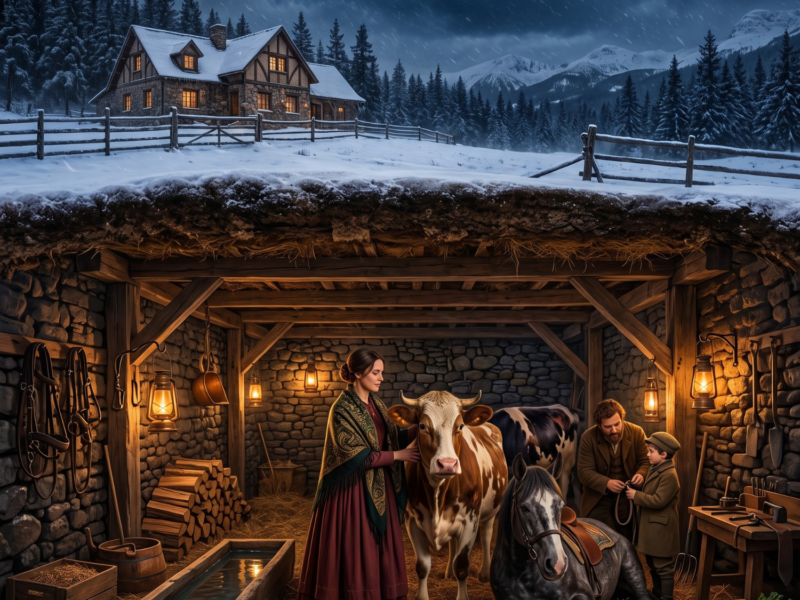
They Laughed at Her Farm With No Barn— Until Winter Revealed What She Built Below|Old west survival
The Sky Turns White
The ultimate test arrived on the first Tuesday of December.
That evening, as the family ate a meager supper of potato soup, a frantic knocking rattled their cabin door. Elias opened it to find a young messenger from town, his horse lathered and shivering in the freezing yard.
“Mr. Hale!” the boy shouted over the rising wind. “The telegraph operator down at the station sent me. A powerful blizzard is sweeping down from the Dakota territory. They say it’s a monster. A whiteout. It’s moving fast, and Dry Creek is going to be struck by the dead center of it. Batten down your hatches!”
The boy rode off into the darkening night, desperate to warn the next farm.
Martha and Elias stared at each other across the table. The time for experiments was over.
The following morning, the sky was a terrifying, unnatural shade of pale yellow. The air was absolutely still, heavy with a suffocating silence that made the ears ring. It was the calm before the slaughter.
Boone appeared at the edge of their property just after breakfast. He was riding his bay, bundled in a massive buffalo coat. For the first time, he was not smiling. There was no mockery in his eyes, only the grave, solemn look of a man preparing for war.
“My barn has survived nineteen winters,” Boone said, his voice carrying clearly in the dead air. “It’s built of thick oak and iron. And I’m still spending the morning adding more ropes to hold the main doors shut. The barometer is dropping faster than a stone.”
He looked at the small, humble entrance of the earthen dugout.
“You have time, Hale. A few hours. You can bring your cattle to my place. I’ve got a spare stall. I’ll shelter them, if you’re willing to pay me back in labor for the hay they eat.”
Martha stepped forward. She looked at Boone’s lined face. She understood, intuitively, the profound magnitude of what he was offering. In a valley where every man fought for his own survival, offering space in a secure barn during a blizzard was the kindest, most generous offer he had ever made them. It was a lifeline.
She looked back at the hillside. She thought of the blisters, the mud, the terrifying moment the earth fell, the precise engineering of the vents, the careful slope of the trench. They had poured their souls into that dirt.
“Thank you, Mr. Boone,” Martha said, her voice steady, ringing with a quiet, absolute conviction. “But we’re going to try this.”
Boone stared at her for a long moment. He didn’t argue. He didn’t call her a fool. He recognized the immovable steel in her spine.
“Then keep those vents clear, Martha,” Boone said grimly, adjusting his reins. “Snow doesn’t have to break through a wooden door to kill what’s inside. Suffocation is quieter than freezing, but it makes you just as dead.”
He turned his horse around and rode away, urging the animal into a gallop.
Suddenly, the two hours they had left before the storm hit did not seem nearly long enough.
The Hale family mobilized. They did not dig any farther. They did not attempt to make any new improvements or grand changes. They simply, meticulously inspected everything they had already built, trusting their labor.
Elias took his hammer and went post by post, driving the wedges tighter, ensuring every support beam was locked solid against the earth.
Martha crawled on her hands and knees along the perimeter, clearing every tiny bit of debris, stray straw, and loose dirt from the drainage trench, ensuring the water flow would be absolutely unimpeded.
Caleb hauled the last bundles of dry straw into the storage corner. Then, following his father’s instructions, he climbed the hill and tied a bright strip of red cloth to the end of a long, ten-foot pole. He drove the pole deep into the earth directly beside the main ventilation shaft, marking its location so they could find it even under ten feet of snow.
Most importantly, Elias took their thickest, heaviest hemp rope. He tied one end securely to the iron handle of the cabin’s back door. He ran the line across the open yard and tied the other end firmly to the heavy wooden frame of the shelter entrance.
If the blowing snow erased the path and blinded them, the rope would physically guide them back. In a true whiteout, stepping five feet from your front door without a lifeline meant walking into eternity.
On the final night before the storm, Martha went down into the dugout alone.
She carried a single candle. The two cows lay quietly in their stalls, chewing their cud, radiating a massive, comforting heat. The draft horse stood resting on three legs, breathing slowly and steadily.
Martha walked to the back of the chamber. She pressed her bare hand flat against the cold, packed earthen wall. She closed her eyes.
She remembered the thin canvas shelter being torn apart by the wind like paper. She remembered the terrifying sound of the snapping timber.
The silence inside the dugout now was absolute, and it was almost frightening.
Doubt, cold and insidious, crept into her mind. A three-night test in autumn was not a three-day blizzard in December. A drainage trench that could handle a heavy rain might overflow and fail against massive volumes of melting snow. A ventilation shaft that worked beautifully today could be buried and choked by a massive drift within an hour.
She was betting the lives of her animals, and by extension the lives of her children, on a hole in the ground.
She blew out the candle and climbed back to the cabin.









