They Laughed at Her Farm With No Barn— Until Winter Revealed What She Built Below|Old west survival
The Collapse of Pride
The rebuilding was a lesson in humility.
Elias, armed with the pickaxe and a fierce resolve, spent the next two days tearing out nearly a third of the ceiling they had just painstakingly excavated. It felt like moving backward, a devastating loss of time as November loomed, but it was necessary.
He scavenged every piece of solid wood on the property. He tore down the remaining corral fence. He dismantled the frame of their ruined wagon. He used the logs to rebuild the support system from scratch.
Instead of spacing the vertical posts five feet apart, he placed them every three feet, creating a dense forest of timber within the earth. He secured the crossbeams more firmly, notching the wood so the joints locked together, distributing the immense weight of the ceiling evenly across the structure.
The chamber became noticeably narrower. The ceiling, once high enough for Elias to stand upright, was lowered, forcing him to stoop slightly.
“There’s no room for pride down here, Martha,” Elias grunted, driving a massive iron nail into a crossbeam with powerful swings of his hammer. Sweat dripped from his nose despite the cold. “When we find a mistake, we fix it. We don’t pretend it isn’t there.”
Martha nodded, her respect for her husband deepening. He had abandoned his ego to save their lives.
They worked symbiotically. While Elias engineered the supports, Martha and Caleb hauled the dirt. They packed the spaces between the timbers with rocks and hardened clay to create a solid, unmoving shell.
After a grueling week, the new supports held. Not a single grain of earth fell from the ceiling.
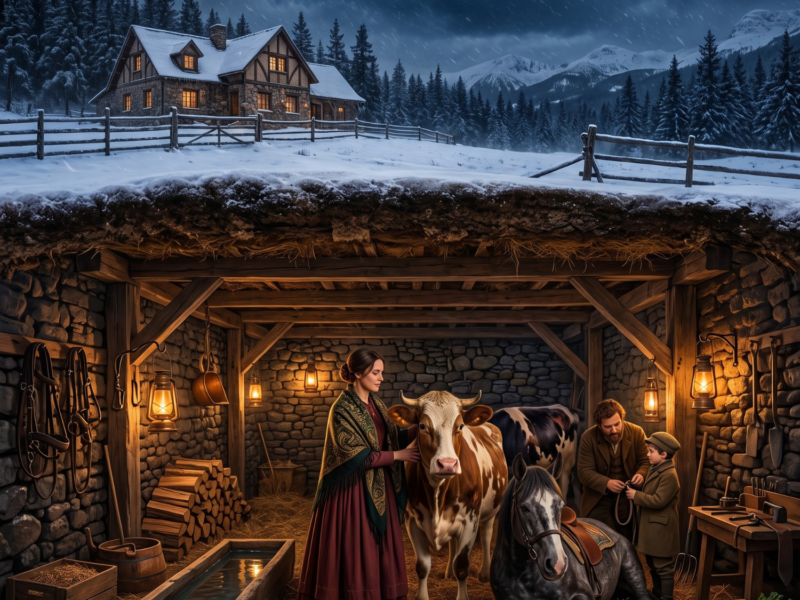
Confident in the structural integrity, they expanded the chamber deeper into the hill. They dug until there was enough space for two wide stalls for the milk cows, a slightly larger stall for the draft horse, and a recessed corner near the entrance for storing the precious winter hay.
It was dark, it was cramped, and it smelled of raw earth and pine sap. But it was strong.
Then, the sky unleashed its next test.
It wasn’t snow. It was a torrential, freezing, late-autumn rain.
The water fell in sheets, turning the valley into a sea of mud. The hillside above the dugout, stripped of its deep-rooted prairie grass by their excavation, absorbed the water like a sponge.
By late afternoon, water began to seep through the entrance of the shelter. It rushed down the gentle slope of the hillside faster than they had anticipated, seeking the lowest point.
By evening, a layer of cold, slick mud covered nearly half the floor of the earthen barn.
Martha and Elias stood in the doorway, holding a lantern, watching the disaster unfold. The two cows, which they had brought inside to escape the freezing rain, shifted uncomfortably. One of the cows slipped, its heavy hoof sliding in the muck. Worse, the water was creeping toward the storage corner, and the bottom layers of their winter hay began to absorb the moisture.
Elias looked at Martha, the flickering lamplight highlighting the exhaustion in his eyes.
“Martha,” he said grimly. “If this were melting snow in the middle of winter, or a spring thaw… we wouldn’t have time to save them. They’d drown in mud or die of hoof rot.”
Martha did not answer immediately. She did not panic. She lowered the lantern, holding it close to the ground, and simply watched the water.
She noticed something crucial. The water was not seeping in uniformly everywhere. The earth itself was not failing. The water was coming through the entrance and following gravity. More importantly, it followed two distinct, low channels across the uneven dirt floor before collecting in the lowest, northern corner of the chamber.
“It’s just water, Elias,” Martha said, her voice eerily calm. “Water wants to go down. We just have to tell it where ‘down’ is.”
The next morning, they attacked the floor.
They dug a deep, shallow trench along the perimeter of the entire chamber, following the base of the walls. They meticulously sloped the bottom of the trench, using a crude level made of a string and a stone, ensuring gravity would pull the water continuously toward the entrance.
At the doorway, they dug an outlet positioned significantly below the floor level, creating a channel that directed the runoff away from the shelter and down toward the distant creek bed.
Elias hauled river stones and covered the soft, muddy ground of the stalls, creating a hard, permeable surface for the animals to stand on. He spent the rest of the day building a heavy, elevated wooden rack in the corner, raising the hay supply two feet off the ground, safe from any potential flooding.
The next storm arrived two days later, a violent mix of sleet and freezing rain.
Martha stood inside the dark chamber, wrapped in her shawl, holding the lantern high. She watched the water seep through the entrance. But this time, it did not spread across the floor.
It hit the perimeter trench, followed the engineered slope like a miniature river, and disappeared smoothly through the outlet, pouring away down the hill.
The stone floor where the animals would stand remained perfectly dry.
For the first time in three months, standing in the cold, damp earth, Martha smiled.
But her relief, hard-won and brief, did not last. The earth had one more terrifying lesson to teach them.









