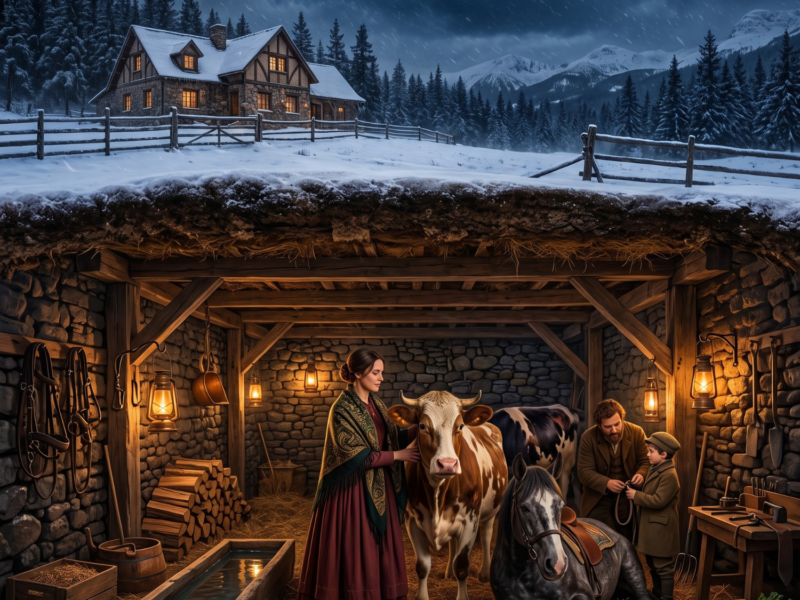
They Laughed at Her Farm With No Barn— Until Winter Revealed What She Built Below|Old west survival
Water and Breath
With the structure reinforced and the drainage solved, they conducted their first full overnight test.
They led the two milk cows down into the dugout, securing them in their stalls, and closed the heavy, insulated wooden door Elias had built for the entrance.
The temperature remained as stable as they had hoped. The howling wind outside was completely neutralized. Almost no draft entered the chamber. It was an absolute thermal success.
The next morning, Martha bundled up and went out to milk the cows. She unlatched the heavy door, pulled it open, and climbed down into the dugout.
She immediately gagged, throwing her hand over her nose and mouth.
The smell hit her like a physical wall. It was dense, overpowering, and toxic. The air was thick with the suffocating scent of ammonia from the animals’ urine, the heavy, damp smell of manure, and the stifling heat of their bodies. The air felt wet and heavy in her lungs, utterly devoid of oxygen.
In the dim light, she saw one of the cows standing with its head low. It let out a deep, wet cough.
Elias came down behind her, immediately sensing the crisis. He looked up at the perfectly sealed, reinforced earthen ceiling, his face grim. He said aloud what Martha had feared deep in her bones from the beginning.
“We managed to keep the warmth inside, Martha,” he paused, coughing against the ammonia. “But we may have trapped the very thing that will kill them. They’ll suffocate on their own breath. The dampness will breed pneumonia. We’ve built an oven.”
Martha rushed forward and threw the shelter door wide open. The putrid smell slowly faded as the fresh morning breeze circulated, but the freezing cold rushed in far too quickly, erasing the thermal protection the earth provided.
They were caught in a deadly paradox. They needed a constant supply of fresh air to keep the animals breathing, but if they opened the door, they turned the underground chamber into a freezing wind tunnel.
Elias, the builder, saw the solution in the mechanics of airflow.
“We need a draft,” he said, tracing lines in the dirt with a stick. “Not a wind, a draft. We need to cut two small vents. One low opening near the entrance to draw the cold, fresh air in. And another, higher opening at the very back of the chamber to let the warm, damp, toxic air escape. Heat rises. The warm air leaving will pull the fresh air in automatically.”
It was brilliant, but it required piercing the very ceiling they had just spent weeks fortifying.
They climbed the hillside above the dugout. Carefully, measuring twice, they dug two vertical shafts straight down through the earth until they broke through the wooden ceiling of the chamber below.
Elias constructed square, wooden ventilation shafts—like small chimneys—and installed them into the holes. They packed the earth tightly around them to prevent water from leaking in. He built small, angled wooden hoods over the tops of the shafts to prevent snow from falling directly inside, leaving the sides open to the wind.
Over the next three nights, they tested the shelter again, leaving the animals inside with the door sealed.
Each morning, the results were a revelation. The air inside the dugout was significantly drier. The suffocating smell of ammonia was drastically weakened, carried away by the constant, gentle circulation of air. Both cows remained calm, their breathing steady. And despite the ventilation, the thermal mass of the earth still regulated the temperature, keeping it far more stable and warmer than the freezing air outside.
It was working. The system was finally balanced.
They settled into a routine. Caleb checked the vent openings every morning, clearing away any leaves or frost. Martha moved the heavy water trough into the deepest, warmest corner of the chamber so it wouldn’t freeze. They verified the hay was secure above the floor. Elias meticulously inspected every wooden support post after each night, searching for any sign of shifting earth.
Near the end of November, as the gray skies deepened into a permanent, bruising purple, Elias stood inside the shelter. He ran his hand lovingly along the rough bark of a support beam.
He looked at his wife. “Maybe you were right, Martha.”
Martha watched the two cows peacefully chewing their hay in the dim light. She did not feel victorious. She felt a deep, abiding dread.
“We haven’t faced winter yet,” she whispered.









