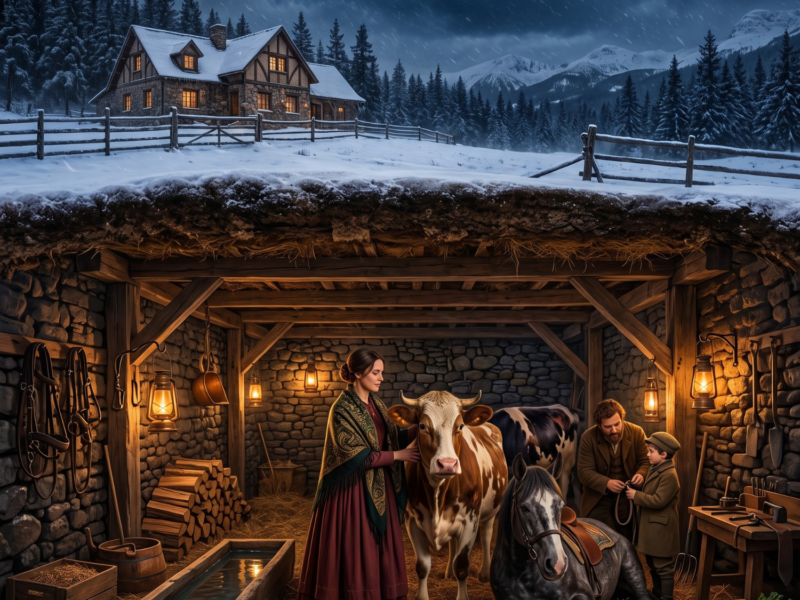
They Laughed at Her Farm With No Barn— Until Winter Revealed What She Built Below|Old west survival
The Empty Ground
The road to desperation had been paved with three months of relentless, quiet disasters.
When the Hale family arrived in Dry Creek in late August, the valley had been painted in deceptive hues of gold and emerald. They brought with them two healthy milk cows, one sturdy draft horse, a wagon load of meager possessions, and just enough money saved in a tin coffee can to buy a cheap, neglected parcel of land on the edge of the settlement.
The property was cheap for a reason. The cabin roof, patched with rotting cedar shakes, leaked whenever the autumn rains came. The well was shallow and weak, requiring agonizing patience to draw a single bucket of murky water. The perimeter fence leaned like a row of drunken soldiers.
But the most frightening thing was the empty stretch of flattened ground behind the cabin. The ghosts of foundation stones lay buried in the weeds—the place where a barn should have stood, where a previous owner had failed.
Elias had been full of robust optimism then. “We’ll repair the cabin first,” he had promised, wiping sweat from his brow under the late summer sun. “Make it tight against the drafts. Then we’ll take the rest of the money, go down to the sawmill, and buy enough good, straight lumber to build a small, tight barn. Just big enough for the stock.”
It was a sound plan. It was the way things were done.
Then came the fire.
In the second week of September, lightning struck the dry timber behind the valley’s only sawmill. The resulting inferno consumed the mill and its entire inventory of cured wood in a single night. The sky glowed an apocalyptic orange, and the smell of burning pine hung over Dry Creek for a week.
Overnight, the price of lumber skyrocketed. Wood that would have cost a few dollars suddenly commanded prices that made Elias pale. The tin coffee can under their bed was no longer enough to buy even half the boards required for a barn.
The tragedies compounded. The late summer heat lingered abnormally long, and the high pasture dried up weeks earlier than expected. They had to start dipping into their winter hay reserves just to keep the cows producing milk. Then, the older cow developed a lung infection. The veterinarian from town charged them exorbitant fees for medicine that seemed to do little more than keep the animal breathing.
By early October, nearly all the money set aside for the barn was gone.
“We could take out a loan,” Elias said one evening at the dinner table. The cabin was dimly lit by a single oil lamp, casting long, wavering shadows against the chinked log walls.
Martha stopped eating. She watched Caleb, their observant, quiet ten-year-old son, break off the last piece of crusty bread and slide it silently onto his little sister Ruth’s plate.
“A loan,” Martha repeated, the word tasting like ash in her mouth. She looked at her husband. The exhaustion was etched deep into the lines around his eyes. “If we borrow money from the bank to buy overpriced lumber to build a barn, how will we repay it if the spring is bad? If a late frost kills the first planting? If the cow doesn’t recover?”
Elias fell silent, staring down at his empty bowl. He knew the brutal truth. A loan would not merely buy lumber; it would put the deed to their new land at risk. The bank was far less forgiving than the weather.
On the surrounding farms, the seasoned settlers began preparing for the inevitable. Men were adding more boards to their barns, hauling stone to reinforce foundations, patching roofs with hot tar, and stacking massive mounds of hay. Boone had been doing the same for nearly two decades. His barns looked like fortresses of timber and iron. His warnings made absolute, terrifying sense.
One afternoon, Boone rode his massive bay gelding into their yard. He didn’t dismount. He looked at the leaning fence, the patched cabin, and the vast, empty space where a barn should be.
“I’ll give you twenty dollars for both cows,” Boone offered, his voice devoid of pity. It was a predatory price, half of what they were worth, but it was cash. “Better to sell them to me now than bury them in the frozen dirt in January.”
Martha stepped out onto the porch, wiping her hands on her apron. “What do you think will kill them first, Mr. Boone? The cold, or the wind?”
Boone looked down at her from beneath the brim of his hat. “Both, ma’am. The cold slows their heart, but the wind steals their soul. That’s why people build barns. Walls stop the wind. Roofs stop the snow. It’s the only way.”
After he rode away, Martha walked to the back of the cabin. The north wind, an early herald of the coming winter, was lashing the open field, bending the dead grass flat against the earth. But as she walked toward the foot of the hillside that bordered their property, she noticed a profound change.
The air was calmer here.
She looked down. Their scrappy, mixed-breed dog, Barnaby, lay curled into a tight ball, nestled perfectly into a small depression at the base of the hill, completely shielded from the biting wind.
Martha stood there, wrapping her arms around herself, and watched the dog for a long time. That was what frightened her more than the creeping cold. It was not the poverty. It was the feeling of losing the power to choose. The valley was dictating their doom before they had even been given a fair chance to begin.
She looked at the sheer face of the hill.
Walls stop the wind, Boone had said.
But what if the walls were already there? What if they did not need to defeat winter with expensive lumber? What if they needed to let the earth do the work?









