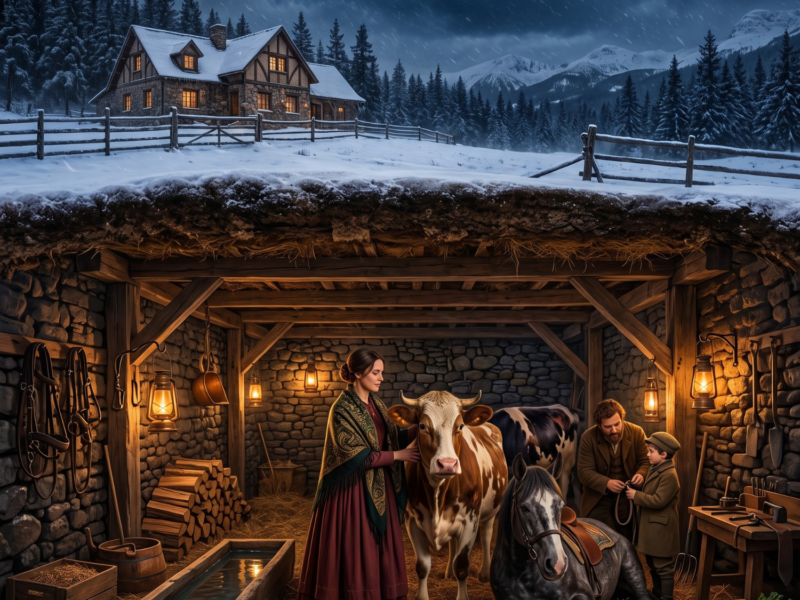
They Laughed at Her Farm With No Barn— Until Winter Revealed What She Built Below|Old west survival
Breaking Earth
They began their assault on the hillside that very morning.
They chose a spot beside the root cellar, where the earth had already proven to be stable clay and dense soil. The entrance faced due south, utilizing the geometry of the land to remain perfectly sheltered from the brutal northern gales.
It was agonizing, back-breaking labor. The ground was hard, packed tight by centuries of rain and pressure. Elias swung the mattock, driving the iron spike into the earth, loosening the soil. Martha followed with a heavy iron shovel, scooping the dirt into a wheelbarrow and hauling it away to form a protective berm around the eventual doorway. Even Caleb helped, using a small hand trowel to scrape away the loosened clay.
Their hands blistered and bled. Their backs ached with a dull, constant throb. By the end of the first day, they had carved out a hollow barely large enough for a single cow to turn around in.
Elias was meticulous. He refused to trust the earth implicitly. He scavenged the thickest, most unyielding timbers from the ruined canvas shelter and used them to frame the entrance and support the low ceiling of the excavated chamber.
On the first night, Martha conducted her test. She placed an old, fragile glass thermometer inside the earthen chamber, resting it on a wooden block. She hung a second thermometer on a nail outside on the exposed porch.
The next morning, she checked the porch first. The red liquid had plummeted to a bitter fifteen degrees. The air outside stung her lungs.
She walked to the hillside, pulled back the heavy canvas tarp they had hung over the doorway, and stepped into the dark chamber.
She held up the oil lamp and looked at the thermometer.
Forty-two degrees.
The chamber was cold, yes. But its temperature was profoundly, miraculously stable. The earth was acting as a massive thermal battery, absorbing the ambient cold and insulating the space within.
Martha pressed her bare, calloused hand against the dark earthen wall. It felt solid, damp, and alive.
“The ground is working for us, Elias,” she whispered when he joined her.
Elias stared at the thermometer. He did not smile. The worry was still etched deeply into his features, but the rigid objection was gone. He nodded slowly. “Then we keep digging.”
They expanded the chamber outward and inward, one grueling section at a time. Elias instituted a strict rule: they would dig only three feet deep at a time. Then, they would stop, meticulously inspect the integrity of the earthen ceiling, and install heavy wooden support posts and crossbeams before continuing.
It was slow work. The structure looked less like a traditional barn and more like a military dugout, a bunker carved into the frontier.
It was during this heavy excavation phase that Boone rode past on his way to town. He pulled his bay horse to a stop at the edge of their property, leaning forward in the saddle, his eyes narrowing at the massive pile of excavated dirt and the dark hole in the hill.
“Digging a hole to hide from your debts, Hale?” Boone called out, the mockery returning to his voice.
Martha set down her shovel. She wiped the sweat and dirt from her forehead with the back of her forearm and walked toward the fence line.
“Do you still want to buy the cows, Mr. Boone?” she asked, her voice level.
Boone scoffed. “Today’s offer is ten dollars for the pair. Lower than last week’s. Winter’s closer. They’re a liability now.”
“Then you should hope I fail,” Martha said, staring him down.
Boone studied the excavation. He looked at the heavy timber supports Elias was wrestling into place. The mockery slowly faded from his weathered face, replaced by a grim, sobering seriousness.
“No, ma’am,” Boone said quietly. “I don’t hope you fail. I hope you understand that wet earth weighs infinitely more than dry earth. It’s deceiving. One badly supported roof, one heavy rain that softens the clay, and that ceiling will come down. It could bury both your cattle and the people digging it. I’ve seen miners crushed by less.”
For the first time since they had met him, his words did not sound like an insult. They sounded like a genuine, terrifying warning. He tipped his hat and rode on.
That night, the house was quiet, but Martha could not sleep. Boone’s words echoed in her mind. Wet earth weighs more than dry earth.
She slipped out of bed, wrapped a shawl over her nightgown, and walked out into the freezing night. She lit an oil lamp and entered the chamber alone.
The silence inside was oppressive, heavy with the scent of raw dirt. She held the lamp high, casting its yellow glow across the ceiling they had carved.
Her breath caught in her throat.
There, running between two of the wooden crossbeams they had installed that very afternoon, were several hairline cracks in the packed clay ceiling.
She reached up, her hand trembling, and touched one of the fissures. Small grains of dirt crumbled beneath her fingertips, falling silently to the floor. The earth was settling. The weight was shifting.
The next morning, Elias was inside the chamber, inspecting the placement of a vertical support post. Martha stood near the entrance, holding the lamp.
Without warning, a terrifying sound—a wet, tearing shhhhk—echoed through the small space.
A clump of solid earth, the size of a man’s head, detached itself from the ceiling and fell, crashing onto the floor directly in front of Elias’s boots.
They both froze. The dust plumed in the lamplight.
Martha’s throat went bone dry. Her heart hammered against her ribs like a trapped bird. The idea of the underground barn might be scientifically sound, but the amateur way they were building it could still kill them all.
Elias stared at the fallen earth, his face pale. The reality of the danger was no longer theoretical.
The warning made Martha understand a profound truth: being different did not necessarily mean being clever. Having a unique idea was not enough. If they wanted to survive, the idea had to be tested, refined, and engineered with the utmost respect for the elements they were trying to harness.
Elias slowly raised his heavy iron hammer and stared at the cracked ceiling above him. The stubborn pride of the homesteader vanished, replaced by the grim determination of a survivor.
“From now on,” Elias said, his voice echoing in the dirt chamber, hard and absolute, “no one digs another inch until this roof can support its own weight ten times over.”









